

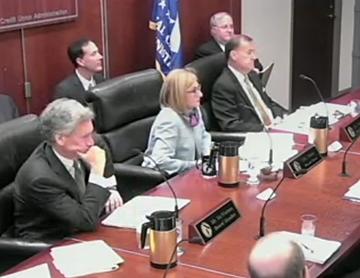
L-R: Mark McWatters, Debbie Matz, Rick Metsger
ALEXANDRIA, Va.—By a 2-1 vote the NCUA board Thursday approved an operating budget for 2016 and 2017 that comes with a 4.1% increase over its predecessor, bringing NCUA’s 2016 budget to $290.2 million.
It is the first time since 2009 that the agency has proposed a two-year budget, with two NCUA board members indicating the plan moving forward is to continue to do so.
Following a lengthy statement that was then followed by a sharp exchange with NCUA Chairman Debbie Matz, Board member Mark McWatters cast the dissenting vote on the budget.
The new budget includes a reduction in full-time employees, but an increase in capital investments as NCUA is enhancing and updating the AIRES exam platform. That investment could lead to more off-site exams and a return to an 18-month exam cycle for well-run CUs, according to Matz. The annual exam schedule will remain for 2016.
The vote also means the release of approximately 800 line-items from its budget, possibly addressing some of the calls from the trade groups for more “transparency.”
The larger budget also comes at the same time, however, that both credit union trade associations have also argued that with the financial crisis over, the NCUA budget should be decreasing.
“The entire operating budget and capital budget combined still represent less than three one-hundredths of a percent of all credit union assets,” Matz said.
$7-Million Savings
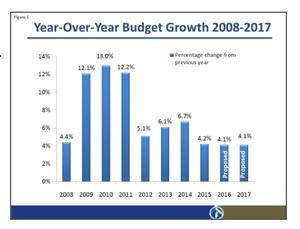
In assembling the new budget, NCUA achieved cost savings of nearly $7 million, said Matz, noting that many of those savings will carry forward into future years. She also pointed out that the additional 4.1% is the lowest increase in the last nine years.
According to NCUA, the five most significant areas where expenses have been pared are:
- The reduction of 26 field staff positions, saving $4.3 million in pay, benefits and travel. NCUA said its budget calls for 1,247 full-time staff positions, a reduction of approximately 1%.
- Another $1.4 million will be saved in pay and benefits during the first full year of the new five-year collective bargaining agreement.
- NCUA plans to refocus national training on the exam program, saving $245,000.
- Another $200,000 will be saved by using more webinars to deliver training.
- Building negotiations conducted already by NCUA’s Asset Management and Assistance Center will save $171,000 from renegotiations of regional office leases.
A fact sheet on the budget, which includes the savings, can be found on NCUA’s website at www.ncua.gov.
The NCUA budget has been the focus of considerable attention this year from credit unions, the trades and Washington.
In July, Matz testified before the House Financial Services Committee’s Subcommittee on Financial Institutions and Consumer Credit, which held a hearing on the agency’s budget. Earlier this year the National Credit Union Administration Budget Transparency Act was introduced in the House, which would require NCUA to provide notice of a public hearing on its budget and invite comments on it—a bill identical to legislation introduced in the Senate that calls for public hearings on NCUA’s annual budget.
At the board meeting Matz said she understands there will always be those who argue that NCUA should cut its budget each year as the number of credit unions declines.
“However, that argument has a fatal flaw,” she said. “Most of the insured shares and troubled assets from those credit unions do not disappear—they are acquired by other credit unions. As a result, the remaining credit unions are growing larger and more complex, posing a greater concentration risk to the insurance fund.”
More Expertise Needed
Larger, more complex institutions require examiners with specialized expertise in commercial lending, sophisticated investments, cutting-edge technology and cybersecurity, Matz said.
“These specialists often require higher compensation than generalist examiners,” she said. “However, these specialists are essential so that NCUA can keep up with the growing complexity of the credit unions we supervise.”
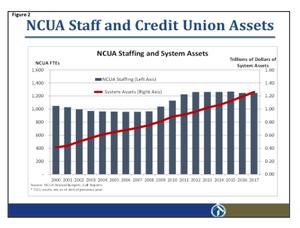
Addressing the agency’s efforts to lighten the regulatory burden on credit unions and expand FOM rules, Matz pointed out, “As we provide regulatory relief and enhance credit union powers, NCUA must have the qualified staff and resources to supervise effectively. This operating budget will ensure NCUA continues to move forward as we supervise a rapidly growing system that now exceeds $1.1 trillion in assets.”
Matz said that credit unions benefit from the agency’s investment in its capital budget, and offered three examples she said support that statement.
“To support the regulatory relief we proposed earlier in this meeting, new field-of-membership software will automate much of the field-of-membership application process. It will allow credit unions to track, online, exactly where their application stands at any point in time, and ultimately will expedite the approval process,” said Matz.
She said the CU online Call Report system will be modernized so credit unions will only have to fill out sections of the Call Report that pertain to their operations.
“Perhaps most importantly, after the AIRES exam platform is modernized, examiners will be able to conduct more off-site monitoring,” noted Matz. “This will not only reduce examiners’ travel, it will also reduce examiners’ time spent on-site in credit unions. The new exam platform could even pave the way for a return to an 18-month exam cycle in the future.”
Matz noted that any future board can further refine the budgets through mid-year reprogramming and annual adjustments, something NAFCU has shared concerns over, stating that a two-year budget cycle could lead to larger budget increases.
“However, the budgets presented today demonstrate our intent to hold the line on budget growth and staffing into 2017, and act transparently throughout the two-year cycle,” Matz explained.
As Matz has consistently stated, she believes the agency is very transparent with its budget process.
“We already have nearly 90 budget-related documents available to the public in a dedicated Budget Resources center. Our budget priorities continue to be based on NCUA’s strategic plan for 2014–2017, and the full plan is also posted on our website. But we are not resting on our laurels. We continue to provide even more transparency on our budgets. If these new budgets are approved, we will release more than 800 line items on our website today,” said Matz prior to the vote.
Looking ahead, Matz said that next January NCUA will publish in the Federal Register its proposed strategic plan for 2017–2021.
“This document will set the agency’s strategic goals and priorities, and those in turn will drive NCUA’s budget process throughout 2017 and beyond,” she said. “I encourage any stakeholders who might have concerns about our budget or budget process to comment on our forthcoming strategic plan.”
McWatters Not In Favor
Prior to the vote, McWatters made it clear he would not be voting in favor, saying the setting of the 2016-17 budget should be viewed in light of two considerations: What actions might NCUA take to reduce its operating budget, and how can NCUA make process more efficient, transparent and accountable?
The FDIC, said McWatters, has cut its budget for the past five years, while “NCUA is compelled to increase its budget for the ninth straight year.” At the conclusion of his remarks, Matz responded by saying McWatters was mistaken, and that when operating budgets are compared the NCUA budget and FDIC budget have largely mirrored each other.
McWatters said he believes there is room to cut the NCUA budget by moving to an 18-month exam cycle (“Unfortunately, NCUA seems to have forgotten that it’s not 2008, it’s 2015,” he said) and by taking a more “collaborative approach” with state supervisory authorities.
The improved health of credit unions, said McWatters, should mean a “peace dividend allowing NCUA to stand down its forces.”
For his part, NCUA Vice Chairman Rick Metsger called the 2016-17 budget “the most transparent budget in NCUA history.”
“The adoption of a two-year budget is a return to normalcy,” said Metsger. “It’s greater transparency to both the CU community and the public. I recommended the return to a two-year budget in September. I would point out that many states, including the home states of all three board members, use two-year budget cycles.”
Metsger said NCUA will now be providing details on 800 budget categories, more than any other federal agency and a five-fold increase over what it has been doing.
“I realize that no matter how much information we provide, some people will say not enough,” he said.
Metsger, who noted that his own office’s budget has been reduced every year, also told the board meeting that he wanted to “set the record straight,” noting that NCUA has never previously held budget hearings, although it did hold some budget briefings under former executive director Len Skiles.