

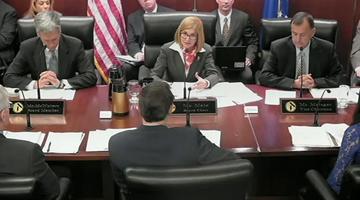
L-R: Mark McWatters, Debbie Matz, Rick Metsger
ALEXANDRIA, Va.—The NCUA board Thursday unanimously approved its member business lending final rule, and in doing so Chairman Debbie Matz stated that a “new era” begins for NCUA as a regulator and for credit unions as business lenders.
As has been the case at recent board meetings, there was some clear disagreement between Matz and NCUA Board Member Mark McWatters over issues related to the MBL proposal, with that disagreement also extending to NCUA Vice Chairman Rick Metsger this time around.
McWatters suggested the rule should not have proceeded without a legal opinion and that language in the proposal pre-empted states’ rights, while Matz suggested some of McWatters’ requests came late at night after materials had been printed, and that those requests were “meritless.”
The rule has not been substantively updated since 2003. The rule goes into effect Jan. 1, 2017, but the personal guarantee requirement will be eliminated 60 days after the rule’s publication in the Federal Register.
More than 3,100 comment letters were received by the Aug 31, 2015 deadline for comment on the proposal, 85% of which were form letters, with most of those coming from banks or bank-related organizations, according to NCUA. About 500 of those comments were unique, the agency said.
“This new era will be defined by principles-based regulation, not by prescriptive limits on credit unions,” said Matz. “This new rule will remove the prescriptive limits that were needed when many credit unions were just entering the business loan marketplace.”
Key Changes
As in the proposal, key changes in the final rule from the original member business lending regulation are:
- Each credit union has the freedom to “prudently” write its own business loan policy without prescriptive regulatory limits.
- CUs can make the decision to waive a member from a personal guarantee, eliminating the current waiver process.
- LTV limits are replaced with appropriate collateral capital.
- All “unnecessary” limits on construction and development loans are lifted.
- The rule clarifies that participation interests in loans to non-members do not count against the statutory member business lending cap.
- The 15% of net worth limit on loans to one borrower now increases to 25% if the additional 10% is supported by readily marketable collateral.
Matz noted that some adjustments and decisions were made from the proposal based on comments received, including:
- New exemption thresholds. Credit unions that originate or purchase small amounts of commercial loans will not be required to have a formal policy. The exemption cap is $250-million in assets, with Director of Examination and Insurance Larry Fazio saying the exemption “acknowledges that small portfolio exposures coupled with generally inactive business lending programs do not pose a material threat to the NCUSIF.”
- NCUA will grandfather the seven states with pre-approved rules, while also allowing all states to submit new rules for NCUA approval.
(Click here for summary of key changes.)
Well-Established Policies
Matz, as she did when the proposal was introduced last year, emphasized that the vast majority of credit unions making MBL loans have well-established business lending infrastructures and solid risk management in place.
“So, it’s time to transition away from prescriptive limits, toward over-arching principles that will provide greater flexibility for credit unions to serve more business owners,” Matz said.
If a credit union opts to launch a business lending program, under the new rule its board and management team will have the freedom to develop their own policy governing how they will do business, Matz said.
“For example, their policy can set guidelines for personal guarantees, loan-to-value ratios, and construction and development thresholds they feel are most appropriate for their credit union,” said Matz.
Referring to the exemptions created in the final rule under which credit unions that originate or purchase small amounts of commercial loans will not be required to have a formal policy, Matz said, “For example, credit unions that only make a few small loans for commercial use — such as delivery trucks or pizza ovens — would be exempt from the policy requirement. And credit unions that buy pieces of those loans would likewise be exempt. As a result, this rule will allow exempt credit unions to serve small business owners as needed, without filling out additional paperwork or hiring full-time staff.”
Matz re-emphasized the importance of the personal guarantee waiver under the new rule, stating that she had heard “loud and clear” from credit unions the guarantee, under the original rule, cost them business.
“Some members who have well-established, strong businesses often simply can’t wait for loan waivers. So they take their business to other lenders, who don’t require personal guarantees,” explained Matz. “That’s why I insisted on implementing the part of this rule that removes the personal guarantee requirement as soon as possible, well before the rest of this rule.”
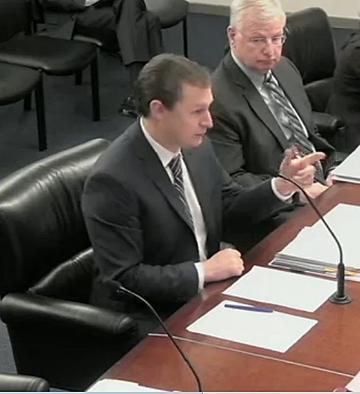
Larry Fazio
Matz added that the agency also heard from CUs that the provision for blanket waivers is not working as intended, therefore the new rule removes the waiver process altogether.
Turning to the impact of the new rule on state charted CUs, Matz reminded that the proposal sought comments on three options for states that currently have MBL rules approved by NCUA, as well as other states that may decide to write their own rules in the future.
“Clearly, the majority of commenters prefer the option to grandfather the seven states with pre-approved rules — while also allowing all states to submit new rules for NCUA approval,” said Matz. “It’s important to note that among this majority is the National Association of State Credit Union Supervisors.”
From its comment letter, NASCUS recommended that NCUA exempt federally insured, state-chartered credit unions in a given state from NCUA’s member business loan rule if NCUA approves the state’s rule,” said Matz, reading from the NASCUS comment.
“Despite this position from NASCUS, a minority of stakeholders argued for states to implement their own MBL rules without any review by NCUA,” explained Matz. “However, just like every other insurer, it is incumbent upon NCUA to set standards. NCUA has a statutory responsibility to protect the safety and soundness of all federally insured credit unions. And this includes state charters as well as federal charters. So our new rule is designed to serve as a floor, or a baseline minimum safety and soundness standard. States may choose to impose a higher standard, but not a lower standard.”
Most States Follow NCUA Rule
Matz added that as the agency has done in the past, when reviewing proposed state MBL rules, NCUA’s rule will guide the agency’s decision “in the interest of safety and soundness.”
The vast majority of states currently follow NCUA’s rule as prescribed, noted Matz. “So in addition to training all NCUA field staff on our new rule, we have also committed to train state examiners on this rule.”
Additional points:
- Asked by Matz why the entire rule won’t take effect in 60 days, at the same time the personal guarantee requirement is removed, Fazio explained that the MBL change requires retraining of all NCUA field staff in April, and all specialists in September/October, “which takes time and resources to implement.” The agency has offered to train state field staff in November, and will issue detailed supervisory guidance for credit unions to prepare their policies before the effective date. “We will, however, implement the personal guarantee portion after our initial exam program staff training this April,” Fazio said.
- Stakeholders will not be able to comment on the supervisory guidance before it’s finalized, noted Fazio. “It would not be appropriate to have regulated entities directly instructing examiners how to examine them. That is NCUA’s job. Nonetheless, the guidance will be shared with credit unions at the same time it is provided to examiners.”