ALEXANDRIA, Va.—The NCUA board Thursday shared concerns over mounting delinquencies within credit unions and the growing number of CUs having CAMELS ratings of 3 and higher.
The board also addressed how the declining rate environment might impact the NCUSIF, and possibly the performance of troubled CUs.
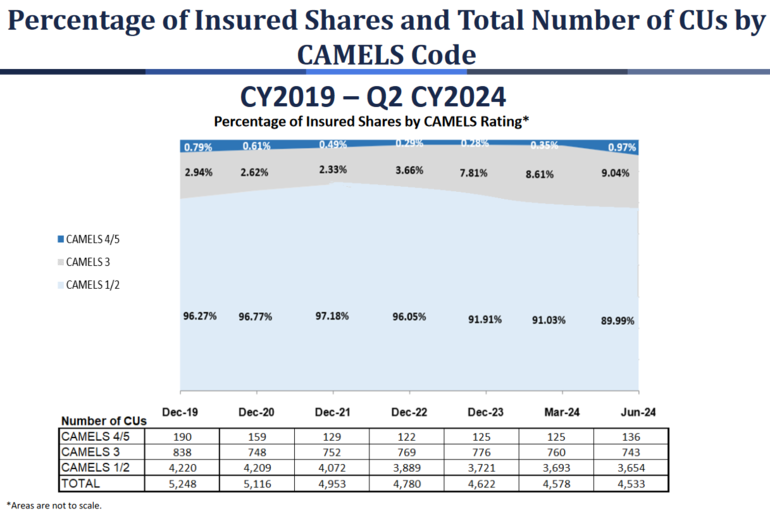
“We are seeing growing signs of concern in loan performance, capital, delinquency rates and earnings across the system and at specific institutions,” Board Chairman Todd Harper said. “The latest quarterly performance data for the industry showed declining growth and weakening performance across auto lending, mortgage loans and commercial loan categories. Furthermore, these trends are contributing to the large percentage of credit unions with CAMELS composite ratings of 3, 4 or 5. In fact, approximately one in five federally insured credit unions has a CAMELS code rating of 3, 4 or 5.”
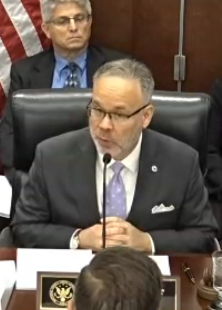
Todd Harper
Harper added what especially concerns him is the increasing number of complex credit unions with $500 million or more in assets falling into the troubled category — CAMELS code 4 or 5 ratings — this last quarter.
“In fact, the number of troubled complex credit unions tripled in the last quarter alone and the amount of assets grew at these institutions by more than fivefold,” Harper said, during the agency's Share Insurance Fund briefing. “It’s been about a decade since we last saw this proportion of insured shares at risk. So, we must remain vigilant as we navigate this situation.”
Harper asked NCUA CFO Eugene Schied if the agency sees this trend worsening or leveling off, and how a declining interest rate environment might affect these organizations.
“I think that is really difficult to say,” Schied said, pointing out there are many factors that have been impacting the performance of CUs with higher CAMELS ratings than simply the interest rate environment. “I think a lot of the factors that you mentioned are at play. However, the declining interest rate environment comes with a different set of challenges than what we saw in the increasing interest rate environment.”
Act 'Expeditiously'
Harper urged credit union leaders to continue to monitor their institution’s performance and balance sheets, and act “expeditiously” to prevent small issues from turning into big problems.
“The NCUA’s supervisory teams, for their part, will continue to monitor credit union performance through our examination process, offsite monitoring, and tailored supervision,” he said. “We will work to maximize the credit union system’s preparedness and resilience for any bumps in the road that may lie ahead. We did that during the wake of the Great Recession when 14 billion-dollar-plus credit unions were in troubled status, yet none of them failed.”
Turning to the Share Insurance Fund, Vice Chairman Kyle Hauptman pointed to the Federal Reserve’s 50-basis-point rate reduction Wednesday, and how that could affect NCUA funds.
Hauptman noted NCUA has “parked a lot of money” in overnights and other short-term investments.
“So, the SIF will receive lower income going forward from that sort of investing. Interest rates are just the price of money, and the NCUA is a seller of money, meaning we lend it out. And like any seller of anything, we get hurt when prices fall,” he said.
Hauptman added that credit unions face less interest-rate risk than they did during the Fed’s aggressive rate-hiking cycle.
“That was a major problem last year, but less so now,” he said. “That’s a positive thing for the Share Insurance Fund, but one that’s hard to measure and obviously not reflected in today’s SIF report. Our short-term income will be reduced, but so is the interest-rate risk facing credit unions. And risks to credit unions is why the Share Insurance exists in the first place.”
Best Performance In 15 Years
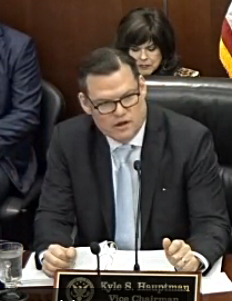
Kyle Hauptman
Harper pointed to the NCUSIF experiencing its best performance in terms of investment income in nearly 15 years.
“The current higher-interest-rate environment has improved the fund’s earnings. In fact, investment income in the first two quarters of 2024 alone exceeded the investment income the Share Insurance Fund earned in all of 2021. So, things have certainly changed,” Harper said. “What’s more, the fund’s yield in 2021 was just 1.21%. The Share Insurance Fund’s portfolio is now yielding 2.54% — more than double 2021’s level. That income, along with slower growth in insured shares, helped to stabilize the Share Insurance Fund’s equity ratio at 1.28%, four basis points higher than the initial projection for June 30.
Harper asked Schied if he expects that performance to continue, noting that a declining rate environment is likely ahead.
“(The Fund) has benefited from the higher interest rates, especially in the overnight holdings,” Schied acknowledged. “We have seen the overnight rates begin to fall from 5.4% in early August, down to now under 5% as of yesterday. That represented a decrease of about $82,000 a day to the fund, or about $30 million a year.”
Schied said the fund’s laddered portfolio has maturity buckets with average yields of under 1.5%.
“As we reinvest (those funds) that will help offset lost earnings from a decrease in the overnight rates,” Schied said. “The amount of the offset will be highly dependent on the overnight rates and where they go, as well.”
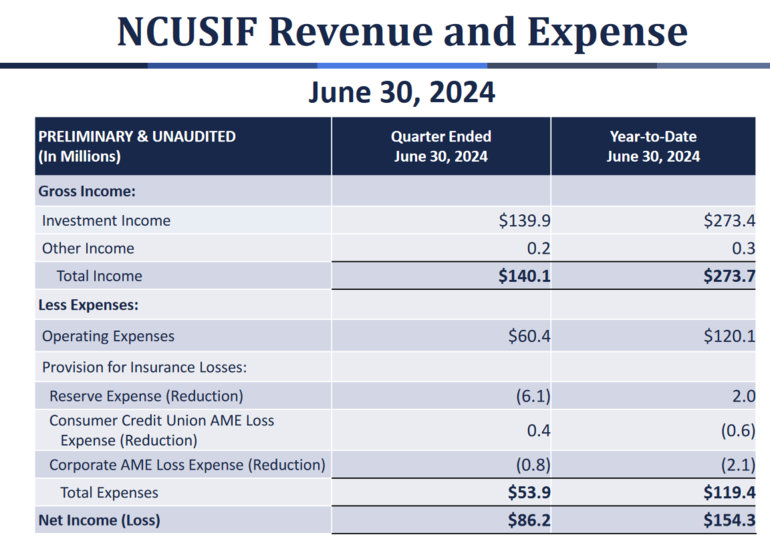
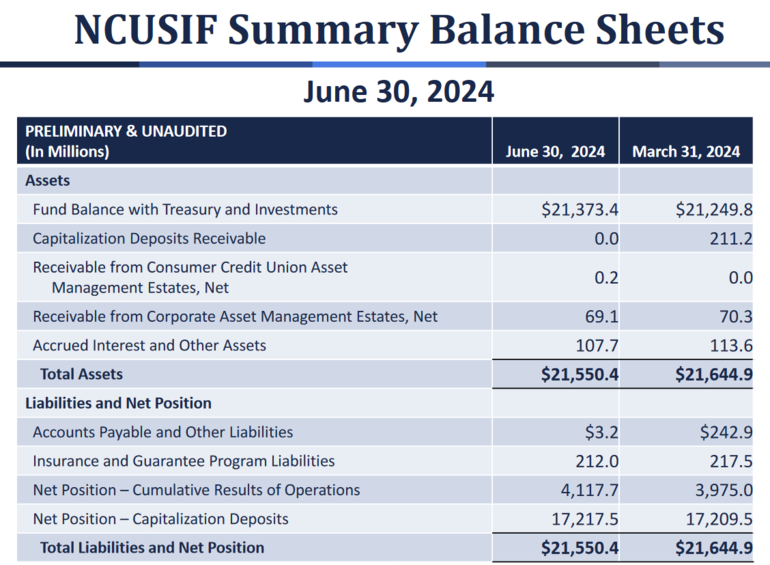
Overall, the NCUSIF for the quarter that ended June 30, recorded net income of $86.2 million. Total income was $140.1 million for the quarter, mainly from investment income in Treasury securities. Investment income increased 5% compared to the prior quarter and increased 38% compared to the second quarter of 2023. Operating expenses were $60.4 million for the quarter.
Harper shared some additional concerns about impacts to credit unions from falling rates.
“Credit unions should prepare for what could be a wave of refinances, when it comes to auto loans as well as mortgages,” Harper said. “This also could mean more mortgages could be made, as more buyers are able to stretch their dollars further and reach into the housing market.”
Other Business
NCUA Thursday also passed two final rules, one to simplify Share Insurance coverage requirements and another to implement the statutory requirements of the Fair Hiring in Banking Act. Both passed 2-0, with Board Member Tanya Otsuka absent due to the recent birth of her baby.