

ALEXANDRIA, Va.–The NCUA board was given an update on the agency’s Diversity, Equity, Inclusion and Accessibility Strategic Plan, and while support was expressed for its expanded initiatives, Vice Chairman Kyle Hauptman also cautioned that the CU community itself becomes less diverse every time a healthy CU merges due to “the crush of regulatory burden.”
The update on the agency’s DEIA Strategic Plan came during the first meeting for new Board Member Tonya Otsuka, who is the first Asian-American to serve on the agency’s three-member board.
The board received the update on its plan, which runs through 2026, from Miguel Polanco, director of its Office of Minority and Women Inclusion, which was established by the 2010 Dodd-Frank Act.
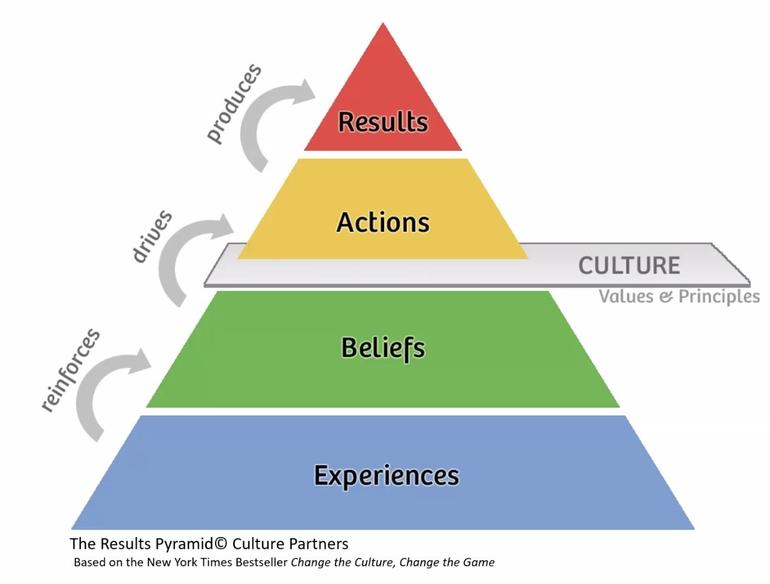
Polanco shared a pyramid graphic he said illustrates the culture that underlines the agency’s mission, experiences and objectives.
Miguel Polanco
According to Polanco, an employee whose experience is consistently aligned with the expressed values of an organization is likely to be engaged and effective.
“When experiences do not align with our established values, our ability to achieve results suffers,” he told the board.
Polanco said ensuring the agency’s employees, vendors and credit unions feel included, respected and valued is a strategic imperative.
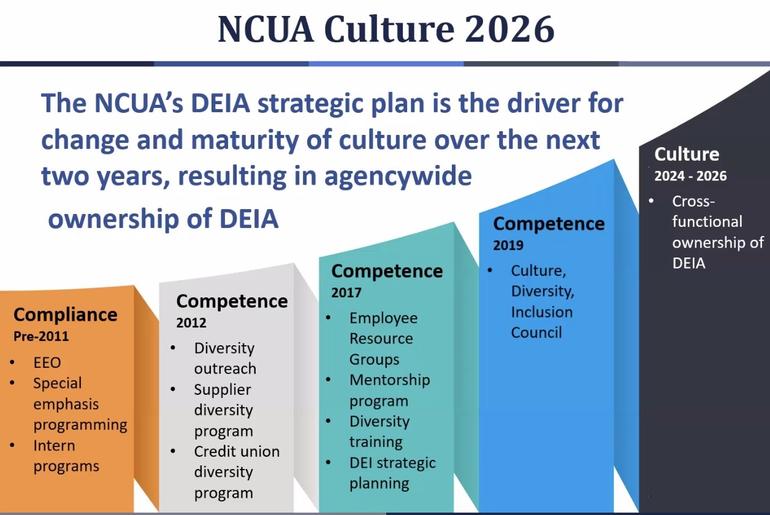
According to Polanco, NCUA is now leveraging functional areas as tools to intentionally drive the culture, He said its DEIA initiatives will be linked to outcomes.
In addition, he said the new plan gives supervisors access to training and behaviors that will consistently create positive experiences for their direct reports, he said.
He added the effort will no longer be siloed under OMWI and will spread across NCUA, and that “rigorous data and analytics” will be used to address any gaps or inconsistencies.
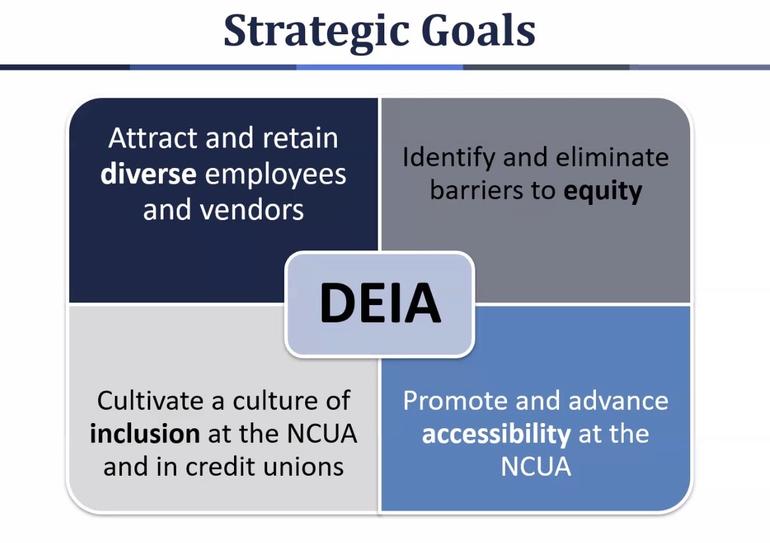
Polanco said NCUA has a strong record of hiring people with disabilities, and doing business with disable-owned business. It is also working with CUs to help them attract people with disabilities.
Harper: A ‘Deep Commitment’ & a Business Case
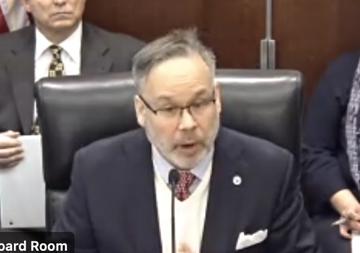
Todd Harper
NCUA Chairman Todd Harper said the agency has a “deep commitment to diversity, equity, inclusion, and accessibility. That commitment stems, in part, from the historic development of credit unions, many of which were created to serve marginalized communities unable to obtain safe, fair, and affordable credit through banks or other financial providers. Those institutions sought to provide financial equity.”
Harper said the agency’s commitment also stems from the business case for diversity, which he said shows those organizations with greater diversity and inclusion perform better and operate more efficiently and effectively.
‘Advancing Principles’
“Through external initiatives like the agency’s annual DEI Summit, the Community Development Revolving Loan Fund, and mentoring grants for minority depository institutions — as well as internal efforts like employee resource groups, outreach to potential suppliers, and hiring initiatives — the NCUA advances these important principles within the agency and across the credit union system,” Harper said.
Just as credit unions have historically focused on building secure financial futures for their members, Harper said NCUA has also sought to draw strength from a broad range of talents and perspectives.
“Specifically, the plan provides the foundation for diversity, equity, inclusion, and accessibility practices in the agency’s recruitment and hiring process and promotes equitable opportunities for the agency’s employees,” said Hauptman. “The power of allyship and a culture of belonging are critical to achieving these collective goals. They improve employee retention, empower employees to work and speak authentically, and give employees the space to become agents for positive change.”
Hauptman: Commendable Effort That Can be Counterproductive
NCUA Vice Chairman Kyle Hauptman, who said a “diverse workforce makes us better and stronger,” noted that one of the performance indicators in the strategic plan is to promote diversity in the credit union industry.
“You and your team are listening to credit unions, and it shows,” Hauptman said. “Our approach to develop training for credit unions to use in attracting and retaining diverse employees and service providers is in response to the overwhelming feedback you received from workshops at the DEIA Summit. In a competitive employment market, employers need as many tools as possible to find talented individuals.”
Hauptman added, however, that promoting diversity in the credit union industry does not include the agency “telling credit unions who should be on their boards. Credit union board directors are chosen by a vote of the member-owners. A credit union’s field of membership ultimately determines the population from which a board member can be chosen.”
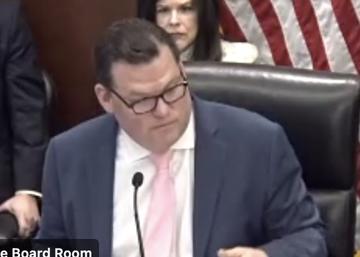
Kyle Hauptman
Feeling ‘Strongly’
Hauptman added he feels “strongly that promoting financial inclusion in general is the responsibility of the entire agency,” and observed, “As one of the original answers to financial inclusion, the credit union movement itself is, by definition, diverse.”
Hauptman reminded there are credit unions formed around faith-based groups, ethnic groups, and employee groups such as public servants, farmers, military personnel, educational systems and more.
“Every credit union was formed because there was a group of people not getting what they needed – being excluded, if you will – from existing financial service providers,” he said. “The small credit unions, and those seeking a new charter, are the perfect example of people taking direct control of their financial well-being by forming and running their own credit union — a financial institution they own and control, dedicated to their specific needs. The only thing more satisfying than taking your business elsewhere is starting your own business offering better products.”
A Note of Caution
Hauptman also cautioned that NCUA needs to remember what “true financial inclusion means.”
“To maintain diversity of the credit union system itself, the NCUA should always consider how our operations affect financial inclusion. The credit union system becomes a little less diverse when an otherwise healthy credit union merges because of the crush of regulatory burden,” he said. “I’d like to call on my fellow board members to make financial inclusion more prominent in our thinking. We can’t congratulate ourselves on our DEIA efforts if we add unnecessary burdens on small credit unions and those seeking to start one.”
The vice chairman also spent several moments in the Q&A with Polanco seeking assurances the agency’s DEIA efforts would not prescribe inclusion of certain groups or numbers.
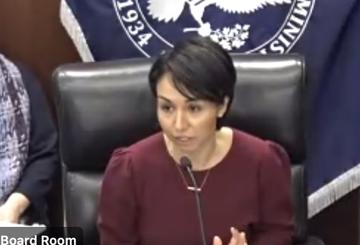
Tonya Otsuka
Otsuka: The Importance of Being Welcomed
Otsuka said that as “one of the newest members of the NCUA community, I felt incredibly welcomed. But, of course, that feeling of acceptance can't just be reserved for board members. It's critical that all employees feel that they belong in their workplace and that their contributions will be viewed on their merit and that they are comfortable speaking up and sharing their ideas.”
Otsuka said she views the DEIA strategic plan as a “road map through which NCUA can promote a culture of inclusion and mitigate barriers to equity and accessibility.”
She also praised the data-driven approach being taken in tracking progress.