

ALEXANDRIA, Va.–By a 2-1 vote, the NCUA board has put out for 60-day comment a proposal on incentive-based compensation arrangements for credit unions of $1 billion or more in assets, rules that have been in development since the financial crisis of nearly 15 years ago.
In announcing his support for the proposal, NCUA Chairman Todd Harper cited two examples where he said compensation packages contributed to the demise of credit unions in the past.
Proposed Rule, Succession Planning, 12 CFR Parts 701 and 741, passed by a 2-1 vote, with Harper and NCUA Board Member Tanya Otsuka voting in favor.
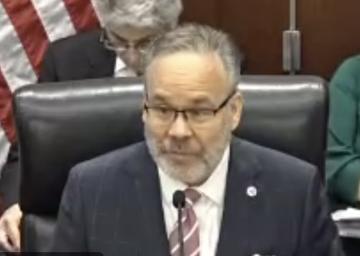
Todd Harper
Required by Dodd-Frank
The NCUA proposal is designed to fulfill its obligations under Section 956 of the Dodd Frank Wall Street Reform and Consumer Protection Act, which requires NCUA and five other agencies to jointly prescribe regulations or guidelines with respect to incentive-based compensation practices at certain covered financial institutions. The rules are aimed at prohibiting any types of incentive-based payment arrangement or any feature of such arrangements that regulators determine encourage inappropriate risks.
The proposal does not require a financial institution that does not have an incentive-based payment arrangement to make the disclosures required by section 956, and does not require the reporting of the actual compensation of particular individuals to date, according to NCUA staff.
The agencies first proposed such rules in 2011 with a follow-up in 2016. The newly issued proposal is a reissuance of the 2016 proposal for public comment.
Three Tiers
The proposal applies to three tiers of institution:
- FIs of $250 billion or more in assets (no credit unions in this category)
- FIs of $50 billion to $250 billion in assets (two CUs qualify, Navy Federal and State Employees’ CU in North Carolina
- FIs of $1 billion to $50 billion in assets (approximately 447 CUs qualify)
Six Factors
The proposal contains six factors for determining whether compensation is excessive or unreasonable or disproportionate to the value of services performed by a covered person and include:
- The combined value of all compensation and fees or benefits provided to the covered person
- The compensation history of the covered person and others with comparable expertise at the credit union
- The financial condition of the credit union
- Compensation practices at comparable credit unions, based on such factors as asset size, geographic location and the complexity of that credit union’s operations
- For post-employment benefits, the projected total cost and benefit to the credit union
- Any connection the covered person has with any fraudulent act or omission breach of trust or insider abuse with regard to that credit union
Key Principles
The proposed rule also contains three key principles that must be considered with incentive-based compensation, according to NCUA staff, including:
- Whether the incentive-based compensation arrangement appropriately balances risk and financial reward
- Whether the incentive-based compensation arrangement is compatible with effective risk management and controls
- Whether the incentive based compensation arrangement is supported by effective governance

Tanya Otsuka
The proposal requires a CU’s board of directors or committee to be directly involved in the oversight of the incentive-based compensation program, and to approve all incentive-based compensation plans for senior executives.
Rules for Recordkeeping
Finally, staff said the last core requirement of the proposed rule involves record keeping. All covered institutions must:
- Document their incentive-based compensation plans
- Maintain them for seven years and provide them to their regulator upon request
- At a minimum records must include copies of all incentive-based compensation plans, a record of who is subject to the plan and a description of how the plan is consistent with effective risk management and controls
The Timeline
The proposal also includes clawback provisions.
The rule provides for an implementation timeline of 18 months, grandfathers existing plans for the life of those plans, and provides an 18 month window for institutions newly subject to the rule to comply.
Harper: A ‘Long Overdue’ Rule
As the 16th anniversary of the collapse of Lehman Brothers approaches, NCUA Chairman Todd Harper observed “this rulemaking is long overdue. It's actually an incomplete assignment, about which lawmakers frequently inquire of me at hearings. They want to know when we are going to finish our homework. For me, the time to act is now.”
Harper, who noted that given the asset thresholds involved some 90% of CUs are exempt from the rules, said NCUA has been required by Congress to act.
“Some may also claim that credit union compensation practices are different from other financial providers,” he said. “That may largely be true but there are clear examples of excessive incentive-based compensation contributing to the failures of consumer and corporate credit unions.”
Two Failures Cited
As examples, Harper cited:
- The failure of Cal State 9 Credit Union in 2008, which cost the NCUSIF $170 million. Harper said the material loss review conducted by the agency found a compensation plan that paid the CFP $400,000 in bonuses between 2006-07 based on net income generated by the credit union’s home equity loan program, which was one of two factors that contributed significantly the failure.
- The failure of Western Corporate FCU (Wescorp) in 2009. Harper said Wescorp pursued a strategy of generating more interest income than would be available from deposits that that was then used to pay high rates on its member certificates, as well as to “support operational expenses including providing substantial compensation increases for its executives.”
Between 2002-08, Harper said the total annual compensation for the leadership team increased by an average of 88%.
“These executives pocketed enormous profits. while the corporate’s credit union members and ultimately the credit union system bore the cost of Wescorp’s failure,” Harper said.
As has been often noted, NCUA had examiners on-site at Wescorp in the years leading up to its collapse.
‘Cannot Happen Again’
“What happened in 2008 cannot happen again in 2024,” said Harper. “I wish that were true, but in just the last year we saw how excessive risk taking by certain banks (led to failures).”
Those risks were often driven by executives’ comp packages, he said, adding regulators need the authority to act in cases of “excessive greed.”
“This rulemaking effort is about providing transparency and accountability. This regulatory effort will better focus the leaders of financial firms on the long-term health of the company instead of just their short-term, personal gains,” Harper said.
Otsuka: Lessons Learned at Prior Job
NCUA Board Member Tanya Otsuka, who previously served as legal counsel with the FDIC earlier in her career, cited some of her experiences from that tenure and called on the Federal Reserve and SEC to enact similar rules.
“If your institution fails on your watch and you still receive your incentive-based pay, I am not sure what exactly you're being incentivized to do,” said Otsuka. “Many of us also vividly remember when Wall Street CEOs still got their bonuses even as their companies needed billions of taxpayer rescue dollars to stop the bleeding during the financial crisis. We as regulators need to be able to ensure that incentive-based pay actually incentivizes prudent management and aligns with safe and sound banking practices in the credit union space.”
What Surveys Have Found
Otsuka cited a 2023 CUES executive compensation survey that found executive pay among credit unions has increased on average of 8% from the previous year, an increase over the traditional trend, and that bonuses account for 20% to 25% of the total compensation for executives at credit unions.
She said surveys also show that 25% of CEOs at credit unions of more than $1 billion in assets receive long-term incentives, up from just 10% of CEOs in 2017.
Avoiding ‘Shockwaves’
“This rule would apply to some of the most complex credit unions whose mismanagement or failure could send shockwaves through the entire credit union system,” Otsuka stated.