ALEXANDRIA, Va.—Credit union lending continues its upward march, with loan balances rising nearly 11% during the first quarter of 2015 compared with Q1 2014, according to the latest NCUA Call Report data.
Not surprisingly, FICUs relied more on lending and less on investments to generate income during the first quarter of 2015, the agency reported. Loan delinquencies, as well, fell to their lowest Q1 level in eight years. All data in the report refers to federally insured credit unions.
Auto lending continued to play a large role in overall loan growth during Q1, while total investments declined from the first quarter of 2014. Membership, assets, deposits and net worth all continued to rise. Net interest margins held steady.
“Credit unions are continuing to make the loans needed to grow local economies,” NCUA Board Chairman Debbie Matz said in a release. “As a result, their members are buying houses and cars, and they’re paying for college to give young people a better start in life. At the same time, credit unions are curbing long-term investments. The switch from long-term investments to loans is decreasing interest-rate risk, a positive development for the credit union system as a whole.”
Loan Growth By Category

Debbie Matz, NCUA Chairman
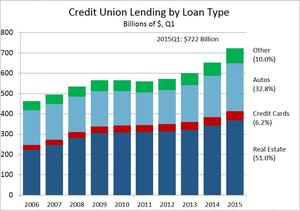
Total loans reached $721.9 billion in the first quarter, an increase of 1.3% from the previous quarter and 10.6% from the first quarter of 2014. Over the year ending in the first quarter of 2015, loans grew across asset sizes and in every major category, including:
- New auto loans grew to $89.3 billion, up 3.4% from the previous quarter and up 21.5% from the first quarter of 2014.
- Used auto loans increased to $147.3 billion, up 2.5% from the previous quarter and up 13.2% from the first quarter of 2014.
- Total first mortgage loans outstanding reached $297 billion, up 1.6% from the previous quarter and up 8.9% from the first quarter of 2014. Fixed-rate first mortgage loans made up 59.3% of first mortgage loans outstanding at the end of the first quarter of 2015.
- Second mortgage loans were $71.6 billion, down 0.5% from the previous quarter and up 2.5% from the first quarter of 2014.
- Net member business loan balances grew to $52.9 billion, up 2.1% from the previous quarter and up 11.6% from the first quarter of 2014.
- Non-federally guaranteed student loans grew to $3.3 billion, up 4.3% from the previous quarter and up 15.2% from the first quarter of 2014.
- Payday alternative loans outstanding were $30 million, down 18.2% from the previous quarter but up 29.9% from the first quarter of 2014.
“The first quarter data shows credit unions continue to excel at providing outstanding value and exemplary service to their members,” said NAFCU President and CEO Dan Berger in a release. “Additionally, credit unions continue to demonstrate their commitment to helping member small businesses develop and grow jobs. These figures affirm that credit unions continue to provide high-quality loans and financial services to millions of American consumers.”

Dan Berger, NAFCU
The loan-to-share ratio at the end of the first quarter was 73.3%, a slight decline from the previous quarter but 4.1 percentage points higher than the end of the first quarter of 2014.
Credit unions continued to move away from long-term investments in the first quarter, NCUA reported. Total investments were $280.4 billion at the end of Q1, a decline of 3.7% from the end of the first quarter of 2014. Compared to a year earlier, investments declined in all categories except those with maturities of one to three years, which increased 20% from a year earlier, to $107 billion. Investments with maturities greater than 10 years dropped 29% from the first quarter of 2014 to $5.3 billion.
Delinquencies Down
Delinquency and net charge-off ratios declined to their lowest first-quarter levels in eight years. The delinquency ratio fell to 69 basis points from 81 basis points at the end of the first quarter of 2014. The net charge-off ratio declined to an annualized 47 basis points year-to-date from 50 basis points at the end of the first quarter of 2014.
The percentage of loan charge-offs due to bankruptcy in the first quarter was 16.9, 137 basis points below the end of the first quarter of 2014.
Membership in federally insured credit unions grew to 99,969,794 at the end of the first quarter of 2015, an increase of more than 2.8 million from the end of the first quarter of 2014.
The number of FICUs fell to 6,206 at the close of Q1, 285 fewer than at the end of the first quarter of 2014, a decline of 4.4%. The decline is consistent with longstanding trends in the financial services industry, NCUA said.
Year-to-date net income was $2.2 billion in the first quarter, an increase of $119 million, or 5.7%, from the first quarter of 2014. As a whole, FICUs have recorded positive net income for 21 straight quarters.
The return on average assets ratio stood at an annualized 78 basis points at the end of the first quarter, a decline of two basis points from the previous quarter but the same level as the first quarter of 2014.
The aggregate net worth ratio was 10.81% at the end of the first quarter, up 20 basis points from a year earlier. The ratio declined 15 basis points from the end of the fourth quarter of 2014, consistent with first-quarter trends, NCUA said.
The vast majority of FICUs remain well-capitalized, with 97.5% reporting a net worth ratio at or above 7.0%. At the end of the first quarter of 2014, 97.0% of credit unions were well-capitalized. As of March 31, 2015, less than 1% of FICUs were undercapitalized, NCUA explained.
Assets Up
Total assets grew to $1.16 trillion at the end of the first quarter, an increase of $60.6 billion, or 5.5%, from the end of the first quarter of 2014.
Overall, share and deposit accounts rose $41.3 billion from the end of the first quarter of 2014 to $984.4 billion. Rate-sensitive money market accounts rose by $7.4 billion from the first quarter of 2014.
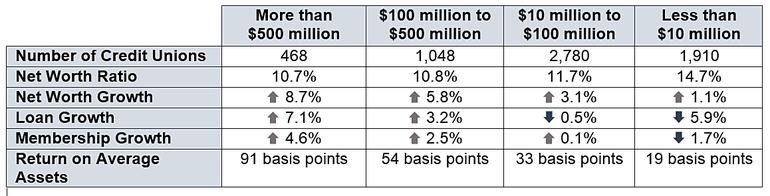
FICUs with more than $500 million in assets continued to lead in most performance measures in the first quarter of 2015. With $817.1 billion in combined assets, these 468 credit unions held more than 70% of total assets at the end of the quarter, NCUA explained. They also reported a higher return on average assets than credit unions below $500 million.
Credit unions with assets of less than $10 million recorded a slightly higher net worth ratio overall, but loan and membership growth were both negative in the first quarter.