

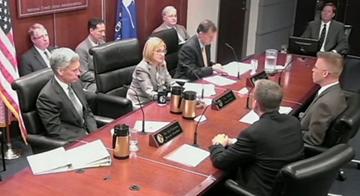
L-R: Mark McWatters, Debbie Matz, Rick Metsger
ALEXANDRIA, Va.—By a 3-0 vote, the NCUA board Thursday approved adding two temporary positions to lead the agency’s Enterprise Solutions Modernization Program (ESMP), which ultimately should lead to shorter on-site exams and contribute to a longer exam cycle, according to the agency.
Costs are expected to be $75,000 annually for four years, which includes the differences in salary and travel expenses for the two temporary positions that will be added, compared to two field positions that are being eliminated to cut costs.
Overall, total capital costs for the new program are budgeted at $15.8 million for the first two years, and another $10 million in year three.
John Kutchey, deputy executive director, explained that when the next two supervisory examiner positions become vacant due to promotion, resignation or retirement, respective regional offices will be consulted to determine whether the remaining supervisory examiners in those two regions can absorb the work.
In a memo to the board, the Office of the Executive Director noted that after the two temporary positions expire in four years, on-site examination costs will be reduced as NCUA’s “modernized systems facilitate more off-site monitoring and less on-site examination time at credit unions.”
The result of ESMP—a program to modernize and integrate the agency’s IT systems—will improve the ability of credit unions to remotely interact with NCUA and allow examiners to review CU data off-site, the memo stated.
Given the complexity of the program and the significant positive outcomes for staff and external stakeholders, dedicated full-time management is essential for the duration of ESMP, the memo stated.
Matz emphasized that as a result of this modernization, credit unions will benefit as well as NCUA.
“When examiners are able to review all relevant information about their assigned credit unions from one off-site location, examiners will spend less time on-site at credit unions,” she explained. “In addition, the integration of NCUA systems will streamline many processes for credit unions.”
Matz explained that instead of logging in separately to “incompatible NCUA systems running on outdated technology,” credit union officials will be able to take a wide variety of actions at their convenience through a new single interface.
“For example, credit union officials will be able to request field of membership expansions, preview member complaints, file Call Reports, apply for grants, and make timely payments — all from one dashboard on their desktop,” Matz said.
Matz told Kutchey she was “surprised” the personnel requests were not included in the 2016 budget when the board voted on it in November of 2015.
“What we presented to the board in November was the capital investment needed for the technology,” said Kutchey. “As we scoped the complexity of this, it extends far beyond just plugging in a couple of new applications…Our vision is a desktop system where an examiner can go to pull up (multiple reports) from one spot. In order to do that, we have to change processes across the organization. It was clear to us this is not a part-time commitment.”
According to Kutchey, the “key outcome” of ESMP will be a better user experience for credit unions and NCUA staff. “The goal is to identify a highly intuitive, single entry point where there is shared data collection and reporting The other data collection processes will be simpler.”
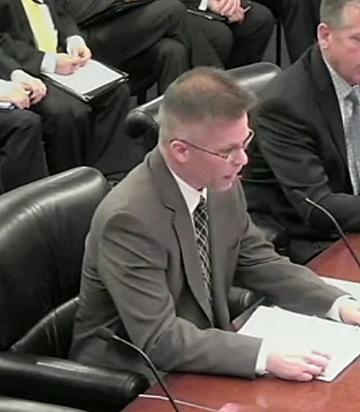
John Kutchey
Kutchey said NCUA staff envisions a configurable desktop where agency staff can get a 360-degree view of the credit union as it relates to NCUA, as well as “dashboard level information” on groups of credit unions.
“Examiners will spend less time collecting data and more time examining it. They will be able to more readily look around the corner,” the board was told.
NCUA staff told the board the project is a “huge undertaking” and will involve all 19 of NCUA’s offices.
“Simply put, there are too many variables and resources to rely on part-time management,” staff told the board in requesting the two new positions.
The new solution will replace the agency’s AIRES and CU Online solutions, among others.
“It’s been two decades since our examination systems have gone through an update,” said Kutchey. “ESMP will allow the retirement of eight to 10 of our systems. Independent research conducted by a third party determined our data collection requirements can be addressed by commercially available solutions. As a result, NCUA will not have to take on the high risk of doing the systems from scratch. Also, the ability to leverage commercial software enables NCUA to adopt inherent business practices.”
Kutchey said that at least 20 subject matter experts and 30 contractors will be involved in working on implementation during 2017 and 2018. The “major transformation effort” will began to ramp up in June.
During a Q&A that followed, board member Mark McWatters asked, “What does ESMP mean to the credit union community, and why is it good for the community?”
“We see consolidation in the industry, and (CUs) are getting larger and more complex, and as an organization we need to flex to that,” responded Kutchey. “This is a maturity from the agency’s perspective to meet the needs of the larger, more sophisticated business models. The intelligence and data analytics are definitely needed…We see opportunity to do a lot more upfront, off-site work, and the ability to get in and get out and reduce time on site.”
When McWatters asked whether that means the potential for extending the exam cycle, Kutchey responded, “It definitely will give us the opportunity.”
NCUA Vice Chairman Rick Metsger told NCUA staff, “I think it’s a tremendous opportunity for us and certainly overdue.”
NASCUS applauded NCUA's attention to ESMP, but said the program is long overdue.
“NCUA’s effort to consolidate its information technology and reporting systems to increase efficiency in examinations under its Enterprise Solutions Modernization Program is long overdue and supported by state credit union regulators,” said NASCUS President and CEO Lucy Ito. “We also believe that state supervisory authorities’ input into this initiative will be invaluable given state examiner direct experience with other federal banking regulators' examination systems, and their own efforts at such modernization. NASCUS and state regulators look forward to collaborating with NCUA to the fullest extent possible.”