By Ray Birch
ALEXANDRIA, Va. — NCUA on Thursday proposed a rule that would allow federal credit unions to reimburse volunteer board members for dependent care expenses, aiming to ease the burden of rising childcare and eldercare costs while preserving long-standing limits on board compensation.
Under the proposal, credit union boards could adopt written policies to reimburse reasonable dependent care expenses incurred while officials conduct official credit union business — a category that has not been reimbursable for more than 30 years, despite sharp increases in family care costs. NCUA staff said the change is designed to remove barriers to volunteer service while preserving the Federal Credit Union Act’s prohibition on board compensation.
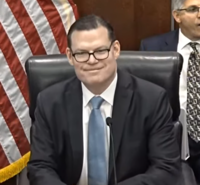
Kyle Hauptman
NCUA Chairman Kyle Hauptman said the rule could help support roughly 20,000 federal credit union board members nationwide, particularly single parents, caregivers, and members of the “Sandwich Generation.”
He noted boards are required to meet 12 times per year, making service more demanding than many corporate or nonprofit boards. The proposal would not require reimbursement, leaving discretion with individual credit unions and requiring any payments to remain reasonable, documented, and appropriate to a credit union’s financial condition.
“That’s a meaningful time commitment, especially during working hours,” Hauptman said about the monthly meetings, adding that this can make board service harder than other volunteer roles. “This change reduces barriers to volunteer service, while preserving flexibility for credit unions.”
Hauptman emphasized that, unlike banks, credit unions rely heavily on unpaid volunteer officials who contribute their time and expertise with no compensation. Rising childcare and eldercare costs, he said, have increasingly made it difficult for volunteers to attend meetings and fulfill their duties.
Citing U.S. Department of Labor data, Hauptman said families spent up to $16,000 per child on full-time daycare in 2022, and between $6,000 and $9,000 on part-time care. He noted that costs in high-cost areas such as Washington, D.C., can be even higher.
NCUA said the proposal adopts the Internal Revenue Code’s definition of a qualifying individual, which generally includes:
- A child under age 13
- A disabled dependent who is physically or mentally incapable of self-care
- A disabled spouse meeting the same standard and living in the same household
NCUA staff reiterated that discretion would remain with individual credit unions. Boards could choose whether to adopt such policies, set reimbursement limits, or opt out entirely.
CLF Budget
Hauptman Thursday was also briefed on the Central Liquidity Facility’s 2026-2027 budget.
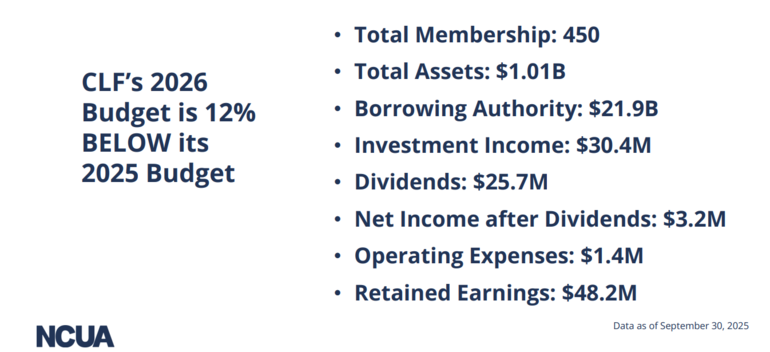
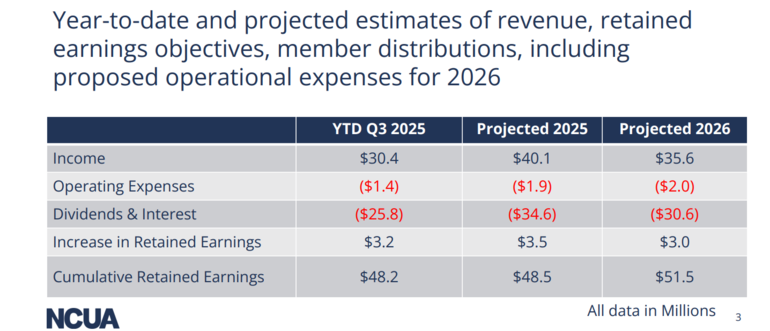
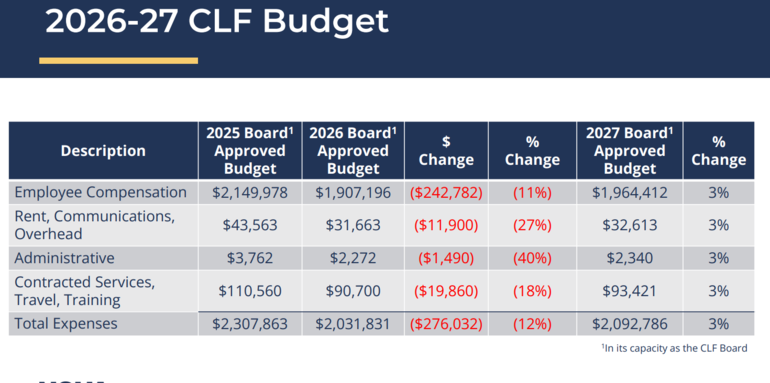
Agency staff reported the CLF’s 2026 budget is 12% lower than 2025, as membership, capital, and borrowing capacity continue to grow. As of Sept. 30, 2025, the CLF counts 450 regular members and 11 corporate credit union correspondents, reflecting a net gain of 14 members year over year. The facility now helps support roughly 10% of all U.S. credit union system assets. The CLF estimates annual budget needs of $2.0 million in 2026 and $2.1 million in 2027, representing a 3% increase following the planned 2026 reduction (see slides below for more details).
Hauptman praised the fund as “admirably lean,” noting the 12% decrease and the CLF’s growing membership. He said the fund serves as a buffer between credit unions and taxpayers, since taxpayers ultimately stand behind the NCUA’s insurance fund if it were ever exhausted. The CLF, he added, helps prevent credit unions from failing in the first place.
“I want to commend you for managing the fund and being respectful of the people whose money we're spending,” Hauptman told NCUA staff.
He described 2026 as a year focused on lowering costs for credit unions, emphasizing that any reduction in insurance expenses is a positive development. Unlike insurance for hurricanes or car accidents, he noted, the primary risk being insured is whether credit unions have enough capital to stay solvent.
“One of the best ways to help credit unions stay financially strong,” he said, “is to let them keep more of their own money.”
NCUA To Host Public Webinar On 2026 Supervisory Priorities
At the start of the meeting Hauptman addressed the fact that last week, NCUA announced its 2026 Supervisory Priorities in a Letter to Credit Unions.
The letter outlines NCUA’s priorities for the remainder of 2026 and highlights the agency’s continued focus on risk-based supervision, with examiners tailoring the examination scope based on the credit union’s unique risk profile.
“I encourage you to read the letter if you have not already done so. To that end, NCUA will host a public webinar to discuss the 2026 Supervisory Priorities in greater detail on February 19 at 2:00 pm Eastern. Please save the date for now, and we will provide additional information on how to sign up for the webinar in the upcoming weeks,” Hauptman said.