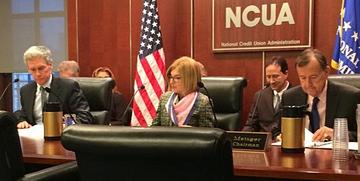
L-R: Mark McWatters, Debbie Matz, Rick Metsger (photo: courtesy CUNA)
ALEXANDRIA Va.—The NCUA board reiterated today that credit unions should not have to pay any more assessments into the Temporary Corporate Credit Union Stabilization Fund based on the TCCUSF’s current performance.
In one of the shortest NCUA board meetings—12 minutes—the agency reviewed the fund’s first quarter results, saying KPMG produced a clean audit for the fund for a sixth consecutive year. The agency credited the fund’s performance, in part, to NCUA’s Asset Management and Assistance Center (AMAC) selling properties the agency owned as a result of the corporate collapse—including the former headquarters of WesCorp, considered by many within credit unions as the shining example of the corporate system’s former problems.
“Today, with six years completed and six years remaining, we are approaching the halfway point of the Stabilization Fund’s statutory term,” said NCUA Chairman Debbie Matz. “However, the worst is behind us: The Stabilization Fund has recorded a positive net position for four straight quarters; first-quarter trends continued heading in the right direction; and if current projections prevail over the Stabilization Fund’s final six years, credit unions should not have to pay any more assessments.”
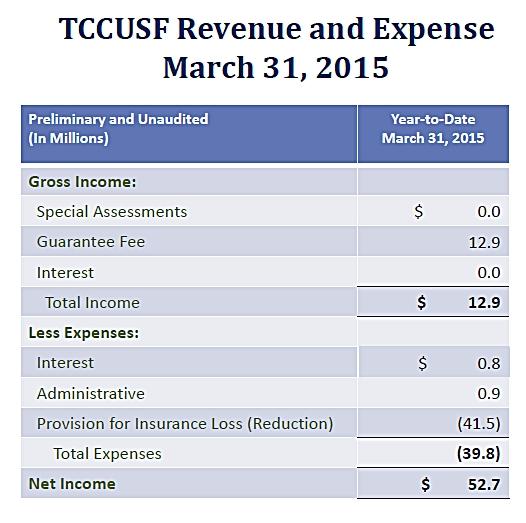
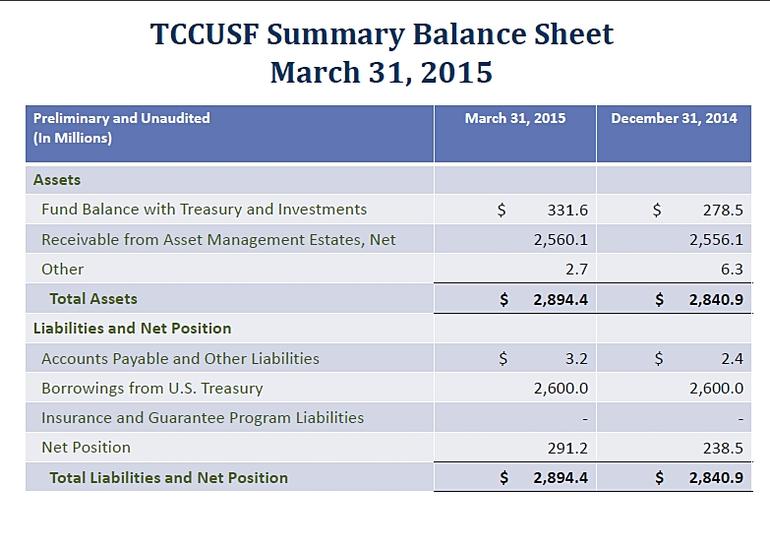
For the quarter ending March 31, the Corporate Stabilization Fund’s net position increased by $52.7 million to a positive $291.2 million. The change is primarily due to improvements in projected cash flows relating to the legacy assets that secure the NCUA Guaranteed Notes and guarantee fees earned, NCUA said. Outstanding borrowings by the Corporate Stabilization Fund from the U.S. Treasury remained at $2.6 billion during the first quarter (see charts below).
In the most recent quarter, Matz noted the fund reached a milestone, completing all the sales of all real estate—land and buildings—previously owned by the five failed corporate credit unions.
“Our final sale was the complex in Rancho Cucamonga, Calif., which formerly served as headquarters for WesCorp,” said Matz, crediting AMAC for their “their diligence in producing real value out of properties NCUA inherited as a result of the corporate failures.”
AMAC this year, as well, was able to sell the last of the 800 homes NCUA ended up owning on Florida’s southwest coast due to the failures of Norlarco CU in Colorado and Huron River Area FCU in Michigan.
“I also want to reassure stakeholders: NCUA continues to pursue legal recoveries against Wall Street firms that contributed to the corporate crisis,” added Matz. “Our legal strategy has already earned $1.75 billion in legal settlements — and we still have 15 lawsuits pending against the firms that sold faulty securities. Our aggressive recovery strategy, the improving economy, careful management of the Stabilization Fund, and the NCUA-Guaranteed Notes have all significantly minimized the costs of the corporate resolution.”
Matz noted that if CUs are to receive any reimbursement for payments into the TCCUSF, the agency must first repay the outstanding borrowings owed to the US Treasury.
Following the meeting, NAFCU Director of Regulatory Affairs Alicia Nealon commented on the news, saying, “We are pleased that the stabilization fund continues to perform well and that NCUA continues to expect to make no future stabilization assessments on credit unions."