L-R: Mark McWatters, Rick Metsger
ALEXANDRIA, Va.–The NCUA board Thursday was given a detailed update on the resolution of the failed corporate credit unions, including how and when any type of “rebate” might be paid to insured credit unions that earlier paid assessments to cover losses.
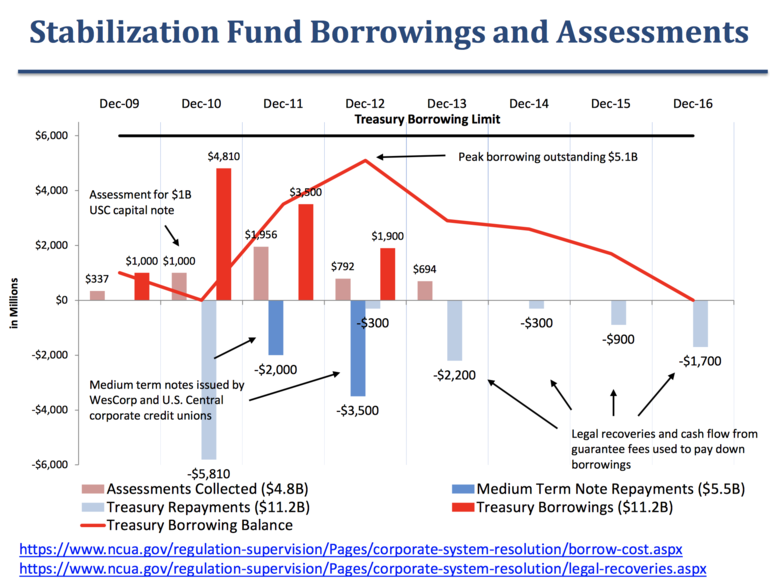
One thing that remains clear: it’s highly unlikely any credit union will see any type of rebate prior to 2021. NCUA continues to wind down the estates of the five failed corporates–WesCorp, Southwest Corporate, U.S. Central, Constitution, and Members United. Between 2009 and 2013, credit unions paid five Stabilization Fund assessments totaling $4.8 billion.
Prior to the board meeting, both credit union trade groups had issued statements calling for more information on the disposition of the legacy assets and to provide more details around when credit unions might be able to expect a rebate.
“We’re going to need billions by 2020 to pay off stakeholders,” said NCUA Chairman Rick Metsger, during Thursday's open board meeting.
Presenting the corporate resolution program update to the board were Larry Fazio, director of NCUA’s Office of Examination and Insurance, Brian Heitman, NGN financial analyst with the Division of NGN Support, Office of Examination and Insurance; and Anthony Cappetta, supervisor in the Division of NGN Support, Office of Examination and Insurance. Their full presentation can be found on CUToday.info in The gov.
Available Resources $1.9 Billion
As of Sept. 30, the total available resources of the estates and the Stabilization Fund were about $1.9 billion. With the additional securities that will become available to sell through December 2017, less the guaranty payment NCUA will need to make in 2017, NCUA said there will be a net total available by January 2018 of $2.5 billion.
But before credit unions start planning on new office space based on that rebate check, the Office of E&I said the remaining projected NGN guaranty payments that will come due in 2020 and 2021 total $2.8 billion.
“So, clearly, we will need the $2.5 billion to help make the projected guaranty payments in 2020 and 2021,” Fazio told the board.
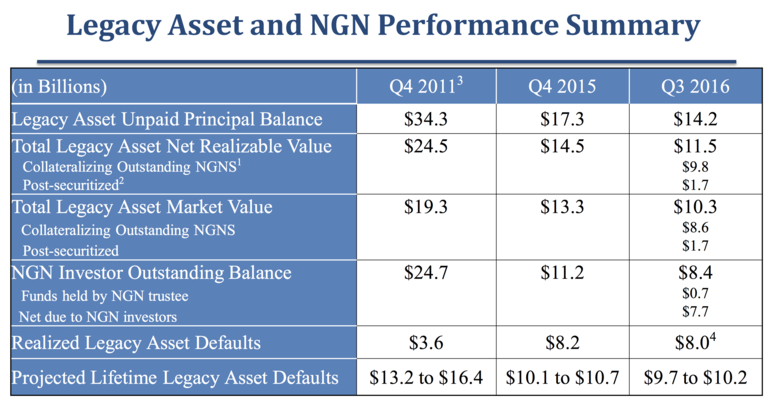
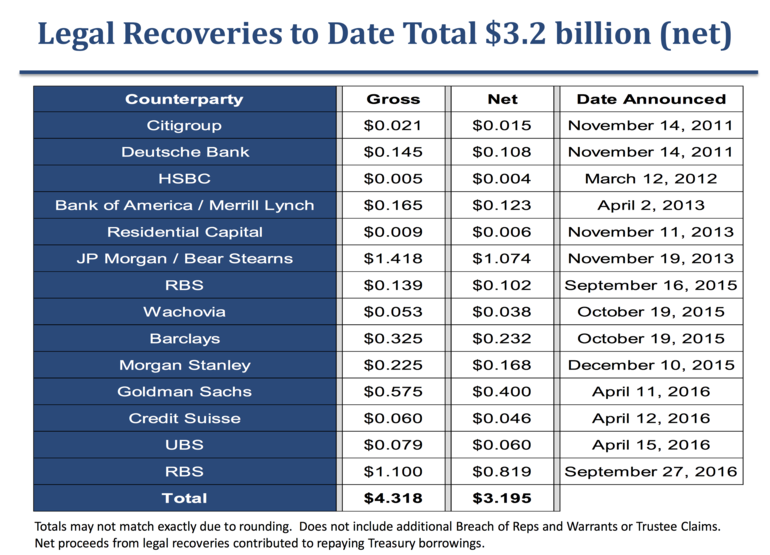
None of the projections include any potential future legal recoveries from lawsuits NCUA has filed against banks and brokerage firms that sold failed securities to the corporate credit unions. Gross recoveries to date have been $4.31 billion, which after legal fees have netted NCUA $3.195 billion.
In addition, with both credit unions and their trade associations consistently asking when a rebate might be paid on the assessments CUs paid into the fund, Fazio clarified that the FCU Act does not provide for assessment rebates directly out of the Stabilization Fund, nor can rebates be provided from the asset management estates. Instead, he said the Act specifically directs that when the Stabilization Fund is closed, residual assets are to be distributed to the Share Insurance Fund, so any “rebate” paid to NCUSIF-insured credit unions will have to be based on the extent to which the distribution to the Share Insurance Fund at the closing of the Stabilization Fund causes the equity ratio of the Share Insurance Fund to exceed the normal operating level at the end of a calendar year triggering a dividend.

Larry Fazio
Fazio noted the NCUA board has the authority to close the Stabilization Fund early and transfer the corporate system resolution program assets and obligations (including the guarantees on any outstanding NGNs) to the Share Insurance Fund. But that creates the potential for significant volatility in the equity ratio of the Share Insurance Fund with any downturn in the performance on the underlying legacy assets given the current size of the remaining obligations in relation to the size of the insurance fund, he said.
Specifically, he said, in terms of depleted capital recoveries, there are four estates projected to have recoveries for investors in depleted capital instruments of the failed corporates. However, all five estates are currently expected to have outstanding senior-creditor obligations, including to the Stabilization Fund through the guaranty it provides on the NGNs, until 2021.
“Thus, until senior-creditor obligations for each particular estate can be satisfied with certainty—that is, repaid or fully funded, including for contingencies—it would not be appropriate to make any distributions to the subordinate depleted capital claimants,” Fazio said in his presentation.
Basis For Rebates?
Fazio noted the agency is often asked what the basis is for rebates of assessments and recoveries on depleted capital. As he said earlier, he repeated that the assessment rebate would flow out ultimately as a Share Insurance Fund dividend, which per the Act is prorated based on insured shares at the time of the dividend.
Showing a slide with all the payout priorities to the low and high end of the projected ranges by estate, at the low end the Stabilization Fund would be repaid $2.5 billion, with another $900 million in recoveries for depleted capital holders. On the high end, the Stabilization Fund would be repaid $3.2 billion, with another $1.7 billion in recoveries for depleted capital holders.
What about the funding options for the guaranty obligations that will be required for outstanding NGNs? According to Heitman, there are a total of $3.25 billion projected guaranty payments NCUA will need to make on the outstanding NGN series, which he called “analogous to balloon payments.”
“With the additional securities that will become available to sell through December 2017, less the guaranty payment NCUA will need to make in 2017, there will be a net total available by January 2018 of $2.5 billion,” Heitman said. “However, the remaining projected NGN guaranty payments that will come due in 2020 and 2021 total $2.8 billion. But it is important to dimension this a little further to understand options about holding and selling legacy assets for the interim period until all the NGNs have matured…The cash flows projected to occur between now and June 2021, without selling any securities, are estimated to be sufficient to fund all but $1.0 billion of the $3.25 billion in projected guaranty payments.”
Heitman told the board NCUA has six options to fund the necessary $1 billion to make the guaranty payments, including:
- Declare an assessment
- Re-securitize the legacy assets NCUA can actively manage.
- Use a provision built into each of the NGN indentures that allows NCUA to access or direct the sale of the underlying securities out of the NGN trusts after the last monthly payment that occurs before the final payment date, which would avoid guaranty payments.
- Use NCUA’s borrowing authority.
- Use the Share Insurance Fund. “This is a distinct option, but there are accounting and legal matters and potential unintended consequences that could factor into this,” said Heitman. “It could also necessitate disruption of the Share Insurance Fund investment portfolio, affecting the future yield of the Share Insurance Fund.”
- Sell enough legacy assets that have exited the NGNs to raise the needed $1.0 billion.
Moving forward, when it comes to selling legacy assets, Fazio said it is important to clarify NCUA’s role as liquidating agent, which is to conduct an orderly liquidation, not to function as a long-term asset manager trying to maximize return on a portfolio.
“Based on this role, the interim disposition plan would involve selling enough securities to satisfy remaining guaranty obligations without needing to borrow from Treasury, use funds from the Share Insurance Fund, or assess credit unions,” said Fazio. “As noted previously, current projections indicate we would need to raise $1 billion through securities sales to fund the December 2020 and 2021 projected hard final maturity payments. Now that NCUA has the ability to sell securities as a source of liquidity, and as a contingency, the Share Insurance Fund can be used without downstream expense consequences for insured credit unions, we should no longer borrow from Treasury other than for emergency needs.”

Sold At 'Reasonable' Price
Fazio said NCUA will sell legacy assets that can be sold at a reasonable price without compromising legal efforts that have a good chance of material recovery that isn’t accounted for in market prices. He said NCUA plans to begin selling 152 securities with a total market value of about $700 million.
“The proceeds from these sales, along with cash flows from the NGN guaranty fee and other inflows, will begin to increase the outstanding amount of Stabilization Fund cash,” said Fazio. “Staff will continue to follow the current practice of investing these funds with the U.S. Treasury until they are needed to make guaranty payments, as well as backstop any potential increase in program obligations, such as any unexpected guaranty payments due to a downturn in the performance of the legacy assets. Again, we can’t rebate funds at this time.”
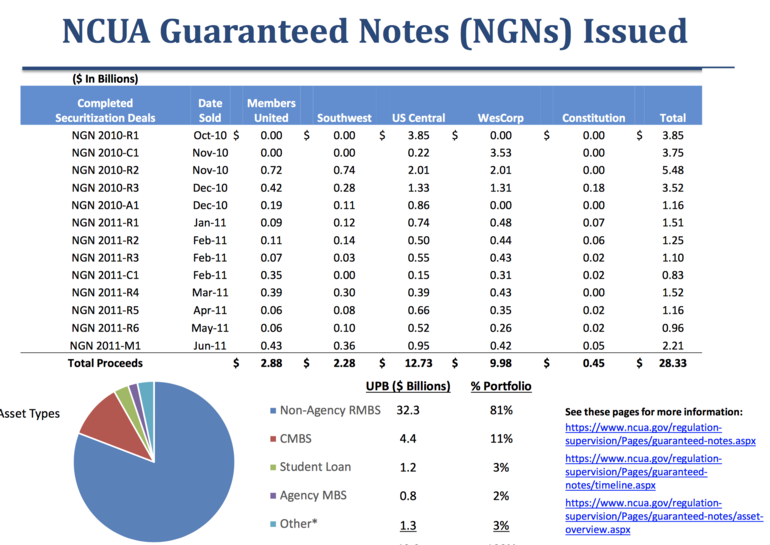
By way of background, according to NCUA, as of 2009 the total unpaid principal balance for the distressed securities was $52.7 billion, but their market value was less than $22 billion. At that time the market losses from the corporates would have exceeded $30 billion, an amount far in excess of the NCUSIF’s then-$11 billion balance. NCUA estimated that in 2009 the failure of thousands of consumer credit unions with uninsured deposits in those five corporates would have resulted in a cost to the credit union system estimated at $40 billion. In response, the corporate resolutions program was created, including the Stabilization Fund, the NCUA Guaranteed Note Program, and the five asset management estates. The Stabilization Fund expires in June of 2021.
CUNA, which just introduced a white paper on the NCUSIF, commented on the board briefing.
“CUNA welcomes actions to begin paying assessment rebates sooner than later,” said CUNA Chief Policy Officer Bill Hampel, who authored the white paper. “But we are concerned that doing so might cause NCUA to raise the normal operating level of the share insurance fund above 1.3%. We don’t believe that would be necessary.”