

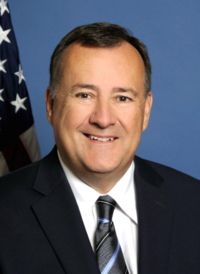
Rick Metsger, NCUA
ORLANDO, Fla.—While the risk-based capital proposal is getting all the headlines, NCUA Vice Chairman Rick Metsger said that NCUA’s field of membership regulations may have a greater impact on the nation’s credit unions than any other issue before the agency in the next couple of years.
In remarks to the Education Credit Union Council’s (ECUC) Annual Conference here, Metsger said “the dual chartering system works most effectively when both state and federal policies keep pace with changes in the financial marketplace, equalize competitive challenges, and streamline regulatory compliance.”
Metsger said that many state legislatures/state regulators have been “advancing” their respective state charters and “thus widening the disparity” between the federal charter and that of various states.
“While the overall number of charter changes has gone down the past few years, the pendulum is now skewing heavily from federal to state charters at almost a three-to-one pace over the last four years,” Metsger said. “Over a similar four-year time period a decade ago conversions ran nearly two-to-one in the other direction.”
Metsger also noted that institutions converting from federal to state charters were significantly larger than institutions converting in the other direction (an average $400 million vs. an average $150 million over the last four years).
Change in field of membership rules are particularly appropriate when those interpretations are dated and no longer represent the current financial marketplace, said Metsger.
“Not long ago a key test of underserved areas was how many brick and mortar offices peppered a given geographic area. Mobile banking challenges that assumption as do evolving definitions of rural areas and well defined community,” Metsger said. “What made sense several decades ago no longer makes sense in a more complex and interconnected world. The federal charter has become devalued and this devaluation needs to be addressed and addressed thoughtfully and carefully.”
Given the education-community audience, Metsger also spoke to the issue of college affordability and issues around student loans, pointing to the current record $1.25 trillion in student debt, which exceeds the entire credit card debt in the country.
Metsger said recent data shows private student lending is up significantly on a percentage basis among the nation’s credit unions but still represents a very small portion of total loans outstanding.
While the risk-based capital proposal is getting all the headlines, NCUA Vice Chairman Rick Metsger said that NCUA’s field of membership regulations may have a greater impact on the nation’s credit unions than any other issue before the agency in the next couple of years.