

WASHINGTON—Mortgage rates that have stayed elevated since the pandemic are reshaping the housing market, making all-cash purchases increasingly appealing to buyers able to sidestep financing altogether.
According to new data from the National Association of Realtors, more than a quarter of U.S. home sales over the past three years were completed entirely in cash. The trend tracks closely with the sharp rise in borrowing costs: mortgage rates climbed from pandemic-era lows in 2022 to nearly 8% in fall 2023, before easing into the low- to mid-6% range this year, NAR economists said.
Higher rates have priced many first-time and lower-income buyers out of the market, while existing homeowners—bolstered by years of home-equity gains—have been better positioned to make cash offers on primary residences, second homes, or vacation properties. As of October, cash buyers accounted for 29% of home sales nationwide, up from 27% a year earlier and just 19% five years ago, Realtor.com stated in its analysis.
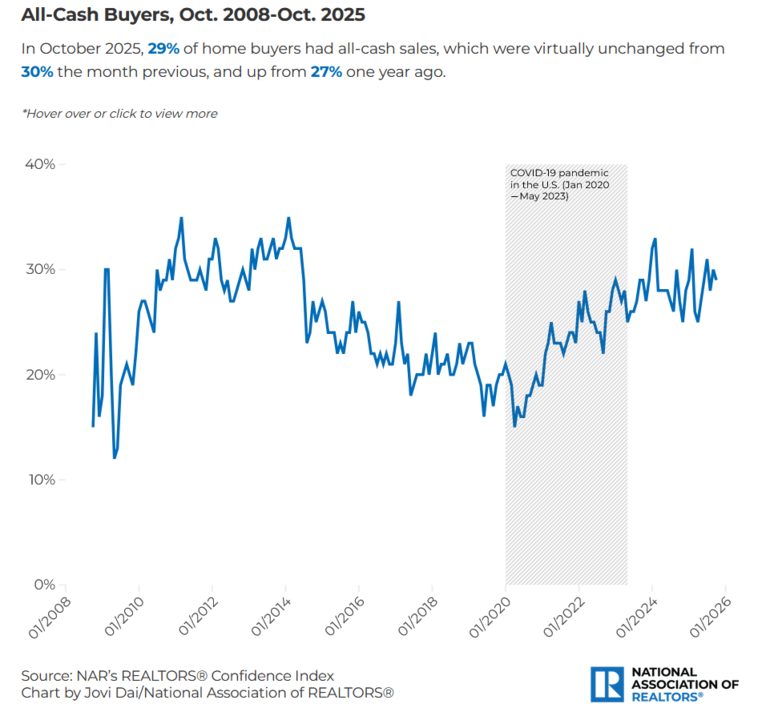
Those findings align with a recent Realtor.com analysis showing that 32.8% of homes sold in the first half of 2025 were purchased with cash.
Harrison Polsky, a real estate agent at Douglas Elliman in Dallas, told Realtor.com the connection between higher mortgage rates and cash sales has been clear in practice.
“As mortgage rates increased, buyers with access to capital increasingly chose to close with cash or cash-equivalent financing,” Polsky told Realtor.com. “It became a bridge strategy. Close as cash to avoid rate and underwriting friction, then revisit permanent financing later through private banks or wealth advisers at more favorable terms.”
As Realtor.com senior economic research analyst Hannah Jones noted in the October report Cash Is King: Trends in All-Cash Home Sales, cash buyers benefit from avoiding high borrowing costs, eliminating financing contingencies, and closing faster—advantages that can be decisive in competitive markets.
Polsky added that cash offers reduce uncertainty for sellers and immediately strengthen a buyer’s negotiating position.
“Put simply, as borrowing becomes more expensive, paying with cash starts to look like a smarter, more competitive choice,” wrote Amethyst Marroquin, research assistant of Member and Consumer Survey Research at NAR.