

COSTA MESA, Calif.--Auto debt pressures are intensifying for U.S. car buyers, with new data from Edmunds showing a growing share of borrowers rolling negative equity into new-vehicle purchases—a trend with clear implications for lenders’ risk exposure and loan structures.
In the fourth quarter of 2025, 29.3% of trade-ins toward new vehicles were underwater, with borrowers owing more than their vehicle’s value at the time of trade-in. That marked the highest share since early 2021, when pandemic-era supply disruptions pushed prices sharply higher. The data suggest negative equity is no longer easing as quickly as many lenders expected.
More concerning for financial institutions, the size of that negative equity continues to climb. Edmunds reported the average amount owed on underwater trade-ins reached a record $7,214 in Q4 2025, while 27% of upside-down trade-ins carried at least $10,000 in negative equity—also an all-time high. Nearly one in 10 borrowers in this group owed more than $15,000 above their vehicle’s value.
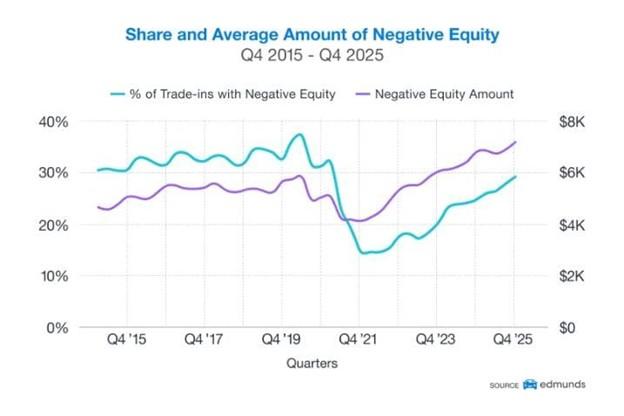
Edmunds attributes much of the imbalance to loans originated during the vehicle shortage of 2021 and 2022, when buyers often paid near or above sticker prices and had fewer lower-cost options. As vehicle prices have normalized and depreciation has returned to historical patterns, loans written at elevated values are colliding with today’s higher borrowing costs, making it harder for balances to catch up with market values.
The data also point to a widening disconnect between how long consumers keep vehicles and how quickly loan balances decline. Longer loan terms have allowed borrowers to maintain familiar replacement cycles, but many are returning to the market with significantly higher remaining balances than anticipated. The assumption that a borrower will break even at trade-in is increasingly proving unreliable.
To manage higher balances, borrowers are stretching repayment even further. Edmunds found that 40.7% of new-vehicle purchases involving negative equity were financed with 84-month loans. While extended terms can lower monthly payments, they also delay equity recovery and increase the likelihood that negative equity will roll forward again.
That dynamic is already showing up in payment levels. In Q4 2025, buyers who rolled negative equity into a new loan paid an average of $916 per month—$144 more than the industry average—and financed more than $11,000 above the typical new-vehicle loan amount.
Edmunds said the data underscore how negative equity can quickly become self-reinforcing. Rolling debt forward may ease short-term affordability, but it often leaves borrowers with higher payments, fewer refinancing options, and increased credit risk the next time they return to the market.