

TROY, Mich.—As inflation, higher borrowing costs and mounting household expenses continue squeezing consumers, growing numbers of Americans are turning to personal loans as a financial lifeline—but FIs risk losing ground to faster-moving non-FI competitors that are increasingly winning over financially stressed borrowers, according to the new JD Power 2026 U.S. Consumer Lending Satisfaction Study.
“We’re seeing a clear opportunity for banks to learn from what non-bank lenders are doing well,” said Bruce Gehrke, senior director of wealth and lending intelligence at JD Power. “Non-banks are making measurable gains with financially vulnerable customers by meeting their needs for speed, simplicity and certainty, even as overall satisfaction across the market remains relatively unchanged. If banks don’t adapt to those expectations, that opportunity quickly becomes a competitive risk.”
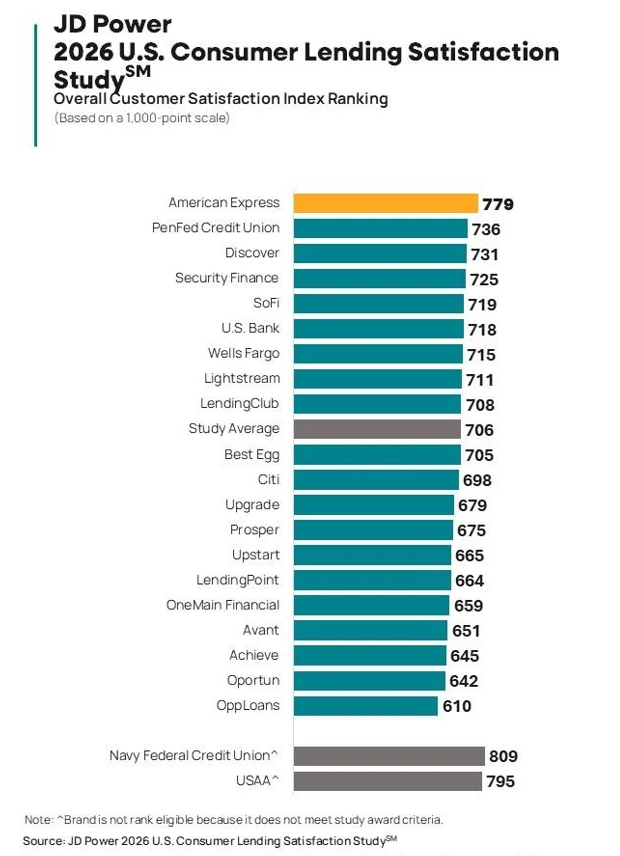
Key findings of the 2026 study:
- Satisfaction edges up as financial health shows modest improvement: Overall customer satisfaction with personal loan providers is 706 (on a 1,000-point scale), up 2 points from the 2025 study. Meanwhile, 27% of personal loan customers are classified as financially healthy this year, up from 25% in 2025. During that same period, the percentage of customers identified as financially vulnerable has decreased to 45%, down from 47% in 2025.
- Speed of funding serves as critical differentiator: Speed is a key driver of overall satisfaction among personal loan customers, with approval times now largely similar across lenders and funding speed emerging as the key differentiator. Satisfaction drops sharply with delays, down 41 points when approval takes more than an hour and down 47 points when funding takes more than one day after approval. Non-banks lead in speed, with 68% of customers receiving funding within one day vs. 58% at banks.
- Non-bank reliance on representatives creates friction with loan approval: Non-bank experiences depend more on representatives throughout the application process, but these interactions are rated less effective overall. Final loan approval requires a representative in a higher share of cases for customers of non-FIs (70%) vs. banks (61%), serving as a strength for FIs (+7 points) and a point of friction for non-banks (-36). Higher reliance on representatives among non-bank customers is driving lower satisfaction at a key moment in the journey, suggesting these customers are less satisfied with the support they receive and diluting some of benefits gained from efficient digital interactions.
Index Ranking
American Express ranks highest among personal loan lenders in overall customer satisfaction for a fourth consecutive year, with a score of 779. PenFed Credit Union (736) ranks second and Discover (731) ranks third.
The U.S. Consumer Lending Satisfaction Study measures overall customer satisfaction based on performance in seven core dimensions on a poor-to-perfect rating scale. Individual dimensions measured are (in order of importance): loan met borrowing needs; level of trust; experience obtaining loan; makes it easy to do business with; people; digital channels; and kept informed about loan. The study is based on responses from 6,513 personal loan customers and was fielded from March 2025 through March 2026.