PALM DESERT, Calif.–A company often considered a fast-emerging competitor to credit unions said it instead is seeking to form partnerships to make loans.
Prosper, the San Francisco-based person-to-person (P2P) online lending platform, has evolved its operations, underwriting, and decision-making metrics, and volume of loans has been skyrocketing. Since a January 2013 relaunch, the company has gone from doing about $10 million in loans each month to more than $400 million each month. It is projecting equally ambitious growth.

Ron Suber speaking to REACH Conference in Palm Desert, Calif.
Ron Suber, the president of Prosper Marketplace, who said he has been rebuffed in his prior outreach to credit unions about potential partnerships, again extended an invitation to that different model of P2P lending, credit unions, to work with his company in making loans.
“I know many of you are very, very skeptical that this is a fad that is going to go away,” said Suber in remarks to the California/Nevada Leagues’ REACH Conference. “But I promise you that Gen X and Millennials aren’t going to do business the way they used to. People don’t pay for things the way they used to. Lending is changing.”
But credit unions continued to express skepticism over whether partnering with Prosper would create a fox-in-the-henhouse scenario. Suber insisted that would not be the case. At the same time, he said credit unions must recognize that borrowing-as-usual is also not the case.
The changes in how people loan and borrow money are part of a much larger cultural change facilitated by technology in which marketplaces of all kinds have emerged in every product and vertical, said Suber. The “Sharing Economy” is now giving way to the “access economy” where companies such as Prosper and Lending Club are seeing a surge of activity.
“In other words, the cheese has moved,” said Suber, referring to the best-selling book “Who Moved the Cheese?” “Your member is not going to borrow or save or interact with you in the same way. Just having a website where they can get a credit card or move money or take pictures of checks—that’s not the answer. It’s larger than that. The largest transportation company in the world owns no cars. The largest lodging provider owns no rooms. The largest financial companies aren’t going to be banks or credit unions. “
In Prosper’s case, it will do approximately $3.7 billion in loans this year. It is projecting more than $7 billion in volume in 2016 for borrowers who come to its platform. The company is about to roll out Prosper Healthcare Lending on Nov. 19, where doctors or dentists send their patients to the company. In some cases that could include 0% loans where doctors and dentists share a piece of the revenue with Prosper.
It is also planning to begin offering lines of credit to consumers.
Credit Unions 'Should Call Us'
“Any credit union interested in lending for consumer debt should call us. We will work with you,” said Suber, noting that Citi just invested $1 billion with the company. “We have some banks who send us their borrowers and we set up branded pages for them. This is the opportunity for you to say yes in another way. People are going to come to you and say I wanted to borrow online and you weren’t there for me.
“That’s what is happening outside of you, and you can participate by investing in the loans and owning them, by sending us your borrowers, or some combination,” Suber continued. “It can go through your underwriting engine, we may fund it, or we may let it go to the marketplace. Once we get to these borrowers they don’t go back. Our competition isn’t you or the biggest banks; our competition is that people don’t know who we are. So we are traveling the world telling our story.”
In response to an audience member asking about interest rates charged by Prosper, which are typically higher than what credit unions charge, Suber said the company asks seven questions of borrowers.
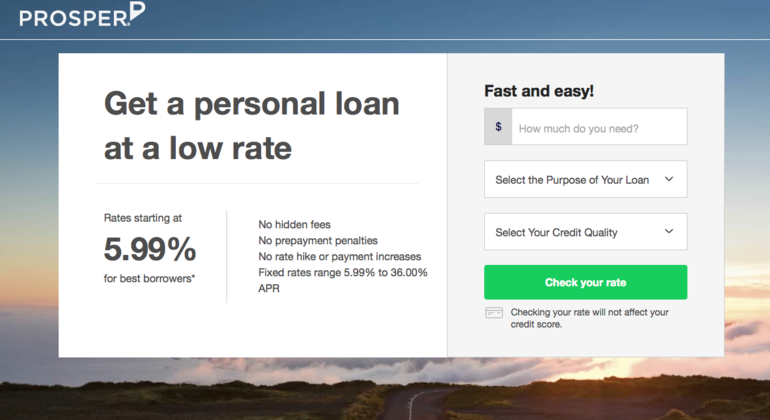
“Once they give us those answers we have tons of data on them. It’s scary,” he said. “ We then go back and say we have seven different loan rates. You get a letter, a number, an offer, a term and a dollar amount and interest rate. And then you choose. We are prime and super prime. Our minimum is a 640 FICO. Our lowest rate is about 4.5% and rates up to 15%. Once you come back to us, we do a hard-pull on the borrower, because now we are presenting you to the lenders. They get to see all the numbers. We keep the servicing and we do the collections. There is no prepayment penalty. There is an origination fee of about 4% for the borrower, and 1% servicing fee annually goes to the investors. This is the opportunity to work with us.”
Suber said the average seasoned loan pays a net 6.5% return.
Prosper, which uses WebBank as its origination bank and which complies with all regs/laws that credit unions must meet, according to Suber, now has a maximum loan amount of $35,000, but it is moving to $50,000. He added that the company has a department that works with lenders to help build deeper relationships with new members who come aboard due to a loan.
How Partnership Would Work
What Prosper would do in a partnership with credit unions, said Suber, is create custom pages and place iPads in CU branches where the loan app appears to be from the credit union but it is powered by Prosper.
“We totally get it that these people are your members. We don’t sell anything else. We just do one thing: consumer credit,” said Suber.
But during a panel discussion later in the day he acknowledged he has heard the skeptics in credit unions that believe Prosper ultimately will begin poaching members with other products and services. He again sought to reassure credit unions that that will not be the case in the event of any partnerships.