

WASHINGTON—Although it is frequently cited, the unemployment rate is not the best indicator of economic health that comes out of the monthly data from the Bureau of Labor Statistics.
New analysis from the Pew Research Center suggests that all the attention paid to the unemployment figures is over-stated. Noting that the while 5.8% unemployment rate “sounds like good news,” it’s not where the news can really be found, said Pew Research.
“For much of the current recovery, the unemployment rate fell even when relatively few people were finding jobs, because even more people were retiring, going back to school, or simply giving up the job hunt,” observed Pew Research in its analysis. “In the past six years, more than 12.6 million Americans 16 and over (seasonally adjusted) have joined the ranks of those not counted as part of the labor force.
Which is why many economists like to look at the employment-to-population ratio, a measurement of employed people as a percentage of the entire adult civilian non-institutional population. Though the ratio has some quirks, it’s less affected by seasonal variations or short-term fluctuations in labor-market behavior than the unemployment rate.
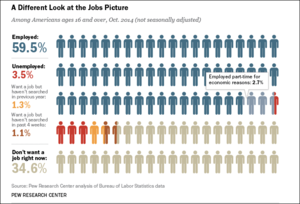
According to the October jobs report, the seasonally adjusted employment-to-population ratio was 59.2% last month, one percentage point higher than it was a year earlier. Over that same period, the “official” unemployment rate fell from a seasonally adjusted 7.2% to 5.8%.
One reason for the difference is that the share of Americans saying they don’t want a job has trended up since the Great Recession, according to Pew Research, from 31.9% of the working-age population in October 2008 to 34.6% last month (on a non-seasonally adjusted basis). Some of that increase, though, may be due to Baby Boomers reaching retirement age; as they leave the workforce over the next several years, labor economists expect the employment-to-population ratio to trend lower. Young adults staying in or returning to school also may be a factor, Pew Research said.
Looking at just the 25-to-54 age group, which strips out most students and retirees, Pew Research said the employment-to-population ratio has been slowly improving since it bottomed out at 74.6% (not seasonally adjusted) in February 2011. Last month, 77.3% of all 25-to-54-year-olds were employed, which is well below the indicator’s pre-recession high in October 2006, when 80.7% of people in this age group were employed.
“Then again, not all employment is created equal, either. During the Great Recession, the ranks of people working part-time either because they couldn’t find full-time work or because their hours were cut back because of slack demand soared from around 3% of all employed people pre-recession to 6.6% in March 2010,” Pew Research Center said. “There are fewer such involuntary part-timers now, but last month they still accounted for 4.8% of all employed people (and 2.7% of the entire adult civilian non-institutional population).”
Related links
Pew Research: Cyber-Attacks Will Grow