WASHINGTON–The Pew Research Trusts has released new data examining household expenditures, which it said is an often overlooked element of family balance sheets.
“In measuring household financial security, significant attention is typically paid to income, but much less to whether those resources are sufficient to cover expenses,” Pew noted.
Using the Bureau of Labor Statistics’ Consumer Expenditure Survey, Pew examined changes in overall spending and across individual categories from 1996 to 2014, while also examining the differences in expenditures by income, “with a particular focus on the degree to which households have slack in their budgets that could be devoted to savings and other wealth-building efforts.”
The Pew analysis focused on the working-age population, which includes survey respondents or their spouses who are between the ages of 20 and 60. For the purpose of examining differences in spending by income, the sample was divided into thirds.
The analysis shows that both median income and expenditures contracted after the Great Recession, reflecting the economic turmoil of the country. By examining household spending, this research helps to shed light on family financial security over time, and especially in recent years, Pew said.
Key findings include:
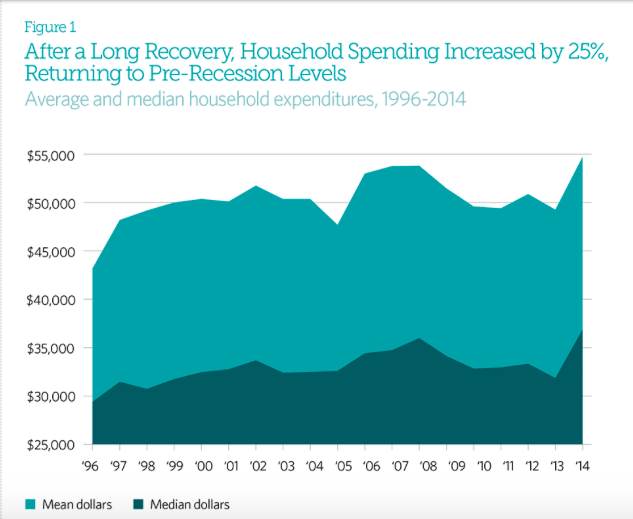
- Overall median household expenditures grew by about 25% between 1996 and 2014, returning to pre-recession levels. After declining during and after the Great Recession, expenditures increased between 2013 and 2014 in particular. In 2014, the typical American household spent $36,800.
- Although expenditures recovered from the downturn, income did not. As the recovery began, median household expenditures returned to pre-crisis levels, but median household income continued to contract. By 2014, median income had fallen by 13% from 2004 levels, while expenditures had increased by nearly 14%.
- Low-income families spent a far greater share of their income on core needs, such as housing, transportation, and food, than did upper-income families. Households in the lower third spent 40% of their income on housing, while renters in that third spent nearly half of their income on housing, as of 2014. Because their core spending absorbed so much of their income, households in the lower income tier spent considerably less than their middle- and upper-income counterparts on discretionary items, such as food away from home and entertainment.
Although all households had less slack in their budgets in 2014 than in 2004, lower-income households went into the red, Pew said. In 2004, typical households at the bottom had $1,500 of income left over after expenses. By 2014, this figure had decreased by $3,800, putting them $2,300 in the red. The lack of financial flexibility threatens low-income households’ financial security in the short term and their economic mobility in the long term, Pew said.
According to Pew, households spent more in 2014 than they did in 1996, after adjusting for inflation; this holds whether the figures are based on averages (means) or medians. The typical household saw its expenditures grow by more than 25%, from $29,400 in 1996 to $36,800 in 2014. Mean expenditures grew 27% since 1996, rising from $43,200 to $54,800. Much of the growth occurred between 2012 and 2014, signaling a promising recovery from the Great Recession and the housing crisis.