

PLANO, Texas–There is a potential “car crash” ahead when it comes to credit risk in the auto market, according to one analyst.
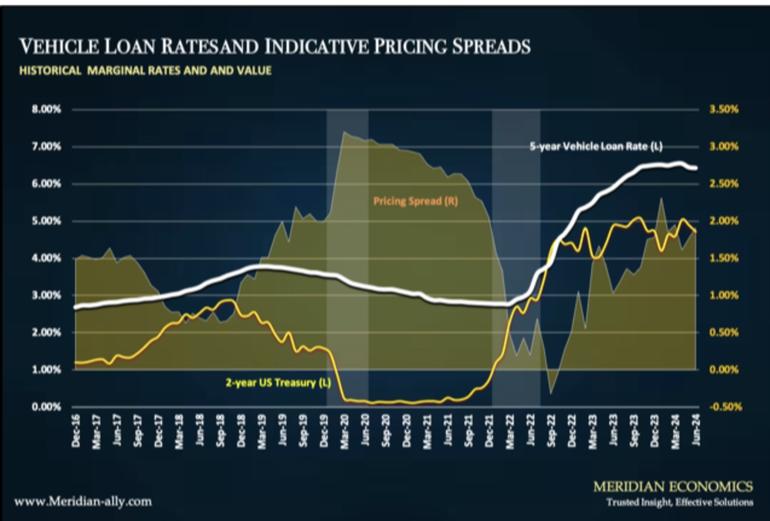
Brian Turner, president and chief economist with Meridian Economics, noted in his most recent report that since September of 2022 the market has been experiencing a “rare occurrence where both auto rates and relative pricing spreads have been increasing at the same time.”
He pointed to data showing that since May 2022- current, market rates have increased 356 BPs to 6.46% while credit spreads have increased 133bps to 1.56%.
‘Double in Size’
“We've now seen auto delinquencies double in size since 2023 and because of rising inflation and finance rates average monthly payments have increased to $735 for new and $523 for used,” Turner said in his analysis. “This compares to 2016 levels of $600 and $400, respectively, but currently having much longer average maturities.”
Turner is urging credit union leaders to “be prepared” for when average rates start to decline either by the end of 2024 or sometime in early 2025, and when credit spreads begin to narrow, “weakening the value of taking on the credit risk at the same time experiencing greater credit risk exposure.”
‘An Interesting Phenomenon’
“This will present credit unions in particular, with an interesting phenomenon - relative short-term loans at relative high interest rates and longer durations priced at relative high collateral values,” Turner forecast. “The higher collateral values and higher loan rates forced higher borrower monthly payments during a questionable economic environment - certainly an credit risk exposure.”
Lastly, Turner cautioned, the combination of higher collateral values, high market rates and longer loan terms creates greater credit risk to credit unions in that they collectively cause greater divergence between collateral value and loan balances (loan-to-value).
‘Greater Financial Exposure’
“This divergence means that it takes longer for amortized loan balances to catch up with the depreciation value of vehicle. The longer the term of the loan, the longer it takes for equilibrium to loan-to-value,” Turner wrote. “With the increased issuance of 72- and 84-month vehicle loan terms, particularly during a period of relatively high vehicle prices and now higher rates, it creates greater financial exposure to potential loan default and charge-offs.”
The Good News
Turner said there is some good news in that the greatest exposure has come from loans issued between 2021-2023, a period of rising vehicle values, longer terms but lower interest rates.
“It also means that the loans are nearing their half-lives,” Turner stated. “But this implied lower exposure has been somewhat replaced during 2023-2024, with 72-and 84-month issuances at relatively high rates and market values--an attempt to help the affordability of vehicle financing for our members but an exercise that increases the credit union’s credit risk exposure.”