

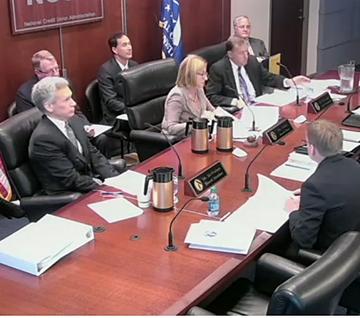
L-R: Mark McWatters, Debbie Matz, Rick Metsger
ALEXANDRIA, Va.—While the NCUA board Thursday approved a final risk-based capital rule, before CUs must comply with the new net worth guidelines in 2019, Congress could step in to delay, alter or remove the rule.
NCUA Chairman Debbie Matz addressed that possibility Thursday, recognizing that the House Financial Services Committee has passed the Risk-Based Capital Study Act of 2015 (HR 2729), better known as the “Stop and Study” bill, which has the backing of both credit union trade groups.
The agency also read a letter into the board meeting’s record from House Financial Services Committee Chairman Jeb Hensarling (R-TX), who expressed his disappointment the agency was considering a final rule Thursday.
She noted that should the bill eventually become law, it would require NCUA to study and report to Congress on four issues:
- Whether NCUA has the clear legal authority to prescribe separate risk-based capital thresholds for both “adequately capitalized” and “well capitalized” credit unions.
- A discussion of the differences between credit unions and other types of depository institutions and reasons why they should have similar or different risk weights.
- A discussion of the rationale behind the risk weights assigned in the proposed NCUA rule.
- Analysis of the impact the proposed rule would have upon excess capital above the minimum level for a credit union to be well capitalized.
“Since these are such important issues, NCUA staff has already studied each of them very carefully,” said Matz. “Our analysis of the legal authority, risk weights, bank comparisons, and average risk-based capital surpluses are included in the preamble to this final rule. However — whether or not the bill becomes law — I have committed to provide a report to the House Financial Services Committee addressing these issues.
The report will also include additional analysis of any projected impact on credit union examinations, Matz said. “I anticipate that the report will be sent to the Committee within the next few weeks.”
Matz added that on Tuesday she received a letter from Hensarling expressing his disappointment the agency was considering a final rule Thursday. Matz said Hensarling requested that his letter be read into the record.
“Reading a letter from a member of Congress into the record of an NCUA board meeting would be unprecedented,” stated Matz. “However, because Chairman Hensarling is a leader on a committee of jurisdiction, I am prepared to make an exception today.”
NCUA’s board secretary read Hensarling’s letter just prior to the RBC vote. Hensarling said the proposal was so “flawed” the agency was forced to re-propose it, and that the revised version “still suffers from deficiencies,” including a legal basis. He further stated the revised risk-based capital rule will undermine safety and soundness.
Rep. Hensarling said the fact NCUA has not respected the “overwhelming bipartisan support” for HR 2769 shows a willful “disregard” for the wishes of Congress. That bill passed out of committee on a 50-9 vote and remains before Congress.