

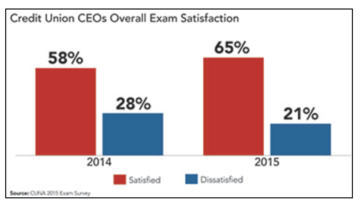
MADISON, Wis.—More credit union CEOs are satisfied with their exams (65%) than dissatisfied (21%), according to CUNA’s 2015 Exam Survey.
“More importantly, this finding is substantially improved compared with that reported last year (58% satisfied vs. 28% dissatisfied),” said Paul Gentile, chair of CUNA’s exam and supervision subcommittee and president/CEO at the Cooperative Credit Union Association. "These are the highest levels of overall satisfaction seen in the four years this study has been conducted.”
Previously, the highest satisfaction was seen in 2012 when 61% were satisfied and 25% were dissatisfied, CUNA stated.
Gentile added, however, that despite exam satisfaction rising, “the fact that over one in five credit unions is dissatisfied is very troubling.”
Improving economic and financial results played a significant role in recent progress, CUNA explained. A large decrease in the proportion of credit unions reporting being under one or more documents of resolution (DORs) also improved the results. In 2015, 30% of responding credit unions indicate they were under at least one DOR. In 2014, 40% of responding credit unions were under at least one DOR—roughly the same as in 2013 (41%) but a bit lower than in 2012 (43%). Exams conducted by state examiners remain substantially less likely to include DORs than exams in which the NCUA is involved, the study found.
Exam duration was little-changed in 2015 (9.2 days), nearly identical to both the 2014 result (9 days) and the 2013 result (9.1 days) but a bit longer than that seen in 2012 (7.9 days).
Exam teams again received very positive ratings on giving credit unions the opportunity to comment, knowledge of rules and regulations, being open to discussion, and knowledge of the credit union. Exam teams continue to receive negative ratings on aspects such as applying "guidance" or "best practices" or “covering themselves,” Cuna said.
The biggest problem mentioned by credit unions is that regulatory and exam requirements in general are putting increasing pressure on credit union resources. “That’s not at all surprising,” Gentile said. “The data clearly shows exam duration remains elevated in 2015. CUNA’s exam and supervision subcommittee believes the NCUA needs to take concrete steps to address this issue—and that’s why we’re concentrating efforts on getting the agency to extend the exam cycle. The financial crisis ended nearly seven years ago. It’s both prudent and appropriate for the agency to refine the cycle to be more consistent with the examination cycle for banks.”
The 2015 Exam Survey is based on 657 responses, representing 10% of all credit unions.