

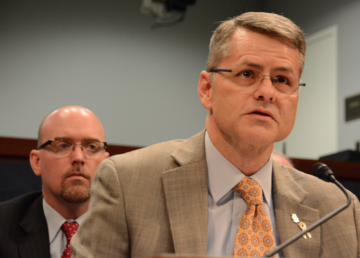
Patrick Miller testifies before HFSC (Photo: courtesy CUNA)
WASHINGTON–Several more credit union-supported pieces of legislation have been introduced in Congress. Rep. Ed Royce (R-CA) and Rep. Jared Huffman (D-Calif.) reintroduced the Credit Union Residential Loan Parity Act, which has the backing of NAFCU and CUNA.
Under current law, when a bank makes a loan to purchase a one-four unit non-owner occupied residential dwelling, the loan is classified as a residential real estate loan; however, when a credit union makes the same loan, it is classified as a business loan and is therefore subject to the cap on member business lending under the Federal Credit Union Act.
“We appreciate Representatives Huffman’s and Royce’s leadership on this issue and their continued efforts to level the playing field for credit unions, especially in the area of member business lending,” said NAFCU President and CEO Dan Berger. “This legislation will give credit unions critical flexibility in serving their members and go a long way toward making rental housing more available and affordable.”
Meanwhile, Sens. Jerry Moran (R-KS) and Joe Manchin (D-WV) have reintroduced the Exam Fairness Bill (S. 774), which would enhance safety and soundness by increasing the consistency and fairness of the regulatory examination system. That legislation also has the backing of credit unions.
“This is a needed step toward improving the federal examination process that would provide regulatory relief to credit unions,” said Jim Nussle, President and CEO of CUNA. “Examinations should be based on the laws Congress passes and the regulations that NCUA enacts, not on examiner interpretation of ‘best practice’ or guidance.”
Patrick Miller, president and CEO of CBC Federal Credit Union, testified in support of the legislation today on behalf of CUNA before the U.S. House Financial Services Committee hearing on regulatory relief, while Peggy Bosma-LaMascus, CEO of the $500-million Patriot FCU in Chambersburg, Penn., testified on behalf of NAFCU.
The 2015 exam fairness bill is nearly identical to the senators' 2013 legislation and would:
- Make available to financial institutions the information used to make decisions in their examination.
- Codify certain examination policy guidance.
- Establish an independent ombudsman at the Federal Financial Institutions Examination Council to which financial institutions could raise concerns with respect to their examination.