

MADISON, Wis.–A decline in higher yielding credit card loan balances has lowered the credit card to total loan ratio to 5% today, close to the lowest in credit union modern history, according to TruStage’s newest Trends Report, which also found new-auto loan balances fell 0.1% in May, savings balances rose at a 4.0% seasonally-adjusted, annualized growth rate and the disparity between small and large credit unions’ return-on-asset ratios decreased significantly over the last year.
Membership growth, meanwhile, grew at a “very weak” 0.4% seasonally-adjusted, annualized growth rate in May, slower than the record-setting 4.5% pace of the last few years, according to the new Trends Report, which noted current membership growth pace is the slowest since 2011.
Here's a look at how credit unions performed by category through May in the analysis authored by TruStage’s chief economist, Steve Rick.
Total Credit Union Lending
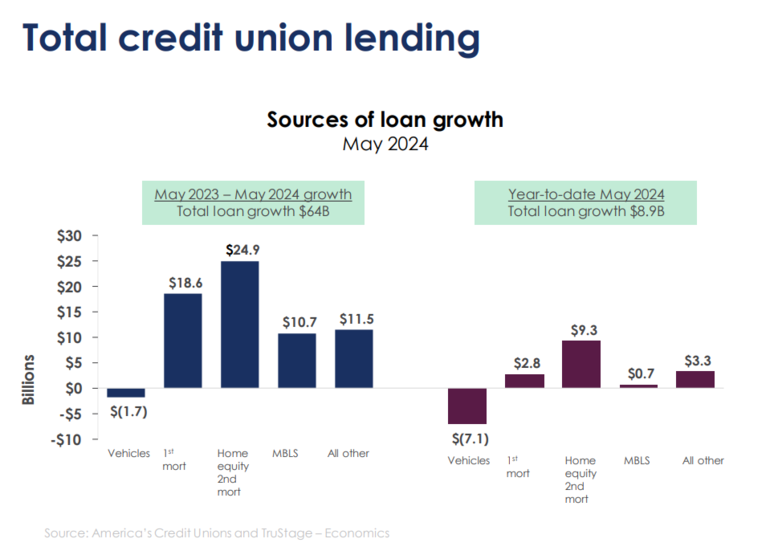
According to the new Trends Report, credit union loan balances rose 0.4% in May, which was much slower than the 0.7% pace reported in May 2023, and rose 4.1% during the last 12 months due to higher interest rates, increased competition from finance companies and tight liquidity.
Home equity loans and second mortgages made up the lion’s share of loan growth during the last five months and during the last year, the TruStage analysis notes.
“Since the end of 2023, credit union home equity/second mortgage loan balances rose $9.3 billion as consumers took advantage of the surge in home prices to borrow against their home equity,” the Trends Report states.
It further notes:’
- Vehicle loan balances decreased by $7.1 billion year to date as originations have been lower than repayments.
- Credit card loan balances declined 0.7% in the first five months of 2024, down from the 2.8% jump in the similar period of 2023.
- The decline in these higher yielding credit card loan balances has lowered the credit card to total loan ratio to 5% today, close to the lowest in credit union modern history. “This is one of the factors slowing the rise in credit union yield on asset ratios this year,” the Trend Report states. “Credit union loan balances are expected to increase only 3% in 2024, the slowest pace since 2011. If the Federal Reserve lowers short-term interest rates soon, we are forecasting 5% credit union loan growth in 2025, still below the 7% long term trend rate.”
Consumer Installment Credit
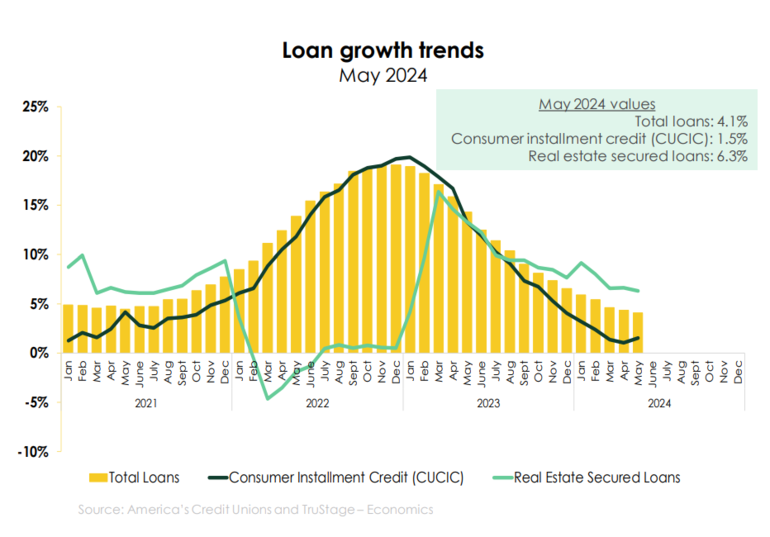
The new Trends Report data show credit union consumer installment credit balances (auto, credit card and other unsecured loans) reported an increase of 0.5% in May, above the 0.01% increase set in May 2023, due to an acceleration in credit card loans.
“During the last 12 months, credit union consumer installment credit grew 1.5%, which is below the total credit union loan growth of 4.1%,” Rick stated in the Trends Report. “Credit union consumer installment credit grew slower than the rest of the market excluding credit unions, which increased 3.6% over the last year.”
The report notes that for all lenders, outstanding consumer credit rose $11.3 billion in May (2.7% annualized rate), according to the Federal Reserve, an improvement from April’s 6.5 billion gain. Nonrevolving credit (large loans like auto and student loans) increased $4.3 billion in May, which accounted for less than half of May’s total increase while revolving credit expanded $8.5 billion.
Slowdown in Lending
“Consumer credit is expected to slow for the next 12 months due to high interest rates and tighter lending standards,” the report states. “Continuing liquidity issues at financial institutions will also slow credit creation. Somewhat offsetting these factors will be continued demand for travel, pent up demand for autos and a healthy labor market. This will ensure loan growth will expand but at a slower pace than the last year.”
Vehicle Loans
Credit union new-auto loan balances fell 0.1% in May, below the 0.1% gain reported in May 2023.
“Higher interest rates and increased competitive pressure from captive finance companies has reduced new-auto lending at credit unions,” the report states. “On a seasonally-adjusted annual rate new-auto loan balances fell 3.9% in May the slowest pace since the spring of 2020. New-auto loan balances fell 3.2% year to date, significantly below the 1.3% increase reported during the first five months of 2023.”
But as the report notes, May is historically the beginning of the new-auto lending season, “so we expected a credit union lending turnaround.”
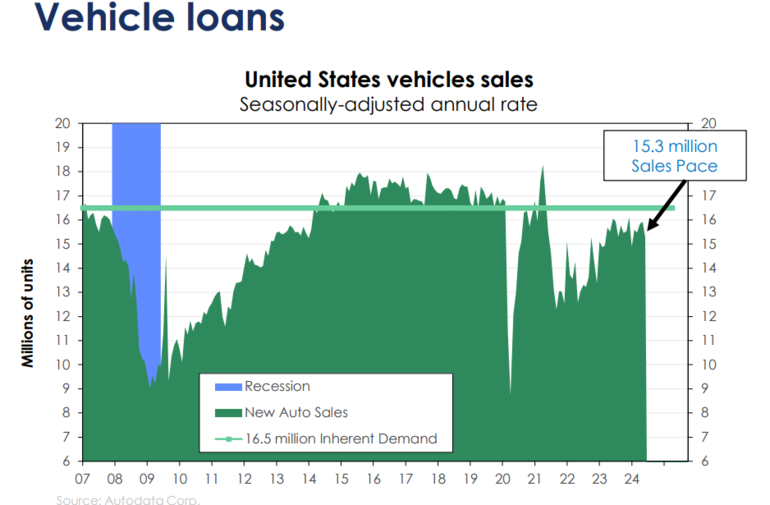
Vehicle sales fell to a 15.3 million seasonally-adjusted annualized sales rate in June – down 4% from April, and 5% below the 16.1 million sales pace set in May 2023 due to a cyberattack on CDK Global, which disrupted operations at 15,000 auto dealerships across the U.S.
The Forecast
“Despite higher interest rates, a healthy labor market and above-average wage growth are allowing consumers to purchase new vehicles, especially those who chose to put off buying a new vehicle during the last two years, because of low inventory and sky-high new-vehicle prices,” the analysis states. “Expect new-auto sales to approach its 16.5 million inherent demand in the first half of 2025, due to lower interest rates, falling prices and an ongoing healthy labor market. The biggest downside risk to auto sales and lending would be an economic slowdown that reduced consumer spending on new vehicles.”
Real Estate
Credit union fixed-rate first mortgage loan balances rose 0.1% in May, below the 0.9% increase reported in May 2023, according to the Trends Report.
“Credit union fixed-rate first mortgage loan balances rose only 0.1% at a seasonally-adjusted adjusted annual rate in May, one of the slowest growth rates in credit union history.
Additional Findings
The report also notes:
- Adjustable-rate first mortgage balances rose 1.6% in May, significantly faster than the 0.6% increase reported in May 2023, and rose 21% during the last year.
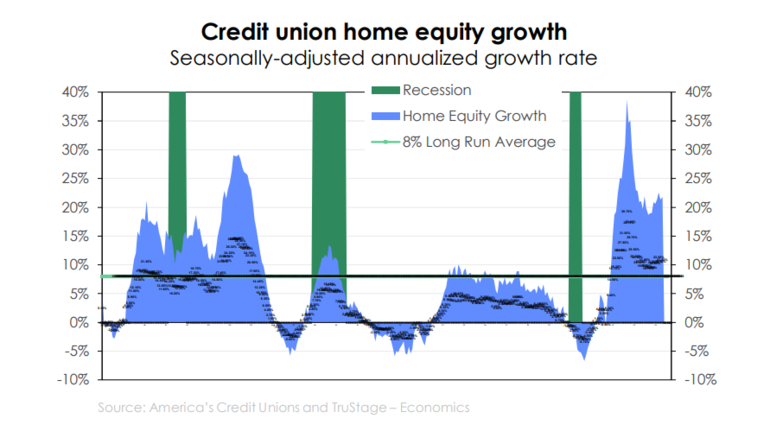
- Credit union home-equity loan balances rose 21.8% at a seasonally-adjusted annual rate in May, down from the record setting pace of 38.7% set in September 2022.
- Fixed-rate first mortgages now make up 29.4% of all credit union loan balances, down from the record high 36.4% set in December 2021.
“Interest rate risk has become a major concern as market interest rates rose over the last couple of years,” the Trends Report states “Lower fixed-rate mortgages as a percent of all loans will reduce some of this risk.”
Other News on the Homefront
The Trends report further notes:
- The contract interest rates on a 30-year fixed-rate conventional home mortgage rose to 7.06% in May, up from 6.99% in April and higher than the 6.43% reported in May 2023.
- The 64-basis point jump in mortgage interest rates over the last year has significantly reduced mortgage originations and home sales. The 64-basis point increase in mortgage interest rates coincided with a 91-basis point increase in the 10-year Treasury interest rate, which rose to 4.48% from 3.57%.
- The 91-basis point increase in long-term interest rates was caused by a 79-basis point increase in real interest rates (due to the Federal Reserve’s quantitative tightening program) and a 12-basis point increase in inflation expectations (due to stubbornly high inflation in the first few months of the year).
- A tight supply of homes lifted U.S. house prices in April despite low affordability. National house prices increased by a seasonally-adjusted 1.2% in April, according to the S&P CoreLogic Case-Shiller Home Price Index, above the 0.3% average set in 2015 to 2019. Home prices are up 6.3% from one year ago.
Savings & Assets
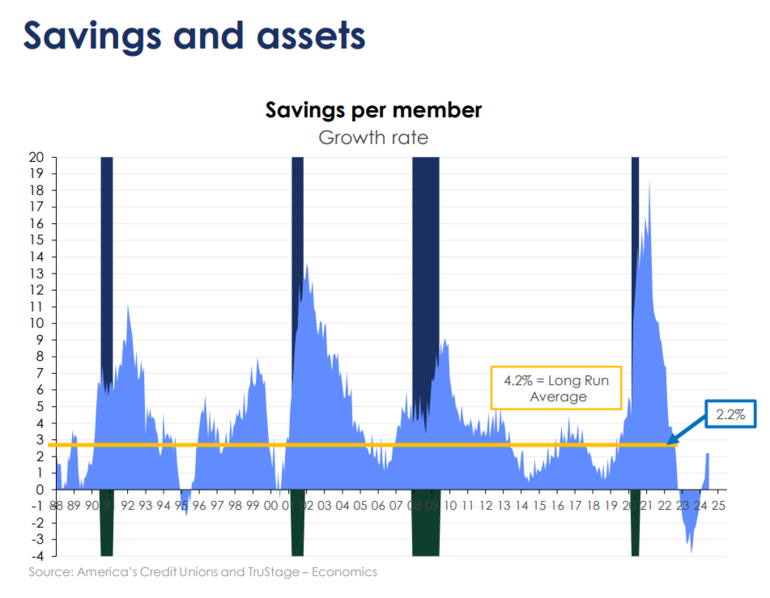
According to the new Trends Report, credit union savings balances rose at a 4.0% seasonally-adjusted, annualized growth rate in May, significantly above the 1.4% pace set in May 2023, but still below the 7% long run average.
“Deposit growth remains below trend due to high inflation and funds leaving credit unions for alternate savings products paying higher interest rates,” the report states. “Savings per member rose 2.2% during the last year from $13,550 in May 2023 to $13,843 in May 2024. This $293 increase in savings per member was mostly funded by the credit union itself due to the credit union paying significantly higher money market and share certificate deposit interest rates.”
The report further notes credit union share certificates deposit accounts grew 37% during the last year ($146 million increase) as members moved $28 million from money market accounts, $54 million from regular share accounts, and the remaining $64 million coming from new deposit inflows.
“This shift to high-interest-rate deposits was a contributing factor increasing credit union’s average cost of funds to 1.84% in the first quarter, up from 1.05% in Q1 2023,” the Trends Report states. “With the Federal Reserve expected to lower short-term interest rates by 50 basis points this year, expect this shift in the mix of deposits to slow.”
Capital & Other Key Measures
The credit union loan delinquency rate (loans two or more months delinquent as a percent of total loans outstanding) rose to 0.84% in May, up from 0.61% in May 2023, the report found.
“Delinquency rates are now above the 0.75% long-run natural delinquency rate, due to the rising number of unemployed (814,000 over the last year), above target inflation, high interest rates, high rent inflation, and the resumption of student loan payments,” the analysis explains. “Credit union loan net charge offs as a percent of average loan balances rose to 0.80% in the first quarter of 2024, up from 0.77% in the fourth quarter of 2023. This charge off rate is above the long-run average charge off rate of 0.50%.”
The Trends Report forecasts credit union asset quality is expected to deteriorate as the labor market weakens during the second half of 2024. In May, the number of job openings fell to 8.1 million, down from the 9.3 million set in May 2023, but still above the 10-year average of 7.5 million.
ROA & Expense Ratios
The report also notes:
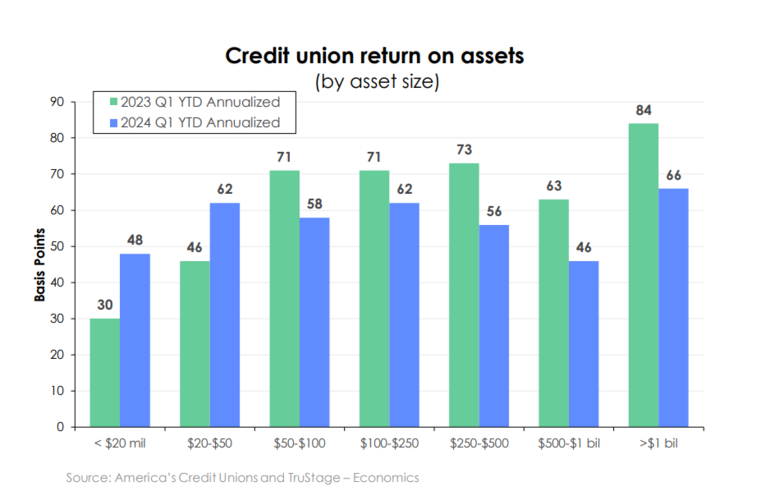
- Credit union return-on-assets ratios fell to 63% in the first quarter of 2024, down from 0.80% in Q1 2023, due mainly to rising provisions for loan losses as percent of assets (0.55% in Q1 2024, versus 0.40% in Q1 2023).
- Operating expense ratios also jumped to 2.96% of assets in Q1 2024, from 2.91% one year earlier due to high inflation increasing the numerator and weak asset growth weighing on the denominator.
“The disparity between small and large credit unions’ return-on-asset ratios decreased significantly over the last year as smaller credit unions generally reported an increase in ROA while midsize and larger credit unions reported a decline,” the Trends Report says.
Credit Unions & Members
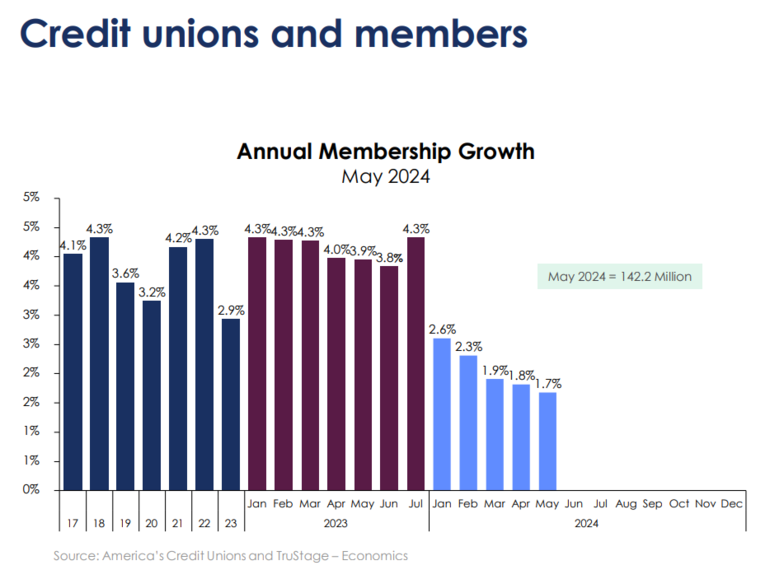
Credit union memberships grew 253,000 in May, or 0.18%, down from May 2023, when the movement added 443,000 memberships at an increase of 0.32%, the Trends Report states, adding the membership gain year-to-date slowed to 0.457 million, down from 2.162 million for the similar period in 2023.
“Credit union memberships grew 2.336 million during the year ending in May 2024, which is a 1.7% increase from one year ago,” according to the Report. “Total credit union memberships have surpassed 142.2 million and are expected to reach over 143.3 million by the fourth quarter of 2024. Weak loan growth and slowing job creation are two factors weighing on credit union membership growth. Credit union memberships grew at a very weak 0.4% seasonally-adjusted, annualized growth rate in May, slower than the record-setting 4.5% pace of the last few years.”
According to the analysis, the current membership growth pace is the slowest since 2011, and before Bank Transfer Day that occurred on November 5, 2011. On that date a consumer initiative called for a voluntary switch from commercial banks to not for profit credit unions. This grassroots initiative grew out of the capitalization bailout of big banks and Bank of America's plan to charge customers a $5 per month debit card fee.
“Expect credit union memberships to grow below 1.5% in 2024, and 1.8% in 2025,” the Report added.