

LAS VEGAS–There’s a good news/bad news scenario for credit unions when it comes to Generation Z: On the plus side, it’s a cohort whose values align with those of credit unions. Unfortunately, many in Gen Z know nothing about credit unions, according to a group of CU leaders here.
Questions surrounding Gen Z were discussed here at Mitchell Stankovic’s Underground Collision meeting here by a panel that included Jorge Esteban, VP-community FIs with Visa; Melia Heimbuck, president/CEO of the Credit Union Association of New Mexico; Jackie Martinez Vasquez, VP-DEI with BECU; Linda Bodie, president/CEO with Element FCU, and Emma Hayes, chief culture officer with State Employees Credit Union.
Here's what each had to say:
Estaban: Gen Z is often positioned in the payments industry as a salvation, it’s a huge demographic. Gen Z is in college. They are not arriving, they are here. There are about 70-million Americans in that cohort. If you look at the income potential for Gen Z through 2034, they will increase income (by a factor of eight). This is an enormous purchasing power.
Something else is happening in the background and that is a historical transfer of wealth--about $80 trillion over the next 30 years. They are looking for wealth and family management, business transitions.
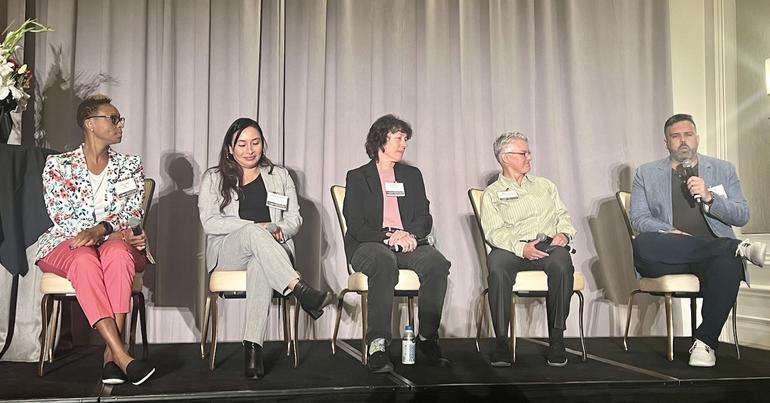
From left: Emma Hayes, Jackie Martinez Vasquez, Linda Bodie, Melia Heimbuck and Jorge Esteban.
What New Numbers Show
From the payments industry, numbers just released show YoY growth in payments by Gen X is 1%, by Millennials 3%, and Gen Z, 17%.
They are more diverse, more eco- and sustainable conscious. They make purchases in a different way than any prior generation. Gen Z buys in alignment to their values. I think that’s where the crux of this argument is, that credit unions have a special place in this cohort.
The grim part is this is a battle you are losing. But it is one you can win.
Q: How are you engaging with Gen Z?
Heimbuck: I look to all our credit unions to engage. I do live with three children who are Gen Z; they don’t approach money the same way we do. I think a lot of what we need to do as credit unions is all about the language we are using.
When we talk savings and credit scores, they aren’t into that because they don’t want to stay in a house or live in one place.
The language around fees doesn’t work because it’s somehow not their fault. My youngest is 15, and for her 15th birthday we went to the Ed Sheeran concert in Denver. We are driving to pick up her friend when my daughter said, ‘Zane’s real name is Amber, and he goes by she, but her mom doesn’t know it.’ They are very, very fluid. We have to remember that when we are talking about loan applications, collecting data per CFPB Section 1071, (which includes data points that are) gender-based.
I encourage all of you to pull together those you are trying to serve to understand their language, their metrics, who they are and how they relate to money.
Bodie: In West Virginia, believe it or not, we have a very diverse population. It’s important for me to make sure we are serving all people.
I have been with my credit union for 25 years. It’s been a journey to reach out and serve the underserved. Over that time, it’s been about how do we change that, be more inclusive, remove pronouns, get past ‘this is how we have always done it’?
Being inclusive has been a major push for our organization. The language is very important. Your employees not only have to know, they have to believe it. If you have one person and they don’t believe it and they use the wrong name or hurt their relationship, (that member is) not coming back. You have to keep preaching it. You have to have it all the time.
Love everyone, serve everyone, welcome everyone. We keep working to improve that because life keeps changing.
Martinez-Vasquez: Twenty percent of Generation Z identifies as LBGTQ+. We know that by 2026 the majority of this country will be non-white. For Gen Z, 6% are immigrants, 22% of them have a parent who is an immigrant or identifies as an immigrant.
I talk about that because we have talked a lot about the infrastructure of credit unions, technology and data, but I want to offer that once we have an architecture that works, we need to dig deeper into what else is going to differentiate us as a financial institution that this generation will want to do business with.
More Than Infrastructure
For us at BECU, it’s not only about the infrastructure, it’s also about how we’re engaging with the community and that our employees reflect the community.
This generation is challenging us to do a few things: to talk a little bit differently; to not only talk about growth as a market opportunity, but to also talk about purpose; to go from transactional to transformational. To not only talk about individual well-being but to collective well-being. And they are challenging us to go beyond hesitancy to be fearless.
They aren’t looking for us to say we are doing something, but for results. If you made commitments in 2020 and you are scaling those back because they’re not in the limelight anymore, you are going to be irrelevant to the future.
Hayes: We have about 2.7-million members. We service only North Carolina. We have quite a few members we are happy to say fall into (Gen Z), but we got them before they knew they were members. We got them when their parents set up their first Fat Cat accounts. It was an amazing opportunity to get them in the door.
My caution to all of you is to make sure you are not just focused on your problems, but that we also remain focused on our purpose. Why are we here? Why do we exist? If we lose that purpose, we lose our advantage of people helping people.
The Grim Side
On the grim side, we have 275 branches and a huge presence, but that branch presence for members (in terms of importance) is shrinking. When we surveyed our membership, they said their number-one priority is technology. Unfortunately, we have not stayed on top of technology, but we are working hard at getting better at that. Technology has to be convenient, cohesive and they have to see how we service them in the ways they want to be served.
We are making sure we are listening and creating a specialized, personalized experience when they come into the branch, but also that same level in technology.
The credit union industry is lagging way behind in sustainability. We are well behind others in the financial industry, specifically fintechs, that prioritize people, planet, profit. We are still reliant on processes in place 15, 30, 40 years ago. But this generation cares about our footprint. Minimizing that footprint will be a way to bring them back.
Not About Checking the Box
Also, when it comes to diversity in your organizations, it’s not about check-the-box diversity. People should be able to see themselves in your organization. People should have a voice and have opportunities to participate across your organization.
This generation is transient; they don’t build a wall, they pitch a tent. We have to be well-positioned to take advantage of how we help people help people and make sure that is relevant.
Just Because It’s Autumn Doesn’t Mean Falling for Schemes to Overcharge You for CU Industry News. Instead, Try This Crisp Offer
The biggest, best and freshest news reporting in credit unions remains free! Each morning CUToday.info delivers its daily Fresh Today news update offering the latest headlines and breaking news right to your email, with the easy-to-read headlines format allowing you to click on the stories that interest you most in order to learn more. So stop paying those bank-fee-like subscription prices from other so-called “news”” publications!
If you haven’t yet signed up for the new email solution on which CUToday.info has partnered with ResponseGenius, you can do so here. Signing up requires less than one minute of your time—and it’s free!
Please note that after signing up you may need to go to your Spam/Junk folder and mark the morning headlines email as safe. CUToday.info does not provide its list of readers and emails to outside parties, and we will not be contacting you to sell you an extended warranty or sending you any links so you may cash in on an inheritance you didn’t know was coming.
And did we mention it’s free?