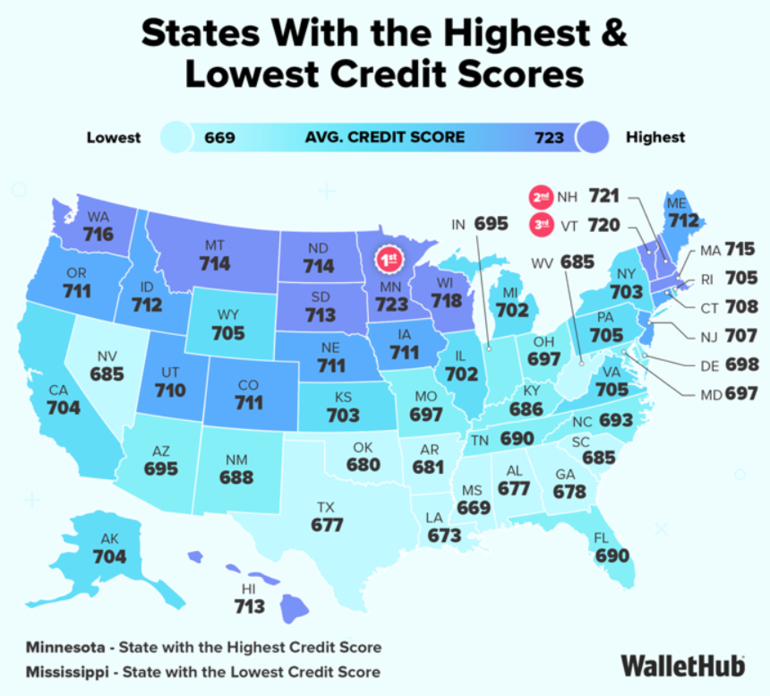
WASHINGTON — Despite rising household debt and elevated interest rates, the average U.S. credit score remains in the “good” range at 702, according to a new WalletHub analysis of TransUnion data, though wide state-level disparities point to uneven consumer credit risk heading into 2026.
The report finds a 54-point gap between the highest- and lowest-scoring states, a spread that could influence loan pricing, approval rates, and portfolio performance for banks and credit unions with multi-state footprints.
Minnesota (723), New Hampshire (721), Vermont (720), Wisconsin (718), and Washington (716) posted the strongest average credit scores, while Mississippi (669), Louisiana (673), Alabama (677), Texas (677), and Georgia (678) ranked at the bottom.
WalletHub attributes stronger credit performance in top-ranked states to higher incomes, lower unemployment, slower growth in credit-card balances, and lower delinquency rates—factors that tend to support more stable repayment behavior.
By contrast, lower-scoring states show signs of higher financial stress and faster debt growth, which could translate into greater delinquency risk if economic conditions weaken. For financial institutions, the findings underscore the importance of geography-based underwriting, targeted financial-wellness programs, and proactive credit-risk monitoring as consumers navigate inflation and tighter borrowing conditions.