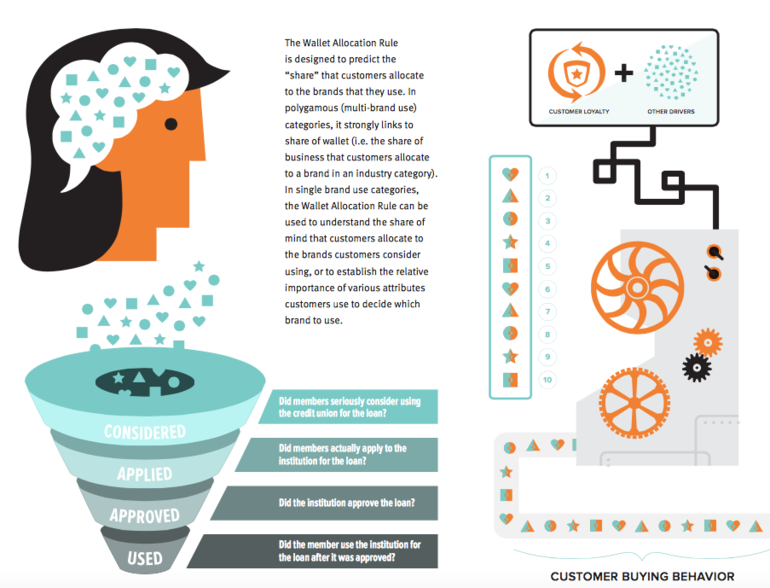
MADISON, Wis.–A new analysis is going to “WAR” to better understand the specific drivers behind members’ loan decisions, both at their credit union and from competitors.
WAR in this case is the Wallet Allocation Rule, and it is at the heart of newly released research from the Filene Research Institute that included interviews with 5,619 current CU members who had a loan with their studied credit union, a competing credit union, or a bank. Respondents must have applied for a loan within the past three years.
Those members were surveyed regarding the process by which they selected an institution for a particular loan category (only one loan was discussed per respondent), and the study separately examined first mortgages, refinanced first mortgages, second mortgages, HELOCs, new auto loans, used auto loans, and personal loans.
Filene said that respondents were asked to select all the attributes that played a role in their decision-making process from a list of approximately 40 choices, and once the larger list was narrowed to only the relevant factors, respondents were the asked to rank those factors in order of importance.
From those findings, the research explores: (1) how members form a consideration set, (2) how much time they typically spend shopping for a loan, (3) their preferred source of loan information, and (4) the most important drivers of loan selection.
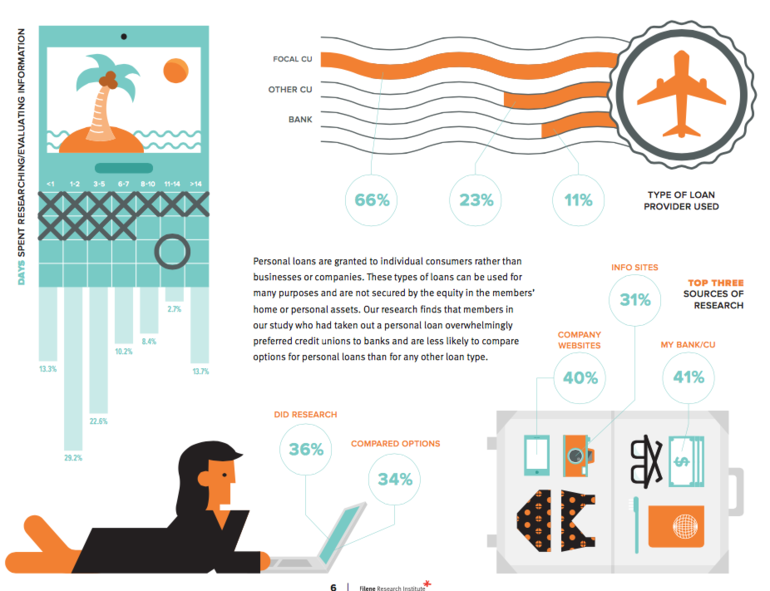
The new report seeks to identify what credit unions can do to build share within the loan categories explored. In the case of personal loans, for instance, the research found:
- Credit unions are particularly strong in attracting members for personal loans.
- The strongest competitors are other credit unions, not banks.
- The top reason that members select either a credit union or bank for personal loans is having an existing financial relationship.
Looking at the other products examined in the research:
- First Mortgages. While credit unions benefit from generally strong relationships with their members, banks are perceived as offering "better fitting" loan types. According to Filene, "A Wallet Allocation Rule Approach to first mortgages" reveals that among members who chose the studied credit union for their mortgage, the most important factor in their choice was their perceived relationship with the institution. For respondents that chose a bank for their first mortgage, price (i.e. interest rate) proved to be the most significant driver. Credit unions are losing based on members' perception that they are able to offer the best loan type to meet members' perceived needs.
- Refinanced First Mortgages. The Wallet Allocation Rule Approach to refinanced first mortgages" suggests relationships are not an important driver of bank loans in this category. Credit unions must address the more price-oriented drivers head-on, Filene said.
- Second Mortgages. Similar to the findings with first mortgages, the "Wallet Allocation Rule Approach to second mortgages" found members say their perceived relationship with the credit union as the most important second mortgage decision driver. The second most important driver in members' decision to use the studied credit union was the rate on the loan. This was the most important reason that banks were selected.
- Home Equity Lines of Credit. “A Wallet Allocation Rule Approach to HELOCs” suggests a vast majority of members who seriously considered the credit union in general preferred the institution to its competitors, according to the Filene report. Specifically, 74% of members who considered the credit union either only considered using it or in general preferred it to competitors. Moreover, credit unions do a good job of translating higher satisfaction into a majority share of members' HELOCs, Filene said.
- New Auto Loans. "A Wallet Allocation Rule Approach to new auto loans" found that “banks demonstrate much stronger connections to car dealerships.” While credit unions are able to compete effectively against banks on price, they are losing out on auto-dealer influenced loans, according to Filene. In the study, 18% of new auto loans went to competing credit unions while banks received 29% of members' new loans.
- Used Auto Loans. Credit unions have a significant opportunity for growth in used car financing, Filene said. "A Wallet Allocation Rule Approach to used auto loans" reveals that “used auto dealers have issues recommending credit unions to consumers. If the problem lies in a lack of awareness or consideration by dealerships, credit unions could create awareness by actively enhancing their communications strategy. “
- Personal Auto Loans. According to Filene, personal loans are the only loan category where the primary competitors are not banks but other credit unions. Members are much less likely to compare options for personal loans than for any other loan type. Members appear to choose credit unions and banks for their personal loans for the same reason: having an existing financial relationship with the provider.
The full Filene report, plus a complete slide deck illustrating the findings, can be found at www.filene.org.