Michael Moebs, Moebs $ervices
LAKE FOREST, Ill.—The CFPB’s warning to banks and credit unions about their checking account “obligations” is actually good news, according to one economist, who says the move indicates the Bureau is letting FIs police their own checking offerings and is also turning away from a sharp focus on overdrafts.
“The key message is the CFPB is not issuing regulation on checking accounts or overdrafts,” said Michael Moebs, economist and CEO at Moebs Services. “The agency is encouraging banks and credit unions to police themselves regarding checking account information, screening, low-risk options, and educating the consumer.”
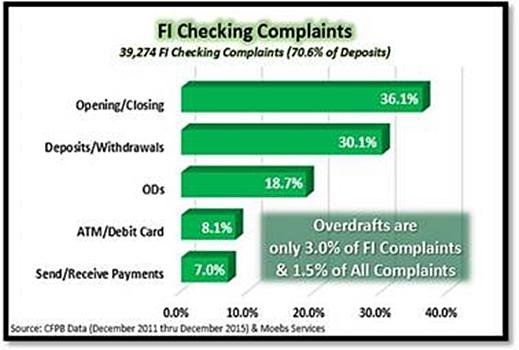
Moebs explained that the “basic fundamental directive” the CFPB is operating on is its own complaint data, which includes complaints from December of 2011 through December of 2015. Checking complaints total 39,274, or 7.9% of the 501,230 total complaints.
“Checking is way down the list of complaints following loans, CRA, and credit cards,” said Moebs.
What the checking account data shows, however, is that opening, closing, deposits, and withdrawals represent 66.2% of all complaints. Overdraft complaints make up 18.7% of all checking complaints, and only 3.0% of all financial service complaints. When comparing ODs to the total complaints, it is only 1.5% of the 501,230.
“The CFPB’s action is to correct overall maintenance of the checking account, where the most complaints are made,” said Moebs. “This is a very good move on their part.”
Moebs summarized the key points of the CFPB’s communication Wednesday morning and addressed the potential impacts:
- There is no regulation being issued by the CFPB, said Moebs. “Effectively they are challenging banks and credit unions to police themselves, and giving them advice on how to do so.”
- The CFPB is concerned that 10 million citizens are unbanked because of a lack of a low-risk checking option.
- The CFPB found that of the top 25 retail banks, only 10 offered and advertised for low-risk checking, an account with no overdraft service.
- The easiest way for FIs to do low-risk checking is to offer a reloadable prepaid card without the ability to overdraw, said Moebs about the CFPB’s direction Wednesday. “This is a very viable option because it is low cost and provides interchange revenue.”
- The CFPB wants FIs to advertise low-risk options to consumers, Moebs pointed out.
- Regulation V concerning Fair Credit Reporting is used by the CFPB to point out a large lack of proper reporting on checking information, and its proper use in screening, explained Moebs.
- “Finally, the CFPB issued a Consumer Advisory to help citizens obtain checking history, how to dispute an item with an FI or CRA, and how to shop for the best low-risk checking deal,” said Moebs. “FIs may want to make this advice available to new checking consumers, especially the unbanked.”