

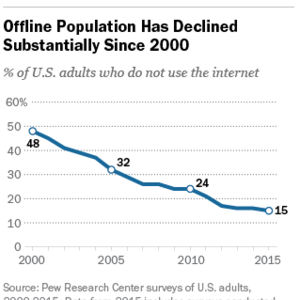
WASHINGTON–As credit unions race to provide mobile access to members, new research finds a solid 15% of Americans still do not use the Internet.
That figure has remained relatively constant for the past three years, according to the Pew Research Center, which released the data.
That 15% figure, however, is substantially lower than in 2000, when Pew Research first began to study the social impact of technology. That year, nearly half (48%) of American adults did not use the Internet, Pew reported.
Pew cited research from 2013 that found the reasons some people do not access the Internet include:
- A third of non-Internet users (34%) did not go online because they had no interest in doing so or did not think the Internet was relevant to their lives.
- Another 32% of non-Internet users said the Internet was too difficult to use, including 8% of this group who said they were “too old to learn.”
- Cost was also a barrier for some adults who were offline – 19% cited the expense of Internet service or owning a computer.
Pew said its latest research also shows that Internet non-adoption is correlated to a number of demographic variables, including age, educational attainment, household income, race and ethnicity, and community type.
Seniors are the group most likely to say they never go online. Household income and education are also indicators of a person’s likelihood to be offline. A third of adults with less than a high school education do not use the Internet, but that share falls as the level of educational attainment increases. Adults from households earning less than $30,000 a year are roughly eight times more likely than the most affluent adults to not use the Internet.
Rural Americans are about twice as likely as those who live in urban or suburban settings to never use the Internet. Racial and ethnic differences are also evident. One-in-five blacks and 18% of Hispanics do not use the Internet, compared with 14% of whites and only 5% of English-speaking Asian-Americans – the racial or ethnic group least likely to be offline.
Nevertheless, reported Pew, the vast majority of Americans are online. Over time, the offline population has been shrinking, and for some groups that change has been especially dramatic. For example, 86% of adults 65 and older did not go online in 2000; today that figure has been cut in half. And among those without a high school diploma, the share not using the Internet dropped from 81% to 33% in the same time period, Pew said.