

LAKE FOREST, Ill.—ATM transaction growth was flat in 2013. With the expansion of mobile services and the high cost to maintain an ATM, will cash machines be around in 2020?
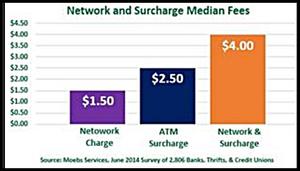
Moebs $ervices posed that question following its recent ATM Study, covering 2,806 banks, thrifts and credit unions. The data shows that the big banks charge the highest combined surcharge and ATM fees when customers don’t have the necessary relationships, and the smallest institutions charge the least.
Michael Moebs, economist and CEO at Moebs $ervices, pointed out the lack of growth in ATM usage—transactions in 2012 and 2013 reached five billion each year, according to Federal Reserve Payment Studies.
“Convenience is a huge factor in ATM use: convenience of time, convenience of location, and convenience of security,” said Moebs.
Combine those conveniences with the “personal touch” of interactive ATMs, and from a consumer’s perspective, ATMs should be around for a long time, said Moebs. “Absolutely have to have cash at 1a.m.? The ATM is your friend.”
But Moebs stated that FIs won’t ignore the high costs to maintain an ATM, especially if ATM usage wanes, saying mobile payment systems are the “wild card. As mobile devices provide more payment options, the need for cash may fall below the ATM cost.”

Michael Moebs, Moebs $ervices
Moebs noted that big ATM providers—such as Chase, Wells Fargo and Bank of America—don’t charge customers to use their own ATMs and may not charge a network fee and even reimburse ATM surcharges for using someone else’s ATM, if the customer has a sufficient relationship.
“Otherwise, these big FIs charge customers 43% higher network fees than other financial institutions,” Moebs pointed out. “If you are not in a network and use an ATM machine which is not your FI’s, expect $4 a transaction, our ATM Study found.”
Looking at combined network and surcharge fees:
FIs above $50 billion in assets charge a median of $5, as do those institutions between $25 to $50 billion. For banks and CUs between $5 to $25 billion, the median is $4.50, $4 for those from $1 billion to $5 billion and $500 million to $1 billion. Among shops $100 million to $50 billion, the median in $3.50, the same price for FIs below $100 million.
“Have a checking relationship service with a mega FI and there will be no ATM charge,” said Moebs. “Step outside behemoths’ FI branches and networks, have no relationship, and face $4 for ATM use. Main Street institutions charge 30% less for ATMs than Wall Street FIs and are a definite option.”
Prices for out-of-network usage or surcharges, especially when both are combined, are high, noted Moebs. “This reflects the cost to maintain the ATM. Debit Cards are cheaper for the merchant who wants to get rid of costly cash with the expense of armed delivery or pick-up cash services.”
But as the need for cash exists, there will always be “daylight” for the ATM, concluded Moebs.
“Large FIs will always provide no-charge ATMs to those users who provide them two or more services,” he said. “Those who do not want or cannot afford the relationship service approach will use debit cards and mobile devices to avoid charges. However, as mobile devices become less expensive and cash costs rise, ATMs will eventually become like incandescent light bulbs.”
Related links
The Irony Of Walmart, CUs, And Checking Accounts
CUs Enjoy Highest OD Opt-In Rates
Will GoBank Steal 2 Million CU Accounts?