

BOSTON–Although the presentation took place live and in 2-D, credit unions here were given a look at how one company and one CU are using AI and virtual reality for immersive employee onboarding and training.
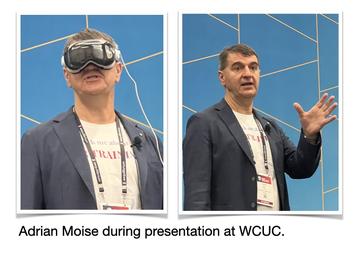
Adrian Moise, CEO of Aequilibrium, who began his presentation before the World Credit Union Conference wearing a pair of Apple Vision Pro, the spatial computing device headset often referred to as virtual reality goggles, said the technology that is still in its nascent stages among credit unions holds huge potential for not only improved training and member service, but for employee retention, too.
“It’s not just technology. Experience is the product,” he said. “So, we are looking into how to bring these experiences together and to digitalize the interactions.”
Cutting Costs, Time
Using virtual reality and artificial intelligence in combination, according to Moise, not only reduces costs but creates more engaged employees who stay longer with the organization because they are excited about the work.
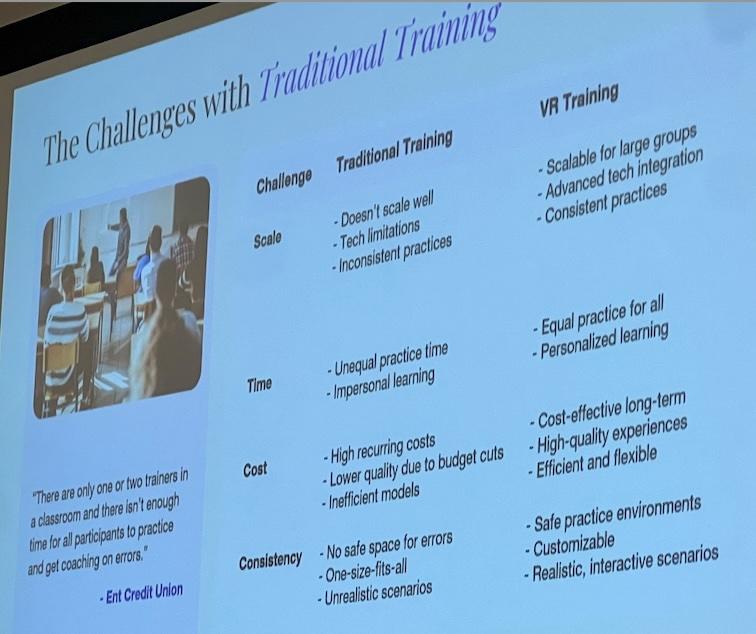
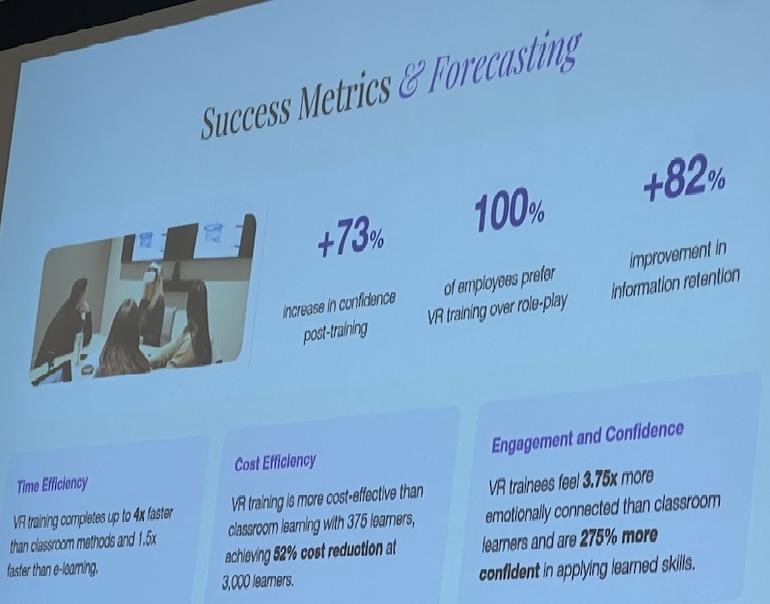
“We see a reduction from 40% to 70-% in both training time and costs. VR addresses scale, time, cost and consistency,” he said. “With training, I empowering you to be comfortable in using your knowledge.”
Unlike traditional training videos, the employee can’t be simultaneously on Tik Tok or Instagram, as the VR training is fully immersive, which also makes it “more memorable,” he said. “You build the muscle memory and then prove your critical thinking.”
He said the technology can be used with:
- Learning and development teams
- Member services team
- Credit union members
Lesson from Walmart
According to Moise, Walmart has 13,000 headsets that it uses to train hundreds of thousands of employees every year. It used headsets to train 400,000 employees ahead of Black Friday, for example, he said.
By using AI a credit union can quickly create virtual content, he said, including creating scrips, experiences and more all through some relatively simple prompts.
The AI and VR also provide real-time feedback on training, according to Moise.
In the graphic below, Moise compared the traditional training model with that of VR/AI training.
A Credit Union Example
One credit union with which Aequilibrium has worked in using virtual reality and AI for training is Ent Credit Union in Colorado.
It has used the VR to train MSRs soft skills, such as recommending the next best product, and to develop sales conversations that encourage members to apply for a credit card, for instance.
It has also used the VR for call center staff, which Moise acknowledged is among the most stressful of careers within credit unions.
“Many don’t feel well prepared to go into this fast-paced environment,” Moise said. “Attrition can be 50% or more. It’s a lot of hiring and pressure on existing resources. With VR training not only are the costs and time reduced, we are seeing employees feeling more engaged. They see the organization is investing in them and that they are not being replaced by AI.”
Real Problems
At Ent, Moise said Aequilibrium has worked to develop resolutions for real problems. It developed a set of 10-20 training scenarios that included both soft skills and hard skills, and then narrowed that to the top three, beginning with leading a sales conversation.
Moise said the company scanned a branch of Ent to create a realistic 3-D digital branch for the VR training. It also uses diverse characters in which the avatar matches the profile of who might be coming into the credit union, and switches between environments, such as the branch or call center in order to make the exercise as realistic as possible switching.
An Ice-Breaker
“Many of the trainees have never used VR before, so there is an icebreaking experience,” he said. “It simulates real-life scenarios and creates a realistic environment. You can have not just one-on-one interactions, but other people can be in the background. (Employees) can learn how to operate in an environment with other people involved.
“The training can continue to evolve from a very friendly member who is used to get the employee comfortable, and then it escalates to more challenging members,” Moise said. “Employees learn how to defuse situations.”
He said using real voices creates realistic situations that are a great improvement over the drop down menus used in standard online training.
There are other benefits, according to Moise. The new employee does not have to come into the office to go through training, the training is interactive, and the trainee can go through training without feeling they are being judged or compared to others.
How to Get Started
For credit unions looing to get started in AI/VR training, Moise offered these tips:
- Educate and immerse
- Align business stakeholders during design
- Hypothesize, build, test, learn. Create a prototype. “Success sells and then build momentum.”
- Create scenarios that lend themselves the best to VR.
- Create scenarios tailored to your organization and then keep those fresh.