

BOSTON–Three credit union representatives from three different continents demonstrated how through the “ripple effect” small credit unions can have a big effect on their members and communities.
The observations came as part of a session during the World Credit Union Conference, with each of the three sharing unique stories around what they are doing to not just make that difference, but to also grow—and in two cases, grow rapidly.
Here’s a look at what was discussed.
‘Are We Cool Enough?’
Paul Norgrove, CEO
Serve and Protect Credit Union, United Kingdom
Norgrove said his credit union has really focused on relevance and having a deeper member impact.
“To me, relevance is about the future. Are we cool enough? Will people still bank with us,” he said.
It’s a crucial question everywhere but especially in the U.K, where credit unions have low awareness and usage, Norgrove noted, holding just 2% market share.
Overall, there are 238 CUs in the U.K, with £1.7 billion in loans, £2.3 billion in total savings, and approximately 1.44 million members.
Serve & Protect CU has £83 million in savings, £77 million in loans and 46,000 members. Norgrove offered as an aside that it was a bit humbling to be called “small” since the credit union is considered large in Great Britain.
Off the Bus
Serve & Protect CU has grown rapidly since getting the “wrong people off the bus” and some years ago bringing in a management team that was young—mostly people in their 20s—including Norgrove.
He credited Mike Mercer, former CEO of Georgia Credit Union Affiliates, for helping to develop the CU’s motto about being “passionate about improving financial resilience.”
“We started with the question, ‘What is financial well-being and how does it compare to financial resilience?’” Norgrove explained. “What were interested in terms of relevance with the future was financial resilience and having a longer-term relationship with members and their money.”
The credit union took several aggressive steps, including closing its branches.
“Members weren’t going, they’re expensive and we wanted to meet members where they are,” Norgrove said.
New Program
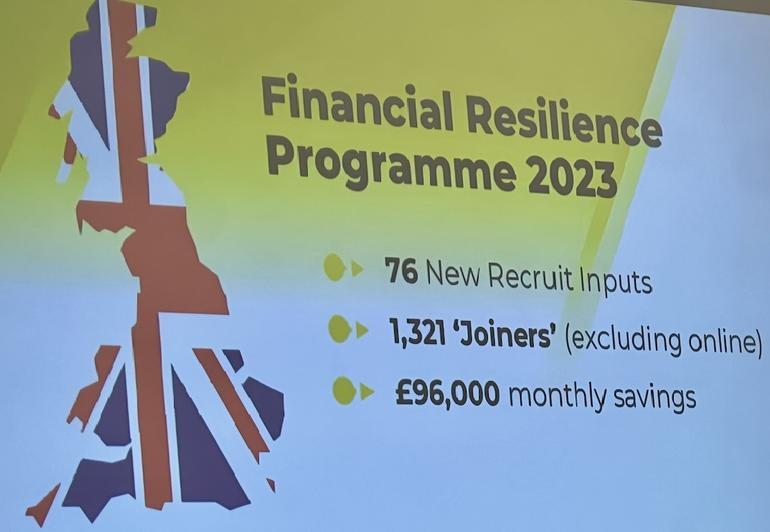
Meeting members where they are meant creating a Financial Resilience Programme that it especially uses with its new members, including recruits in the military and police.
“We don’t talk about savings and loans; they would tell us to go away,” Norgrove said. “Many recruits don’t know much about money. They see the credit union as a safe place to be educated on finance.”
The credit union also offers a series of free financial webinars that include as topics:
- Managing the cost of living
- Budgeting and spending
- Boost your credit score
- What are lenders looking for?
The Credit Union’s Model
How does Serve & Protect CU’s model work?
“We work on salary deduction. We get paid before they get paid (direct deposit in the U.S.),” Norgrove explained. “It means we don’t have to be reliant on credit scores so much. We use open banking. We encourage our members to pay themselves first, to save first, to build resilience for the future.
“Ninety one percent of the people who complete the program say their financial resilience has improved after saving with deductions from their salary,” Norgrove added.
It appears to be working. Norgrove reported that over the last three years assets are up 58%, loans are up 80%, membership is up 52%, and it’s seen a 214% surplus.
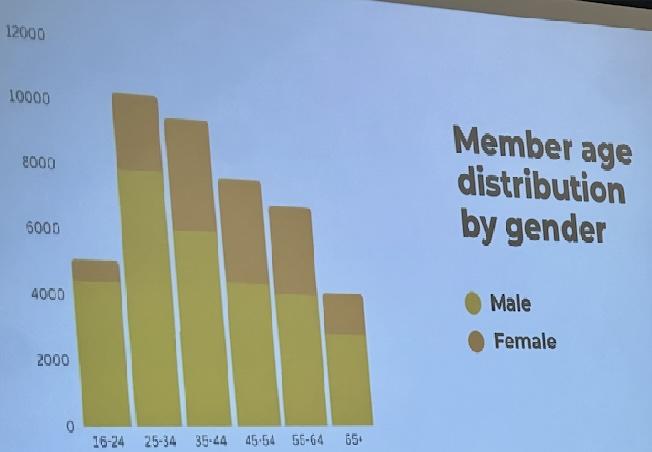
The new program has also brought down the average age of members, as the graphic below demonstrates.
Fine Dining, Not Fast Food
Karen Madry, CEO
Afena FCU, Marion, Ind.
Karen Madry
The $99-million Afena FCU serves a five-county FOM that includes rural, low-income communities and is “riddled with people who struggle day to day,” said Madry. AFCU is a CDFI.
“I advocate through story telling,” said Madry. “The way I do that or became proficient at that is I had to find my members’ stories. And the way to get my members to share their stories was to share my own. I am very open about where I came from and the road I travelled. I grew up in poverty, was raised by a single parent, I faced bankruptcy, I was the victim of an abusive relationship, I faced divorce.
“So, I opened up and shared these things with the members of my community. which allowed them to trust me,” she continued. “I told them I understood where they had been and I wanted to build a financial institution that did not judge people for where they had been but was focused on where they wanted to go.”
As a reminder, Madry said there is a sign in Afena’s offices that reads, “We don’t just make loans, we help people achieve their dreams.”
A 700% APR
But that doesn’t mean it does so the way others credit unions do.
“I know fintechs are the way people are moving and we’re thinking how can we do things faster and more efficiently. But at our shop we want to makes sure every member, regardless of their socio-economic background, has a fine dining experience, not fast food,” Madry told the meeting “When members come in, regardless of how much they make—and we have some members who live on $700 a month—they are all treated like royalty. We take time to understand each member. We don’t make decisions on where you have been, but on where are you today. Where do you want to go? It’s our job to help you to get there.”
Madry said the credit union frequently helps members get out of payday loan debt, including refinancing one member recently who had a loan with a 700% APR.
“We take the time to educate them on how predatory lenders are impacting their lives and that they have a choice. Low-income families don’t believe they have a choice. They have heard ‘No’ so often they don’t trust financial institutions.”
‘Exponential Growth’
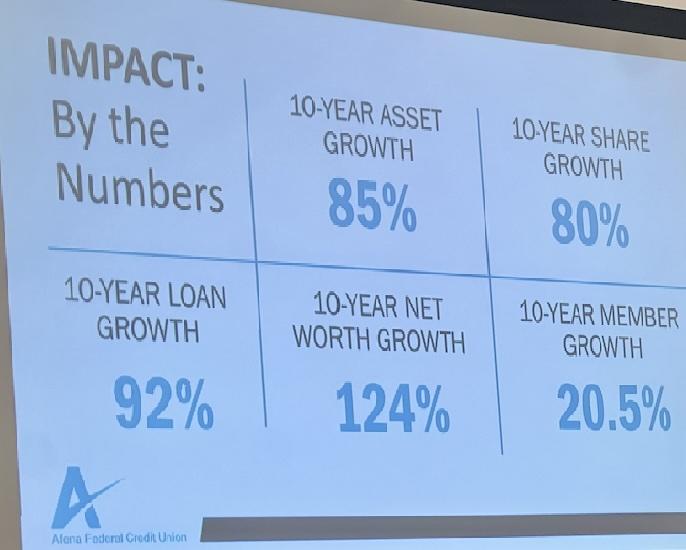
Madry said the trust in Afena Credit Union has led to “exponential growth,” and she shared the chart below to illustrate what has happened at Afena CU in the decade she has been CEO.
Madry, who recently testified before Congress about the harm an NSF/OD fee cap would cause credit unions such as hers due to the loss of income, urged other small CUs to stay active in advocacy.
But most of all, she wants small CUs to not think small.
“I’m proud as a small credit union in asset size, because I know we are mighty,” she said. “Being a small credit union doesn’t mean we operate in a small circle. We have a voice and we can make a big impact. We just have to be willing to stretch our hands and do more with what we have.”
Changing Lives, One Life at a Time
Grace Akinyi, Head of Programs
ACCOSCA, Africa
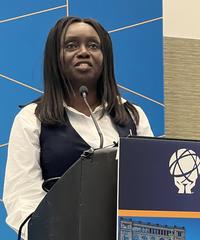
Grace Akinyi
The African trade association, ACCOSCA, uses the tagline, “Changing Lives, One Life at a Time,” and it’s something Akinyi said she has seen and can attest to.
There is huge opportunity in Africa for changing lives, noted Akinyi. The median age in Africa is 19, and there are 54 countries on the continent where CUs can take root, as many have.
A Million (Solvable) Problems
“We have a million problems. But they are problems that are solvable,” said Akinyi. “Credit unions make sense because humans are the heart of everything we do, and today financial access is almost a necessity.”
In Africa, Akinyi said collaboration has been especially powerful in empowering people, including beyond just finance.
“We provide education. People are crying out and asking how can they live decent lives,” she said.