

BOSTON–Credit unions here were offered some insights into one of the most pressing issues of the day—attracting and retaining talent “in a new era.”
Caroline Vahrenkamp, director of advisory services with Filene, first shared with the World Credit Union Conference here some thoughts around the Great Resignation and the related Great Recalibration, and then share some lessons on talent in a new work landscape.

Caroline Vahrenkamp
“The current labor market and shifting employee expectations present both risks and opportunities,” Vahrenkamp said. “The pandemic and recession reset the labor market. There is evolving employee engagement and shifting employee expectations, particularly around remote work.”
‘The World is Burning Down’
Vahrenkamp wryly observed that many CU leaders who had been around for 30 or 40 years have just said “this world is burning down and it’s time to retire. So, we’re seeing this great turnover.”
For those leaders who moved up or who remain, Vahrenkamp said the bigger question today is around shifting employee expectations, especially around remote work.
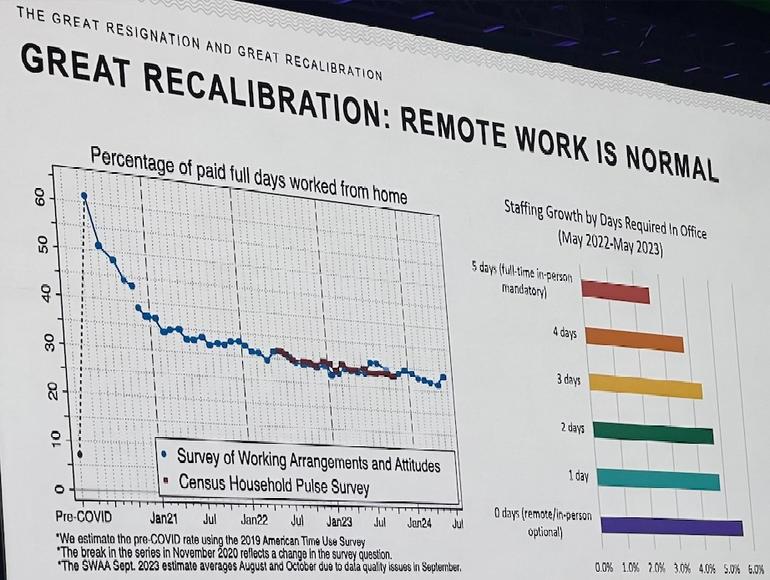
“We call this the Great Recalibration. A lot of executives expect the world to be the same, and a lot of employees expect it to be different,” Vahrenkamp said, adding that research shows 26% of employees plan to switch jobs in the new year.
“Labor leverage increased hugely after pandemic, and while it has declined it is still way above where it was before. It means labor has more control and power in the market,” Vahrenkamp continued. “The big change that occurred and which has remained is entrepreneurship. The number of small businesses formed in the U.S. has reversed trend with many new businesses formed. It means we are no longer in competition for our workers with other credit unions or banks, it means we are in competition with our workers going to work for themselves.”
Vahrenkamp said the remote work has become the “new normal.”
What Do Workers Want?
So what is it workers want?
“Increasingly,” said Vahrenkamp, “they are looking for more from their employers. Overall, there is a perception you don’t have the loyalty to a company anymore, because the companies don’t have loyalty to you.”
What employees want more control over, said Vahrenkamp, is:
- When they work
- What they work on
- Who they work for
Vahrenkamp said credit unions need to rethink how they attract employees, as outlined in the slide below.
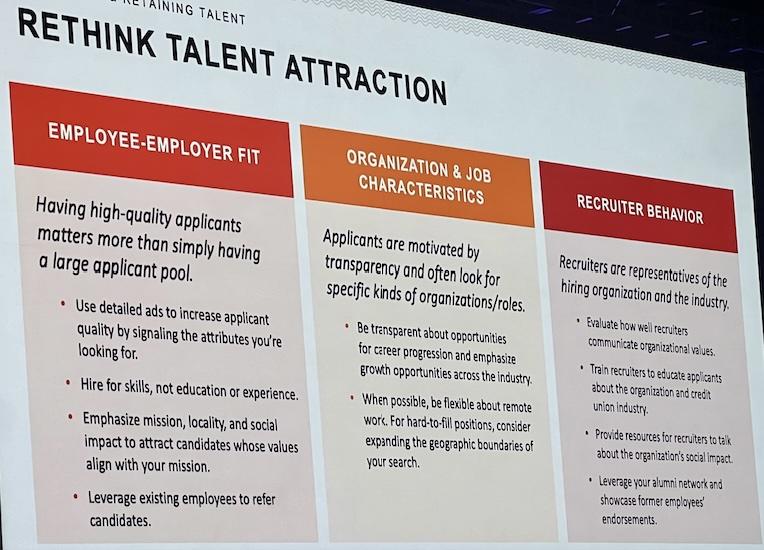
Vahrenkamp urged credit unions to emphasize social impact, especially with prospective employees.
“It can make a huge difference with the prospective employee that connects with you there. It’s not about donations. It’s about how many members have you helped.”
Working With Third Parties
Vahrenkamp urged credit unions that work with recruiters to ensure those companies correctly represent the credit union.
“They are your public face in the market. How well do they explain your values?” Vahrenkamp asked. “Do they understand the impact you bring? Do they understand what the value of a credit union means? That will give you a much better fit in attracting the right kind of employees.”
Retaining Workers
It’s one thing to attract the employees, but how do you keep them?
Filene recommends:
- Revisit benefits offerings. “Don’t just think about the basics, think about family leave, parental leave, mental health benefits, days off, bonuses. These are things that will resonate with them.”
- Address workplace inequities. “By this I mean if some employees get access to certain things but others don’t, address those,” Vahrenkamp said. “An example is that some people have to come to work every day and wear the uniform. Others can stay home in sweatpants. Can you find a way to balance that?”
- Tackle employee burnout. “This has only continued to accelerate. Find areas of friction that just suck out all of your employees’ energy. Such as the meetings that could be an email. The commutes. Lunch opportunities. Find ways to help them find meaning in their work. Create that safe environment where they feel trusted.”
- Realign corporate social responsibility efforts. “Think about how you engage in the community. Look at what’s relevant to your employee base and even your membership.”
Employee Engagement
According to Vahrenkamp, employee engagement really boils down to three things
- Transparency. “Employees understand the context and purpose behind organizational strategy, decision-making and financial performance
- Trust. “Employees and managers trust one another and everyone keeps the organization’s interests top of mind.”
- Fair treatment. “Employees share in the responsibility for success and everyone shares in the reward.”
How Credit Unions are Responding
According to Vahrenkamp, credit unions have been responding:
- With programs to help employee financial well-being, such as financial wellness courses. More than 50% of workers experience financial stress, she said.
- With programs to improve physical well-being. “Look for thoughtful upgrades to the physical workspace that can enhance employee well being.”
- By repurposing the corporate office to support organization goals. “Create flexible spaces that suit a variety of purposes. Provide space to allow for social collaboration and for individual cognitive work. Find ways to give offer employees more control over their workspaces.”
- By leveraging the mission. “Identify, clarify and advertise the purpose, values and vision of the credit union. What makes a credit union a special place to work? Don’t be shy about owning the mission. This allows employees to select-in and can serve as a tiebreaker for recruitment. Orient managers to motivating employees, rather than simply supervision or discipline.”