

BOSTON–Two veterans in the lending space shared their insights into how AI is being developed and used, what “alternative data” really means, and more during a discussion here.
Participating in the panel discussion during the World Credit Union Conference here were Chris Hamilton, EVP-chief lending officer with the Golden 1 Credit Union, and Tom Tobin, founder and CEO with Modelshop.
Here is a look at what was discussed?
Q: What is your big takeaway with AI?
Hamilton: To me the big takeaway is if you haven’t started the journey, it’s not a big bang, you can step into it as long as you lay out the right roadmap.
Q: What is your definition of AI?
Hamilton: AI has been around for a while. Think of AI is nothing more than what the average person would do when faced with the same facts. How would they make a credit decision? AI has been in financial services for years. Your FICO score is a rudimentary AI tool. The question is how to we continue to evolve, and that includes all the data you can bring in and the tools used to aggregate that data and to make decisions.
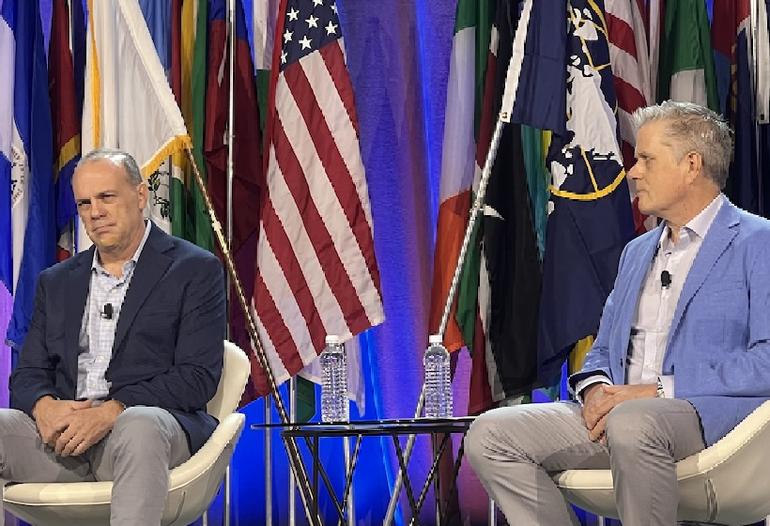
From left, Chris Hamilton and Tom Tobin.
Tobin: My definition of AI is pretty broad. I see a huge spectrum from automatic doors, which is very simplistic, all the way through to the singularity stuff and general intelligence. In the middle is where we really play today. We have evolved from expert systems to machine learning tools today that have gotten much easier and allow for tailoring to models. Going forward, large language models and gen AI are putting a human touch on it. It feels more human. You can interact, you can talk to these systems. That’s where we’re going pretty rapidly.
Tobin: My passion is around automation. I think the math and the analytics to segment and classify is great, but bringing it all together to serve the member and create a frictionless experience is the hard part. But we are making great strides toward that.
Hamilton: At end of day, credit unions are about members. I view AI as a way to deliver a better experience to that member. It’s not just about risk but about enabling the right conversation with that member.
Q: How do you define alternative data?
Hamilton: I really don’t think there is alternative data. If you think about decision making, you want as much data as possible to make that decision. It’s additional data. At credit unions we have tons of information on the consumer. Think about the checking account. It’s incredibly rich both from an aggregate perspective as well as the individual transactions themselves. It’s incredibly powerful not just from a risk perspective but for identifying products to use.
Tobin: I don’t call it alternative data, I call it ‘not credit data’ to look at the full data picture. The other term I don’t like is cash flow underwriting. It’s not just about cash flows. I think of it as financially modeling your member’s experience. With this detail you are able to make smarter decisions to advise them on their financial journey. A score in buckets can’t capture nuance. Detailed banking data allows you to see who they are paying, the credit detail.
Q: There is a lot of new technology. What are some of the shortcomings of legacy data?
Tobin: A lot of the systems we are using for decisioning are way too rigid. They make decisions for how you structure your pricing, for example. Putting people in buckets is a pretty blunt instrument. More innovative credit unions want you to do trial pricing, pricing elasticity analysis and more. Legacy systems kill agility.
Hamilton: When I think about what we’re trying to accomplish, it’s a couple of things. One is that personalization and really understanding who the member is, how to evaluate the risk, evaluate the product fit, and evaluate the terms of the loan the member is trying to acquire. It’s also about how do I interact with that member in the right way.
The other piece is you have to have the ability to test. You might have a hypothesis, but how do you evaluate that on a go-forward basis? Being able to enable personalization and having the ability to quickly adapt to the market place, implement new strategies and do the testing are the three pillars we are looking to leverage as you go down that path.
Q: What’s the difference between using a score and AI decisioning?
Tobin: A score is a classification model. You are putting people into tiers or buckets. Interactive decision engines now have ability to respond to new stimuli, new events, new information, and then they can drill into the detailed data. That is very different from a score. A score is propensity score for likely repayment.