

ST. PETERSBURG, Fla.—It’s been 35 years since the “Miracle on Ice,” when a group of young, amateur U.S. hockey players who weren’t even expected to medal stunned the world by defeating the all-powerful team from the Soviet Union in the 1980 Olympics.
The lessons from that victory applied 35 years ago, apply right now, and will be applicable a thousand years from now, according to the man who captained that team.

Mike Eruzione speaking to CSCU meeting.
Mike Eruzione said what he and his teammates took away from that experience can be applied at any company, including credit unions.
“For 35 years I’ve had the opportunity every once in a while to tell a story,” Eruzione told CSCU’s Solutions Conference. “It’s an accomplishment nobody in the world thought we could accomplish. And I mean nobody.”
The lessons from that extraordinary time, immortalized in the movie “Miracle” and Al Michaels’ “Do you believe in Miracles? Yes!” call, aren’t limited to hockey; they’re applicable to credit unions, Eruzione said.
“The goal of companies and teams and individuals is to be the best and to be successful,” said Eruzione. “It wasn’t a fluke; we weren’t lucky. It was a process, and it doesn’t happen overnight.”
For those who aren’t familiar with the story, or those who can’t get enough of it, the now 52-year-old Eruzione took everyone back to 1980 when traditionally the U.S. Olympic hockey team was pulled from the college ranks, practiced for two weeks and headed off to the Olympics. Teams such as the Soviet Union’s were professional, considerably older, and had been playing together for many years.
Doing Things Differently
Coach Herb Brooks changed all that, telling the team “we are going to do things differently.” It held tryouts around the country, put together a group of 68 potential players, and then narrowed that down to 26 over two weeks. It followed up with six months of practice—and more cuts.
Eruzione said he still vividly recalls Brooks’ remarks to the final 26. :
“I will be your coach but I will not be your friend,” Eruzione recalled. “The second thing he said to me stayed with me to this day: ‘If you don’t want to be here, then leave.’ And it’s the same with companies. You’re not just hurting your company, you’re hurting yourself and your coworkers. Understand your role. Understand this was a team. You want to put yourself in a position where you surround yourself with people whose goals and objectives are going to be the same as yours. We knew we needed an incredible work ethic.”
In the months leading up to the 1980 Olympics in Lake Placid, N.Y. the team went to Europe to paly all the great European teams and to adapt to the larger sheet of ice on which European and Olympic hockey is played. Near the end of the tour, after a 4-4 tie in Norway against the Norwegian team, Eruzione said the team was leaving the ice after the game when Brooks brought them back out to run punishing drills the team called “Herbies.”
“After we got back to the locker room he looked at us and said, ‘If you play this way again, you will lose’.” The team played at 10 a.m. the next morning, and won 8-0.
R-E-S-P-E-C-T: What it Means to Erizione
“There are a lot of values, one of the most important things is respect. We had lost sight of that value,” said Eruzione. “Herb said, ‘If you don’t respect yourself and your competition, you will not be successful.’ It was a great lesson for us.”
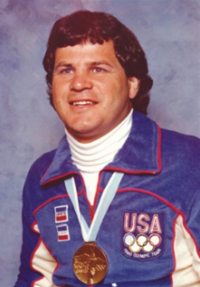
Mike Eruzione in 1980.
The team returned to the U.S. where it continued to play games against all kinds of competition. “I’ve never met a company or a team that was successful because of luck. It’s hard work. And intangibles,” said Eruzione.
Despite all that hard work, when the team played the Soviet Union at Madison Square Garden in the weeks prior to the Olympics it was crushed 10-3.
“When times are difficult and there’s adversity, how do you handle it?” asked Eruzione. “When the game was over, we went to the locker room and were prepared to be screamed and yelled at. When Coach Brookes came in, he said, ‘If we ever play again, remember how you played in the second and third period.’ He turned a negative into a positive. We couldn’t wait to get to Lake Placid. The same thing is true business. Don’t dwell on the negative, fnd the positive.”
After several unexpected victories in the Olympic games, Eruzione said the U.S. was scheduled to play the Soviets, who had just beat Japan 18-0.
“This was the biggest game any of us had ever played. The locker room before the game deathly quiet. And I’m sitting there thinking we are so ready to play, and I’m the captain. I’m waiting for Herb to come and give the great speech. And all he said was, ‘Gentleman, you were born to be a player, this moment is yours.’ We beat the Soviets 4-3.” Eruzione scored the winning goal.
What Many Don't Remember
What many don’t recall is that the game against the Soviet Union was not the gold medal game; the U.S. still had to play one more against Finland. Trailing 2-1 headed into the third and final period, Eruzione said, “The true test of character and leadership is how you respond when you are behind the eight ball. Before we went out Coach Brooks looked at us and said, ‘If you lose this game you will take it to your grave. Your grave!’ And you can put a couple of words in front of grave. We went out and played the best 20 minutes of hockey in our lives.”
Eruzione returned to a theme he said he thinks of often. “Herb never lost sight of that value of respect. Respect your success. Respect your accomplishments. Don’t get too caught up in the moment; enjoy it, but don’t lose sight of respect.”
Eruzione quoted E.M. Swift, a writer for Sports Illustrated, who talked about the character and work ethic of that 1980 team. He believes that is what really separated that team. “That was true 35 years ago. It’s true in 2015, and it will be true a thousand years from now.”
The Moment He Remembers; No, Not That One
Eruzione said it isn’t that gold medal victory he remembers most from 1980, even though the victory was named by Sports Illustrated at the top sports highlight of the 20th century.
“To me it still comes down to one moment, and that was marching in the opening ceremonies. Because if you never get there, you never get the opportuntiy. And each of us in our lives have opportunities. What enabled all this to happen is the best part of the story.”