

Are Your Worried? Then Read This And ‘Unlearn’ It
NASHVILLE, Tenn.–Are you or your credit union worried? It’s a learned behavior that can be unlearned, according to one person.
In remarks to TMG’s Executive Summit here, Mitch Matthews, life coach and author, shared advice with CU executives on how they can control their levels of worry.
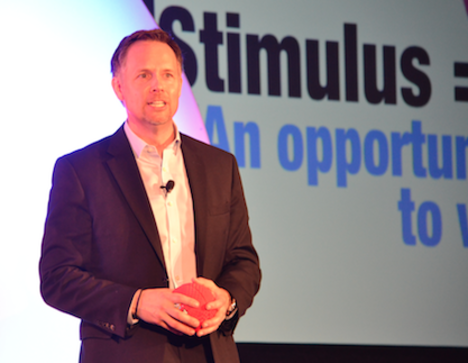
Mitch Mathews speaking to TMG meeting.
Matthews, who said financial executives are prone to worry as a result of human biological responses, and the result is it destroys the ability to think creatively.
Often, Matthews said, change -- such as that caused by disruptive innovation in financial services -- is met with worry, and the result is missed opportunities.
To illustrate his point, Matthews pointed to American high jumper and Olympian Richard Fosbury, the first to leap backward over the bar. His method, which was met with many a raised eyebrow, eventually became known as the Fosbury Flop and remains the preferred method by track and field athletes today. The catalyst for the Fosbury Flop, Matthews shared, was a change in the landing surface from sawdust to a mat. According to Matthews, most athletes hated the mat when they first encountered it. Fosbury, on the other hand, saw an opportunity, which allowed him to open his mind to the possibilities it could offer the sport.
'Where's The Mat?'
In that spirit, Matthews suggested, whenever financial institution leaders find themselves confronted with frightening or offensive changes, they should ask, “Where’s the mat?”
To show participants how to start unlearning worry, Matthews shared a couple exercises he believes can shut down the human body’s natural “fight or flight” reaction to the stimulus of worry. One of them is the “Buckets Exercise.” The practice allows individuals who are worried about anything from personal to professional troubles to place their worry into one of three mental buckets: one for things they can control; another for things they can influence; and a third for things they just have to let go of because they simply can’t control or influence them.
A second exercise Matthews took the participants of his session through involved three parts. He called members of the audience to confront worry first by identifying it; next by replacing it; and lastly by doing something intentional, such as taking a walk, or even more simply, smiling for 50 seconds.
A 'Recovering Worrier'
Matthews, a self-described “recovering worrier,” said his decision to stop worrying came after a mountain climb during which he was nearly struck by lightning. He had worried all the way up the mountain “about all the ways I could die,” and yet getting struck by lightning hadn’t even made his list.
“It was at that moment, huddled in a cavern on the top of a mountain, that I realized I’ve been living my life from mountain top to mountain top, always waiting to relax or to enjoy the moment,” he told the TMG meeting. “I didn’t want to live that way any more.”
To help himself unlearn worry, he decided to teach it, which has led him to his current career as a life coach and author.