

ANAHEIM, Calif.–Best practices and lessons learned in business development were shared by veterans of the discipline during a “Fireside Chat” here.
The discussion took place during the CUNA Marketing & Business Development Council’s annual meeting here, with both panelists and audience members sharing what has worked and not worked for them in driving new membership.
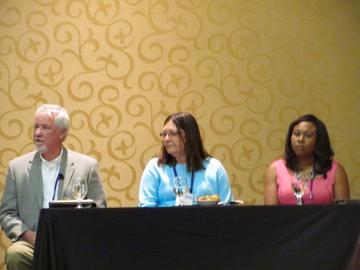
From left, at CUNA Marketing & BD Council meeting: Dan Stoltz, Sue Rising, and Jemise Harkley.
Participating in the panel were Jemise Harkley, philanthropy and community relations manager at the $1.4-billion America’s First FCU in Birmingham, Ala.; Sue Rising, AVP-Marketing at the $3-billion Member’s 1st FCU in Mechanicsburg, Penn., and Dan Stoltz, CEO of the $850-million SPIRE FCU in Falcon Heights, Minn. Here’s a look at the questions posed and the answered provided.
Q: How to get the CEO to buy into your robust business development plan?
Harkley: We have just changed business development to member development, because we just went into business lending. We have four people, and for many credit unions that is huge. It’s hard to quantify how you bring in business in member development. The wide variety of methods we use verifies that we still need people. We set up in break room at our benefits partners, which is what we call our SEGs. Our CEO sees that we’re out there and engaging with people, and bringing back information that is beneficial to them. It also shows we have a strong presence in the community, and our CEO believes we need to have the manpower.
Q: Tell us about the metrics you use to track the performance of your department?
Harkley: One of our corporate goals is enrollments. We have 1,700 benefits partners, and we had a charge to engage in 150-250 new companies to bring in. We measure lunch-and-learns, office visits, and we also do a coupon with the companies that participate with us. On one side there was a $50 gift card if they opened an account, and on the other side was $100 off a loan. We track those.
Q: How do you lobby to get business development dollars?
Rising: It’s all about building the right strategy and driving revenue. You have to start with the right people. We often think people inside our credit unions are the right people, but often they are not. We need people who are persistent, who are present in the community, who are willing to work the evenings and the weekends.
Stoltz: I think we’re hearing a lot more about data science, predictive analytics and big data, and we certainly use that at SPIRE. But for me, we really talk about the soft side of what marketing and branding are all about. Number one, there is pride within our own employee base when they see our brand out in the community. Sometimes we don’t weigh that enough. Our market is like others in that it’s hard to find key personnel. A top five brand helps us to do that, but it’s hard to measure. The last thing is giving back. That’s our culture, that’s what we’re about. We say, ‘We want to be go-getters and go-givers.’ Sometimes it’s so easy to get into the metrics, but it really is that soft side to me when you’re talking to the CEO and the C Suite.
Q: Big thing for me every quarter is to show how effective I am with the number of memberships we have; how do you track the success of your BD professionals?
Rising: We are very data driven. From our BD side of the house we look at business loans, business deposits, the number of SEGs they are brining in. It’s all about the relationship that’s the key. We are a little unique in that we don’t have incentives. When you throw out incentives that’s what people will go after, but what you want is that entire relationship. We do do the traditional things in lunch rooms, $100 direct deposit if they bring that to us, etc., but we’re also very big into sponsorships and we are constantly looking at what’s going on in the community. Even on the charitable giving side of the house it’s all about that relationship. We’ve come a long way from the days where we would just give out money.
Q: What have you done that is unique?
Stoltz: We’re in year two of an aggressive business development plan. We’re growing at about 800 members a month. One thing our marketing department has done is to have introduced a food truck. This is about trying to create the brand everywhere you go.

SPIRE Credit Union's truck.
When we were in some financial struggles with capital, we realized we needed to get out and brand. We bought a 1952 truck that we painted it up and looked nice; we really bought it for parades. Then we decided to do some commercials in which I talk to members. It’s unscripted. But it’s about Midwestern values and really relates well to our state. (The truck has) become the new icon for us and is asked to be at places all the time.
I admit I wasn’t really in favor of the food truck at first. You have to get licensing with food, and you have to get people who are really passionate. We found a member who really wanted to get into the food truck business. We have this truck at our 16 branches serving food to both members and non-members. It’s really about getting the brand out and giving them a great deal on food. The object isn’t to make a lot on the food.
Harkley: We found a lot of companies do benefits fairs. If your companies do that, you need to get out there and engage with them. Job fairs have also been another method of getting a lot of companies in at the same time. The benefits are two-fold: you promote your own credit union employment, and reach other companies.
We also do something similar to the food truck with a mobile ATM that has an office. We go out to community events and provide the ATM service at those big festivals. We are able to pull the canopy out and have people come inside and it’s just like sitting in the branch. It also allows us to get out after tornadoes and hurricanes.
Q: Do you have incentives for your front-line, member-facing employees.
Harkley: We do pay incentives. But we vet those new members to we make sure they are fully engaged and understand everything we offer.
Rising: We don’t pay BD people incentives, but we do offer front-line incentives for certain products. We do have a global incentive that everyone works toward and at end of the year if we hit those numbers, everyone receives a percentage of that depending on their salary and their evaluation.
Stoltz: We say, and it’s not trite, that it’s everybody’s job to do business development. Everyone gets the same amount, up to $500 per quarter. The CEO and the tellers get paid the same.
Q: With all the banks doing similar things, what do you do to differentiate yourself?
Stoltz: As far as branding, we want to be different. What we will do is listen to what their needs are and collaborate with them on doing something different. You have to find out what that partner is really looking for. At SPIRE, we have annual meetings like everyone. We say go big or go small, we pay people $25 to come. At our annual meeting two weeks ago had 3,000 people come.