

WASHINGTON–From a macro level, just what needs to be done to move the credit union industry forward?”
That provocative—and broad—question was posed to credit union leaders participating in the UNDERGROUND Conference hosted by Mitchell Stankovic & Associates here. CUToday.info is providing coverage of the unique meeting as part of UNDERGROUND Week. This is the second installment in the series; the first can be found here. The meeting, held at the Newseum in Washington, sought to create a forum where executives to get together and share ideas that were outside the mainstream.
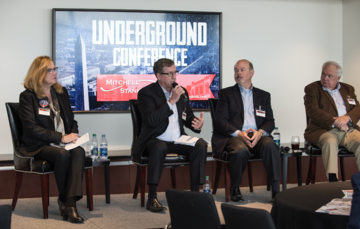
From left, Patsy Van Ouwerkerk, Todd Lane, Dave Doss and Stan Hollen at UNDERGROUND Conference.
The question of what can be done to move credit unions forward was asked of a panel that included Stan Hollen, CEO of CO-OP Financial Services; Todd Lane, CEO of California Coast Credit Union; Dave Doss, CEO of Arizona State CU, and Susan Mitchell, CEO of Mitchell Stankovic.
“Collaboration is important to achieve economic scale,” commented Stan Hollen. “The big CUSOs were formed when a group of CEOs saw a need, came together and said we need to do something. Collectively, our industry is just not big enough. We pale in size to the big banks. None of us has the resources to spend the money a very large bank spends on R&D. It is imperative that we collaborate.”
For Lane, the issue is where the “tipping point” may lie.
“What will trigger attention as an industry toward our tax status with our legislators?,” asked Lane. “I’m concerned we’re approaching this tipping point as the cumulative impact may potentially influence our favorable tax status. While reading (CUNA Economist) Mike Schenk’s piece that banks ought to start acting like credit unions, it struck me that credit unions ought to start acting like credit unions.”
Mitchell said she has noticed what she called a “crusade” today to be politically correct, and all that has done is leave consumers frustrated. “There are bad guys out there,” said Mitchell. “Credit unions should be the superheroes, the game changers. Instead we are talking about the industry going away, imploding. I believe passionately in what credit unions are all about. The timing is right for us to be different and engage in the idea that our dialogue should be about belief and in solidifying our credit union community.”
Doss echoed Mitchell, pointing to how much he admires the CU mission of serving people. But, he acknowledged, “I am very concerned. I feel there is a lack of vision about what we are and what we’re going to become. Our role and our fiduciary responsibility is to take care of our current members and protect our credit union so it will take care of future members. We have to build a unified vision.”

Attendees during UNDERGROUND Conference.
Other Points Raised
Other points made during the panel discussion:
- Many people ask, “Where is the next generation of leader?” Panelists said its important to create a culture that gives opportunity and expands beyond the comfort zone.
- Good people may leave. “You aren’t intentionally developing someone to leave you, but it happens and it is good for the industry,” attendees at the UNDERGROUND Conference were told. Hollen noted he has had many former senior executives that have gone on to run large credit unions.
- Credit unions are going to continue to see growth in outsourcing, so it’s critical to hold vendors accountable and to expect them to give back to the industry.
- One panelist pointed to what he sees as the hypocrisy by some CUs that would often rather see a member go to a bank than to another credit union. “There’s too much competition between CUs for FOM,” said Hollen. “I do not think we could start shared-branching today. That’s too bad. It is the banks who we should really be competing against.”
- One person expressed concern that credit unions are becoming more and more bank-like every day.
- Concerns were also expressed over the number of CUs that have obtained a low-income designation (LID). “If you pull the call reports and see how many multi-billion CUs have a LID designation, I think you would be shocked. What is the true purpose of them going after that LID designation? Are they truly operating in low-income areas, or are they trying to escape some of the regulations and restrictions we all have, such as the MBL cap and ability to raise supplemental capital.”
- Lane person shared his belief that credit unions need to participate in well-defined and cohesive strategies with their trade associations. “I think engagement of their membership to a much larger extent is important and I’m concerned about what seems to me to be a constant pursuit of charter expansion and how that brings us to that tipping point.”
- Not surprisingly, MIllennials were part of the discussion—but not in the typical context. “It isn’t just about the Millennials. We bemoan that membership is aging, 50 plus. Why? It’s an opportunity to engage families as one unit? We’re balancing aging parents, their children, grandchildren. We can bring them together not just to create wills and trust services, but for dialogue. This is what’s going to happen in your world for the next five years.”
- Strong reservations were expressed that regulators have forced credit unions to morph into something other than what they were created to be. “It’s no longer about us sitting here and accepting that the CU world is going to consolidate. It’s about being relevant, right now! In the 1980s the industry went through significant change and the regulator was our partner. They wanted us to be a vibrant industry. It is not the same today. You can have safety and soundness, but the regulator should also be an advocate for the industry. We need to be able to come together for the good of the whole. I think we need reform at the NCUA board level; I think three board members is not enough; I think we need at least five. They need to help us in executing the vision; but the vision is up to us.”
- Credit unions, the audience was told, are critical to what’s happening in the consumer world. “Let’s articulate a new CU message, a new reality show and talk about what it’s going to take for us to revolutionize and generate a new CU reality.”
Audience Has Questions
During a group dialogue, panelists took questions from the audience. Here is an overview of the Q&A:
Q: Is there one way we can act more like a credit union?
A: “Fees and overdraft programs are a place to start. Engage your members in ownership, take advantage of political climate. repurpose your vision. Be aggressive in your mission.”
Q: Is the CUNA membership issue going to fracture the industry?
A: “It will change the industry, but it is also a defining moment for us to come together. We need to create a unified position and hold those outside the circle accountable. WE shouldn’t waste the bullets on issues that have little impact. We need to stand together and demand regulators act as partners to those they serve.
"Although, the future of small credit unions demands creative strategies for growth and cooperation, it really comes down to- serving our members and serving them well,” said John Faries, CEO Columbine Federal Credit Union, who was an attendee at the meeting.