

RANCHO CUCAMONGA, Calif.–What do you do with multiple contact centers when agents aren’t supposed to be in contact—and yet more people than ever want to contact you?
You develop a plan, move quickly, leverage the tools you already have, and count on a little bit of luck, according to CO-OP Financial Services, which reconfigured contact center staff across seven physical company locations, plus moved hundreds of employees into work-from-home environments in approximately 15 days.
According to Nick Calcanes, chief operating officer with CO-OP, the reality of what the coronavirus pandemic might lead to began to become clear just six weeks into the year.
“It really started in mid- to late-February, as the news of what was unfolding in China was being reported,” Calcanes said. “We began to think of what that might mean for CO-OP.”
CO-OP offers 24/7 member contact center services as part of its “Engage” solutions that provides after-hours and overflow call center support to credit unions. The operation involves several-hundred employees.
Big Technology Upgrade
By early March CO-OP was completing a significant technology upgrade at its Fort Worth, Texas, center that had involved 120,000 man-hours of work. Between 35-40 technicians are working on the upgrade at the Fort Worth contact center at any one time.
Those tech upgrades had been taking place for more than a year and a half as part of a broader initiative to modernize and integrate all the call centers at CO-OP and Iowa-based TMG, which CO-OP had earlier acquired.
By bringing the Iowa call center into parity with its other counterparts and giving all agents the same sorts of tools and anti-fraud protections, CO-OP said it was able to create an interoperability across its locations.
That was the first bit of luck, acknowledged Calcanes. Another piece of fortunate timing: Just prior to the pandemic’s body blow to the economy, CO-OP finished implementing its “universal agent” technology to allow calls to roll from one location to another.
“We wanted to be able to load-level and have the ability to cross-train agents,” he said. “We didn't do that with the pandemic in mind; it was a strategy decision as part of business continuity planning.”
'Once You’ve Seen One…’
Calcanes said CO-OP and its member credit unions clearly benefitted from the investment and planning as the threat of the pandemic became more apparent. But it didn’t mean the new threat wouldn’t bring new challenges. Calcanes noted he has seen other pandemics during his 30-year career, and observed, “There is the saying, ‘Once you have seen one pandemic, you have seen one pandemic.’”
According to Calcanes, the company reviewed its options by exploring how it could best leverage its technology and facilities while keeping the safety of staff, including social distancing, in mind. That meant locating agents who remained in the call centers at least six feet apart.
In Texas, CO-OP was able to find extra space by standing up a disaster recovery site it already had in place Grand Prairie, approximately 21 miles from its Fort Worth facility. It also has a contact center at its main location in Rancho Cucamonga, Calif.

Nick Calcanes
CO-OP refers to its approach to its physical facilities as a “pod system,” in which staff remain segregated from each other. Currently, the company has seven such “pods” from which contact center staff are working, in addition to their homes. The idea is to limit the threat should any one employee test positive for COVID-19.
Shifting to Work-From-Home
CO-OP’s other challenge is one familiar to credit unions all over the country: how to move employees into work-from-home arrangements in a business in which agents need constant computer access and are always on the phone.
“At the time we had zero agents working remotely; now we have achieved 100% of our target of 125 agents working remotely, with remaining staff spread across six office locations,” said Calcanes. “The technology easily enabled us to immediately engage. We gave people laptops and had people set up in their homes. It took about two and a half weeks in Texas and Iowa to move people to remote facilities. We were a little lucky, but also prepared.”
The migration of staff went beyond just the technology. CO-OP also had to adjust its training on the fly, and it moved quickly to create training videos for staff in fewer than 10 days. Those same instructional videos are now being used as it onboards more than 100 other agents.
Similarly, CO-OP has had to address another issue CUs have faced, which is the security risk of people working at home.
“With security we have to be vigilant and diligent,” he said. “The technology on all our laptops is as locked as it can be. Then we have to rely on people to follow the protocols. We have a system in place to monitor all of our platforms, and we are still diligent with that.”
Calcanes said CO-OP has not had to lease additional space, as the company had already been planning for growth with the facilities it has.
Where to Begin
In Iowa, where CO-OP has two facilities, all of the employees who had worked in its Clive, Iowa location were sent home, while some employees who worked in its Urbandale, Iowa facility were sent to the Clive facility to create greater social distancing.
The first employees to be assigned to work from home were those considered to be most at risk. At-risk employees are those who have self-identified as at risk or who meet definitions from local health agencies or Centers for Disease Control guidelines.
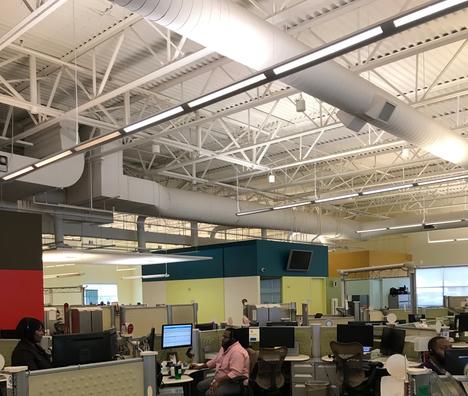
CO-OP contact center in Fort Worth, Texas.
After that, Calcanes said the company reviewed its “span of talent” and worked to have the right mix at home and in its offices.
No Performance Issues
Tammy Snyder, SVP- contact center services, told CUToday.info, “We had zero people at home going into this.”
Once the at-risk employees were assigned to work from home, Snyder said CO-OP looked next to those workers who are self-motivated and who could succeed in that environment.
One concern of many CUs and other employers in the mass transition to working from home has been that the lack of supervision would lead to workers spending work time on the couch and binging Netflix. But that hasn’t been the case, said Snyder, who reminded employee performance is still monitored.
“We can still measure,” said Snyder. “We use the same quality control monitoring. All calls are recorded. Our service excellence teams still monitor. We talk to agents every day by instant message and by phone.”
After beginning with an initial group of five employees working from home and creating the videos and other training in real-time, she said the company was able to work out kinks and continue the transition.
“Our team got people up and running quickly without a hitch,” she said. “It went way smoother than I thought it would.”
A Surge in Calls
That smooth transition has not just been fortunate, it’s been a necessity. As the shelter-at-home orders expanded and people lost jobs, call volume into contact centers has soared. Calcanes said the contact centers were initially seeing call volumes 75% to 100% higher than typically experienced, and volume is still 60% over where it was one year ago.
“We have been monitoring calls and you can hear the agents want to do the right thing. We’re seeing a spirit of self-motivation,” said Calcanes. “We’re even looking at how we can continue to improve, and not just maintain” service levels.
Tugging at the Heart-Strings
Snyder agreed.
“It is a difficult time,” she said. “Many members are asking, ‘How are you doing? Are you working from home?’ They conclude at the end by saying, ‘Be safe.’ The agents are hearing stories of layoffs, hearing about a husband who has lost a job, of the need to delay a loan payment. They are talking about stimulus checks. Some of the calls are similar to the news stories you hear that tug at the heart strings. (The agents) are in the middle of it themselves and are delivering the same great level of quality service.”
According to CO-OP, as credit unions continue to field more member calls themselves, the company has continued to add new clients or expand existing relationships.

Tammy Snyder
The Employee Response
While the work-from-home transition has met CO-OP’s objectives, what about employees? How have they responded?
“They are excited. And they are happy to have a job,” Calcanes said. “They are fulfilled to do what we are doing. They are concerned about the safety and well-being of the people on the other end of the phone.”
For those employees who are coming in to work at the contact center, the company has created CO-OP Cares, which provides a pay boost. “They are excited and motivated to be good teammates,” said Calcanes. “I have not heard any negatives.”
Added Snyder, “CO-OP Cares is to show our gratitude. We are acknowledging what it takes every morning for them to get up and come in every day. People appreciate it. One half of our workforce is now at home.”
Snyder said she is in contact every day with employees via instant-messaging, and while there have been a few glitches, those have been resolved.
In turn, Snyder said employees have expressed thanks for the opportunity to continue working, with one work-from-home employee sharing a fondness for the new commute.
For those working in the office Snyder said it has been necessary to consistently remind people to practice social distancing, and for management it has required a change in how contact agents are coached.
A little over two weeks ago, CO-OP began requiring masks of those in its office in Rancho Cucamonga, Calif., as per a requirement of San Bernardino County, California. It has also been taking employees’ temperatures before they can enter the workplace. The company makes masks available to employees at its other locations should they want one.
A Permanent Change?
What happens when the stay-at-home orders are lifted? A number of credit union CEOs have already predicted they anticipate many employees will want to continue to work from home, at least for a few days per week.
“From my perspective, I have not looked at this as permanent,” said Calcanes. “There is a lot to be said for collaboration in the contact center, for having a cup of coffee together or working at a white board. There is a lack of control at home over who comes and who goes in an individual home. We want to maintain the ability to rotate people. This is not a new issue. I know from a prior life where we went remote, people asked about coming back to work. There is something to be said about collegiality and collaboration, and I’m a tech guy. We expect to begin to migrate people back in.”
Work-from-home capabilities are an issue the company will discuss as it does its longer-term planning.
“We’re going to take a look at it and balance the team’s desires,” said Calcanes. “I know some people have communicated they want to stay remote.”