

ALEXANDRIA, Va.–Credit unions are being offered some advice and strategies for better penetrating the nation’s largest ethnic minority group, the 55-million people in the U.S. who are Hispanic.
It’s a market ripe for credit unions, as approximately half of Hispanics are unbanked or underbanked, according to a panel discussion here hosted by NCUA on “Unique Challenges and Opportunities Serving Hispanic Credit Union Members.”
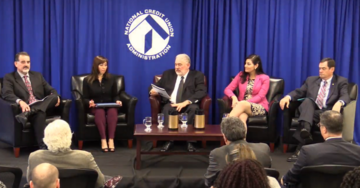
From left, Sergio Osuna, Maria Martinez, Bill Myers, Miriam De Dios, and Robert Peterson, during NCUA panel discussion.
The discussion, moderated by Bill Myers, director of NCUA’s Office of Small Credit Union Initiatives, also included Miriam De Dios, CEO of Coopera Consulting in Des Moines, Iowa; Maria Martinez, president and CEO of Border Federal Credit Union and co-chair of the Network of Latino Credit Unions and Professionals, in Del Rio, Texas; Robert Peterson, president and CEO of One Source FCU in El Paso, Texas, and Sergio Osuna, a supervisory examiner with NCUA’s Region V office.
The panel discussion was also translated into Spanish in real time.
Here’s a look at some of what was discussed:
Myers: Is the opportunity in Hispanic market generally about the size of the market, or are there other issues?
De Dios: There is a tremendous opportunity in this market. It’s not just the size. The median age is 27, with 15-million Millennial Hispanics. We have more than $1 trillion in purchasing power.
Myers: What are the regulatory issues related to serving Hispanic markets?
Osuna: A credit union faces the same issues when taking in a Hispanic group as any other group. The thing about the Hispanic community is that, especially with newer immigrants, they tend to live in defined areas and are easier to identity. You can often bring them in as an underserved area. Under the current (FOM) rule, a credit union must establish a service facility, but the proposed FOM rule allows that service facility to be an interactive website. So that should make it a little less burdensome. As for the Customer Identification Program, which is part of BSA, we want credit unions to make sure they have the proper procedures in place, first and foremost, the identification process. Credit unions can accept a passport with an ID, a Matricula Consular, a permanent or resident alien card.
De Dios: Sometimes we find some misunderstanding around the Customer Identification Program. Often, procedures don’t align with the CIP, and it’s important to look at the make-up of the community.
Myers: How do you build trust in this market? They are unbanked and unbanked for a reason.
De Dios: That’s the Holy Grail question. I think it’s important to clarify which segment of the community are you talking about. Not all Hispanic or Latino groups are the same. There are new immigrants, Millennials and fourth and fifth generation Hispanics. The trust building is especially important for that immigrant segment. It starts with a genuine interest that is bought into by all levels of the organization. This is especially important in parts of the country where the Hispanic population is not the majority yet. Growing up, my family came from Mexico, and in Mexico you have banks and credit unions, and banks cater to the wealthy. My family generally was comfortable in dealing with cash. I was unbanked until I was a teenager. The institutions they are used to dealing with speak Spanish, don’t ask a lot of questions, and are easy to work with. It’s also important to deal with the whole family unit.
Peterson: In El Paso, 82% of our population is Hispanic, and we have an inordinately high number of multi-family housing units. And we see these families coming to us because of this dynamic. So it’s really important that you serve all of them; it’s your opportunity as a credit union to bond with all of them.
Martinez: If you are going to advertise that you have services in Spanish and have literature in Spanish, it’s very important you have staff that can speak to them in Spanish. I recruit (potential employees) right on the spot in stores if they speak Spanish and if they are nice. You would also be surprised at the people you can meet at community events. Those are the people you want to bring into your credit union. It can be culture shock. It’s so important to know the culture if you want to serve them. It’s important if you have a core system that can identify the language they prefer to speak so your teller knows how to converse with that person when they come into the branch.
If they feel comfortable with you, they are going to bring you their business. With us, the VITA program has been so effective at helping us to recruit people, who then bring other people. You have to look for the tools that will bring people in, and they will bring their families and their kids—often, their kids are translating for them.
Osuna: We don’t forget when someone helped our parents. We will remain loyal. Building those relationships goes a long way. It lasts for generations.
It’s really important to educate staff first. Just because someone is bilingual does not mean they can successfully communicate. There are many subcultures. They also need to be educated about documentation and a plethora of other things. The second part is to educate your potential members and your existing members, as well. Many credit unions offer educational programs; but that doesn’t mean that your members or potential members are always going to take advantage of it.