

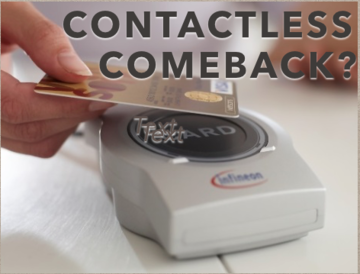
LITTLETON, Colo.—Contactless payment cards may be staging a comeback, due to sluggish EMV transaction speed at the point of sale and issuers’ desire to protect their brand.
Contactless cards, plastic that works like a digital wallet with NFC tap-and-go technology, have been around for at least 10 years but never caught on due the lack of NFC-capable POS terminals in the U.S., analysts have stated.
Now interest is back—with the cards having a chip in them today. The plastic is also known as dual interface cards, since they can still be inserted into the POS terminal like a standard chip card.
With digital wallets such as Apple Pay and Samsung Pay prodding merchants to accept NFC payments, and new EMV terminals bringing with them NFC capability, the use case for the tap-and-go plastic is back, explained Troy Bernard, director of EMV and emerging products at CPI card group, which offers the dual interface cards.
New Reasons For Use
But the reasons for using contactless cards today are different than when they were first introduced.
“There is a growing concern over the time chip card transactions are taking,” said Bernard. “Merchants are facing long lines and customers are not happy about the wait. Contactless cards are a means to speed up the transaction, since they are faster than dipping a chip card, something that issuers see important to cardholder service. So there is a lot of discussion around contactless EMV cards, especially around solving the problem of backed up lines at the checkout lanes.”
Another reason issuers are showing interest in the dual interface chip cards, according to Bernard, is that they want to protect their card brand.
“Issuers understand that their cardholders, in growing numbers, are becoming interested in contactless payments through mobile wallets,” said Bernard. “But with most digital wallets the issuer does not always get to control the cardholder’s experience and they often lose their brand behind Apple and Google. And, with Apple Pay, they have to pay to play. So if I am going to invest in EMV and tap and go for digital payments, why don’t I invest in my own card and brand versus giving that to Apple?”
There, too, is the need for issuers to simply stand out with EMV, said Bernard, adding that the contactless cards allow banks and credit unions to do that. Now that issuers have invested in EMV, and total U.S. card conversion is about 50%, some are asking, “How can I be different,” said Bernard.
“The interest in contactless cards is just starting to grow,” explained Bernard. “We are just starting to get our first orders. Now that the EMV rollout for many issuers is largely done, they are taking a deep breath, realizing the world did not come to an end, and are considering what’s next on the list for EMV. We tried to talk to banks and credit unions about contactless EMV cards during the EMV rollout, but with all that was going on, that was a high hurdle.”
Cost, however, is an issue, as dual interface cards come with a price tag about twice that of standard chip cards, according to industry reports.
Higher Price
Yet Bernard said the price, for issuers who want to issue the tap-and-go chip plastic, has not been slowing acceptance of the dual interface cards as has the lack of NFC POS acceptance, prior to EMV and Apple Pay.
“Google and Apple have stated that there are more than two million merchant locations today that accept contactless,” said Bernard. “That’s way up from the 350,000 contactless terminals in place when Apple Pay first arrived.”