

NEW YORK—If you’re reading this story while scanning other headlines or even looking at another type of media, there’s a very good chance you’re not an “essentialist.” And an equally likely chance both your personal and professional lives are the worse for it.
That’s the analysis of Greg McKeown, who argues that in a world where credit unions want more members, more walletshare, and more loans, the real secret to success lies in having “less.” In understanding that, he said, a credit union can understand the real “essence of strategy.”

Greg McKeown speaking to PSCU MoPRO meeting.
McKeown is the author of the book, “Essentialism: the Disciplined Pursuit of Less.” His life pivoted 16 years ago while in law school when he was asked to answer the question “If you could do anything, what would you do?” For McKeown, the answer was not to be a lawyers. Instead, he became a writer and teacher and eventually found his way to leading life as an “essentialist.”
How he got to his understanding of essentialism had much to do with another question: Why is it that otherwise successful people and companies don’t break through to the next level?
“That’s a non-trivial question to me,” said McKeown. “If you and I had a race, and you won, and then we have a second race and you have a 10-yard advantage, it’s likely you have a 100% chance of winning, and we race a third time, you have a 20-yard advantage, you have another 100% chance of winning. But that’s not what happens. What we see time and again is that people and companies that win the first race don’t win the second and third race.”
Hiding in Plain Sight
In examining that perplexing question, McKeown said he found the answer "hiding in plain sight.”
“The reason that individuals and companies don’t break through to the next level is success,” said McKeown. “With success came options and opportunities, which sounds like the right kinds of problems to have. But it turns out to be a problem if it leads to what Jim Collins’ called ‘the undisciplined pursuit of more.’ “
It is that undisciplined pursuit that resembles much of the lives led by most people, and the strategies pursued by most companies, according to McKeown.
“I would put to you we have entered a new kind of bubble right now. It’s hard to notice when you’re in it. The bubble we’re in is the ‘busy-ness bubble’,” he said. “How do you know? When you asked someone how they are doing these days, they all say, ‘I’m so busy.’ Success can become a catalyst for failure. I’m not against success. I’m against the undisciplined pursuit of more. I’m for the undisciplined success of less, but better. “
McKeown shared the story of one busy person, an established executive, who opted to “retire in role.” That is he stayed on with his company, but stopped and decided to pause in a period of self-analysis at work, and in his life. It was a process that involves looking through a “lens that said ‘is this the very best of me?’ He asked, ‘What if I were paid only for the value I bring to the company?’”
The executive who made this change described it as “getting his life back,” according to McKeown. “He got space back at work. He got creative space at which to discern between the vital few and the trivial many.”
“This is the idea,” stressed McKeown. “That you can even do a few things superbly well, or you could do many, many things ‘averagely’ well. And if you do the first thing you can have the breakthroughs and move the needle.”
Too Many Needles
Moving that needle has become such a challenge because so many people are paying attention to so many needles, he said.
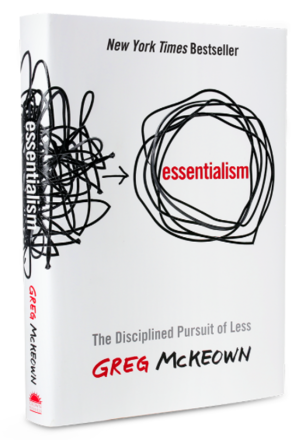
Essentialism: The Disciplined Pursuit of Less, by Greg McKeown.
“We are told that e-mail is a productivity tool. But what is first thing we do when we want to be productive? We turn our email device off,” observed McKeown. “Every time you check email you are surrendering your agenda to someone else. The fact that we do all this so effortlessly is a sign of how ripe the bubble is.”
McKeown described the personal and professional lives as “making a millimeter of progress in a million different directions. The primary challenge of management is resource allocation. So why are you utilizing your time and energy and resources so that you are pulled in some many directions?”
Another issue that leads to so much effort wasted on the non-essentials, according to McKeown, is too many people and organizations attempt to avoid conflict. As an example he pointed to company meetings that start to get squirrely with two or more people disagreeing over something, and someone else will make a statement such as “I think we’re all talking about the same thing,” or “Let’s take this offline.” “I’ve never seen an offline conversation take place. I want to go there, that’s where the real conversations are taking place,” said McKeown, only half in jest. “You have to have the hard conversations. You have to have the conversations about trade offs, you have to force those to the top. You will never find solutions to every problem. You have to identify the trade-offs and choose which is the priority.”
Making trade-offs won’t please everyone. But nothing ever will, he said.
“By trying to please everyone, you please no one,” he said. “The lie that just makes me furious is that ‘If you can just fit it all in you can every thing you want in life. If you say yes to everyone you can please everyone.’ The problem is you can’t do it. The reward of non-essentialism is stress. Non-essentialism does not deliver on its promises. It is a totally false idea, but it’s been peddled to us so often it sounds like it’s real, like it’s possible.”
'We Are Being Conned'
McKeown noted that the word “priority” entered the English language in the 1400s in the singular, meaning the very first or prior thing. By the 1900s the word evolved into “priorities.” But it’s an oxymoron, he suggested. “Can you really have multiple things that are the first thing? Can you have 10 things that you must get done?”
McKeown said every person and organization must recognize that resources are limited, and that there are really only a few true essentials in life.
“We are conned by the busy-ness of our times; everything is a priority,” he said. “You say, ‘But we’re about serving members, that’s what we do.’ But really there is a lot you do that doesn’t really serve them. Even in this pursuit of serving the member it’s important that we don’t make them the master in an unhealthy manner.”
The highest performing company of the past 30 years, he said, is Southwest Airlines, which has lived through incredible disruption by being incredibly disciplined to the pursuit of less.
“The essence of strategy isn’t what you’re going to say yes to, but what you’re going to say no to. You haven’t made a decision until you’ve decided what you’re not going to do. It’s true in companies and in life. If you don’t prioritize your life, someone else will.”
Seeking to put it all into perspective, McKeown turned to the best perspective-provider of all: time and death.
“If we want to live a life where we focus on the things that matter in life, we have to become essentialists. And when we’re on our deathbeds we may regret many things, but being an essentialist will not be one of them. The number-one regret of the dying is we lived a life based on other people’s nonessential expectations of us.”