

LAS VEGAS—Three credit unions that have redesigned facilities as part of new branch strategies shared their stories here.
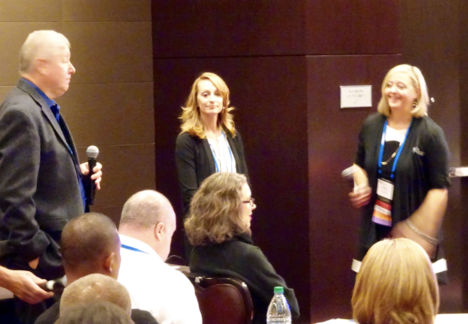
From left Kurt Thelen, Terri Baker and Michelle Grabicki speaking to CUNA Council's meeting in Las Vegas.
During the combined annual meeting of the CUNA Technology Council and CUNA OpSS Council, Terri Baker, retail operations director with Oregon Community CU in Eugene; Michelle Grabicki, VP-corporate culture with Numerica CU in Spokane Wash., and Kurt Thelen, CEO of Campco CU in Gillette, Wyo., all discussed their new retail approaches, as well as the lessons they have learned along the way.
Here’s a look at what each had to say:
Terri Baker, Oregon Community CU
$1.5 billion in assets, nine branches plus a call center.
Baker said Oregon Community has remodeled two of its nine branches to date, the first its facility in Salem, Ore., which, like its others, had used the traditional teller window branch layout.
The branch does about $1.2 million per month in loans and averages 6,800 transactions, 2,000 of which are from shared branching.
The new facility, which is about three miles away, uses universal employees and more sophisticated, Next Gen ATMs from Diebold as part of its open layout.
“This is the time we actually hired a design firm to help us, and the one thing that’s really important is to work on is project management and communication,” said Baker. “There were a lot of fingers in the pie there.”
The big change for members is the creation of teller pods near the back of the facility and a person who greets them upon entering the branch and directs them where to go, which is often the ATM.
“We used the same staff, so it’s really, really important to have staff who had been for years in a traditional style branch embrace this universal employee concept,” said Baker. “The manager of that branch was really into lending, so we moved him into a different department and promoted a younger manager who was full of energy and loved this concept. She was a force with employees to get their buy-in. We included the employees from day one and we did a lot of training on accepting change.”
OCCU has decreased its full-time employees to 6.75 at the new branch from 8.75. FTE decrease from 8.75 to 6.75.
“We’ve seen a 98% decrease in shared branching transactions at the teller because we just walk them to the ATM,” Baker said. “In person-transactions initially decreased by 32%, and ATM transactions increased by 40%.
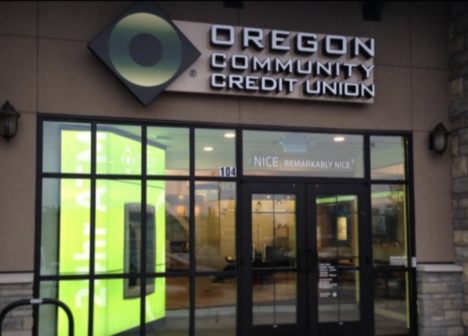
Noting that central Oregon can see nine months of gray skies and rain, Baker said it was important to the CU to build a bright, warm environment. It has incorporated the local scenery in photos in the branch, and it used digital signage for marketing.
The second facility redesigned by Oregon Community is on the campus of the University of Oregon, which it was chartered to serve. That branch is located in the university’s Duck Store, and when it was remodeled OCCU renegotiated in order to move its small, 180-square-foot facility to the front of the store.
That branch is cashless, with transactions done via the ATMs. This one is cashless; everything is through ATMs. “We service a lot of Millennials here, and we’re very involved with the students, and this works well for them,” said Baker.
Baker said the lessons Oregon Community has learned as it redesigns its facilities include:
1. Communication is huge when you’re doing these new branch facilities.
2. The IT department needs to be brought in at the very beginning. “I have a lot of ideas, and they are great at asking how and why?”
3. “The other thing that was very helpful was to have a very strong branch strategy. What are we trying to do? Loan acquisition? Member acquisition?”
Michelle Grabicki, VP-corporate culture,
Numerica, Spokane. $1.6 billion in assets, 18 branches.
Like Oregon Community, Numerica’s branch redesign is a work in process. It has reconfigured six of its facilities, meaning 12 are still using the traditional design format. The goal is to overhaul two-to-three branches per year.
“Our journey began five years ago with a new CEO who said she had a horrible new account experience in one of our branches,” said Grabicki. “She said she could hear everything being said in the cubicle next to her, which meant they could hear everything she was saying. Around that same time, we also were discovering our identity and what we wanted to be in the community, and that led to a huge rebranding process. So our teams rebranded every element of the credit union.”
Grabicki said one of the things Numerica “got right” was very early in the process realizing the importance of involving all levels of employees in the process.
“This isn’t just a senior management decision; senior management doesn’t spend every day working in that facility,” she said.
Among Numerica’s goals with the new branches:
1. Integration of technology to complement human interaction. “We want to help our members to have that 24-hour access, but it’s important not to lose that human interaction.”
2. Create a new retail experience that breaks down barriers. “Sometimes there is a little bit of a power play when the member is laying everything out on the line. We wanted to create an atmosphere of partnering with members.”
3. Numerica sought to create a “hoteling” space within the branches to improve privacy.
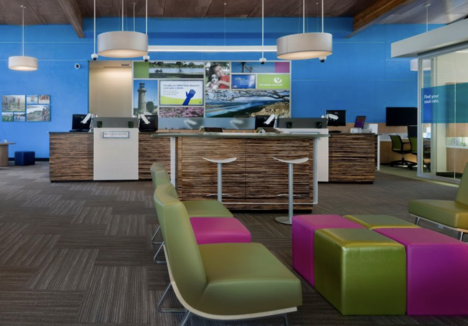
Numerica Credit Union.
“We wanted to push the envelope with our design. Our brand is about helping reduce members’ stress, helping them to live well,” said Grabicki. “So we wanted a decor that would help them to be happy. It’s amazing when people go to these branches after they are open. Members really like it and want to stay and hang out. Community is very important to us, so we wanted to have community space. If an organization wants to come and utilize the meeting space, it’s an option for them. We also have the enhanced ATMs that could fulfill members’ needs 24 hours per day.”
One “controversial” decision, said Grabicki, was opting not to offer teller service at its drive-through, which is instead is serviced by ATMs. “We did a lot of communication around the fact that the drive-up is open 24 hours a day,” she said, noting members can make loan payments at the machines. To date, less than 1% of members have had a negative comment about the drive-throughs.
“The branches have an open floor plan and universal staff. It’s one of the biggest challenges, asking people to do a lot more, and we’ve learned a lot around that and have restructured positions.”
Traditional service rep positions are still available, but employees who want to can graduate to a higher position providing more services.
Grabicki said the new branches are contemporary, comfortable, transparent and high tech. On the wall behind tellers at each branch are photographs that reflect the local area. “It makes it feel very personal to the member,” she said.
Grabicki said its objectives with the new facilities include:
- We wanted to increase net members within targeted demographic.
- We wanted deeper relationships with members.
- We wanted an increase in non-branch transactions. “We really wanted to push people to the technology and we have met our goals. What we have not seen is a decrease in branch transactions. People love to come into our branches, but we’re also serving more members.”
- We wanted to increase products per household.
In terms of a lesson learned, Grabicki urged keeping members completely updated, including having pictures and branch designs on hand in the branch. “You can’t talk to them too much,” she said. Grabicki added it’s also important to ensure all departments know what’s going on in the branch.
She also stressed the need to have a consistent process in place for transitioning from one type of branch to another. For that reason, Numerica has created a “Branch Transition Guide” so everyone will know what to expect.
Campco FCU, Gillette, Wyo.
$98 million in assets, one branch.
When Kurt Thelen first moved to Wyoming to take over as CEO of Campco FCU he found a credit union that matched the boom-or-bust cycles of the town by adding buildings when times were good.
“As they outgrew a building they would just buy another one and move a department over there. When I came on board they were looking at buying two more pieces of property in the wrong section of town. The next question I asked, ‘If we don’t think this is the right part of town how easy will it be to sell these buildings?’”
To sell those buildings, Campco agreed to a lease-back agreement with the buyer in which it said it would remain in the buildings for three years after the sale. Even with that it took two years to sell the buildings.
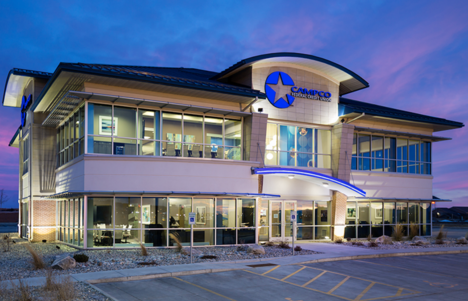
Campco CU's new office.
“What did that also do for us? It made us commit to the fact we were going to build a new building,” he said.
The result has been a new building Thelen said is a “postcard” in its community.
But before arriving at postcard status, Thelen offered this advice to CUs expanding facilities:
- “I would rally encourage traffic studies. You think you’ve picked the right piece of property, but use an outside firm for a traffic study to make sure what you are thinking is right.”
- Lot size: “So often I see credit unions buying the lot before buying the building. Take whatever lot you are going to buy, and add a half to that. You’re going to grow bigger.”
- Know the long-term goals of your organization and of your community. “Is the community growing? In what sections is it growing?”
- Location really does matter. “It’s not if you build it they will come, especially if you are in the wrong part of town.”
- “Get everyone behind a new logo. You’re going to use that a lot in your new building.”
Among the features of Campco’s new building is a quiet room for staff that is separate from the break room. It’s a place an employee can go, for instance, to make a phone call or deal with a personal issue. It also has a new mothers room.
The new design uses teller pods, which Thelen said gives tellers the opportunity to learn other parts of the job, making their work more fulfilling. Campco’s mission statement is on the wall behind the teller pods.
“We have tried to get our building to show off as a postcard. This is just not like any other bank in town,” he said. “That’s where we get our most compliments; this is a place where they want to belong.”
CUToday.info earlier profiled Campco’s new facility. That story can be found here.