

NEW YORK—As if credit unions weren’t sufficiently challenged in attempting to penetrate and serve the Millennial market, one person said that market isn’t singular—there’s more than one.
And any credit union looking to build marketshare among Millennials needs to rethink the whole concept of "marketshare: when it comes to Millennials, as well, according to one person, who offered some interesting insights into what drives the thinking of Millennials and how it differs from that of earlier generations.
Michael Parrish Dudell, a Mllennial himself who is an expert on his generation and author of “Igniting a New Generation. How to Activate and Engage the Millennial Market,” said there is a silver lining for credit unions in reaching the market(s): “Seventy percent of Millennials would rather go to the dentist than a bank. And that’s good news for you.”
Dudell, in remarks to PSCU’s MoPRO conference at which the Millennial market was a consistent source of discussion, admitted that prior to being invited to speak he knew almost nothing about credit unions.
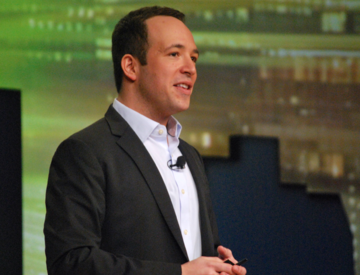
Michael Parrish Dudell speaking to PSCU's MoPRO meeting in New York.
“Before being here I did a lot of research, and I think more than any industry I’ve talkrd to this industry is really poised to win with Millennials, because there is a lot of value here,” said Dudell, who is also the author of the “official” book of the Shark Tank, “Shark Tank: Jump Start Your Business.”
The biggest mistake all retailers, financial services providers and others make in attempting to get marketshare among the biggest generation ever, is paying too much attention to the data only.
“People tend to focus on the statistics, the what and how, of Millennials. But the real meat is the ‘why.’ You need to understand why they behave the way they do,” said Dudell.
Dudell, 32, called Millennials “the most talked about generation” in history, a generation he defines as having been born between 1980 and 1996, people who are now between 18 and 34 years of age.
“This is the most diverse generation in U.S. history, 42% are non-white. This is the first generation raised on computers and the Internet,” he said, recalling a memory from first grade when the card catalogs were carried out of his school library and replaced by computers. “The is the Most educated and most underemployed generation. They are not finding jobs, or finding jobs that pay enough to repay student loans.”
Dudell said Millennials are also generally politically agnostic and uninvolved in politics.
“Millennials don’t vote,” he said. “But it’s not because they don’t care. It’s because they are disconnected and the candidates are fake and it doesn’t matter which side you are on. When we see how they handle this disconnect on a political level is how they also behave on the retail level.”
Millennials do feel deeply entrepreneurial and believe entrepreneurship to be a critical skill, he added.
So how did Millennials arrive at this mindset? Dudell offered three reasons:
Information Technology & Advertising
Dudell noted the average consumer today sees 5,000 messages every day, up from 500 in 1975. “We as consumers have grown up at a time where this information is everywhere, we were constantly plugged in,” he said. That overwhelming number of messages can mean that no one message ever gets through.
But what about the perception that Millennials all feel entitled?
“A lot of people think Millennials are entitled, and some are, but really it is about expectations. It’s what we grew up on.”
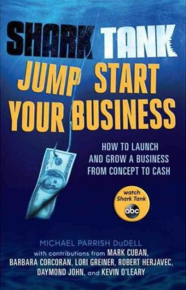
Michael Parrish Dudel also authored the official book of Shark Tank.
The New Economy
Dudell said Millennials were all sold the story that you go to school, you get a job, you work hard, you get the car, the kids, the American Dream. And from 1995-1999 it all seemed true as the economy boomed. But then it all crashed in 2001.
“That’s when many Millennials started graduating,” he said. “This is time when Millennials are coming into their prime. We were told that if we followed a model something good would happen, and it didn’t. So now Millennials are not very trusting.”
The Helicopter Parent
Technology has allowed many parents to remain constantly plugged into their children’s lives. “We were given trophies for ninth place! Do you know what ninth place is? Last. We were taught we were unique little snowflakes, we would grow up to be present, and we could be anything we want. I love the concept of mindset, but that’s not the case. As we get older we see life is very different.”
Dudell urged credit unions to recognize the Millennials are a “bifurcated” market, and that a 32-year-old Millennial such as himself is quite different from a 22-year-old Millennial just graduating from school, for instance.
“The younger Millennials are different in some ways,” he said. “They are hyper-focused on experiences and their personal brand. They are also a little more conservative than older Millennials; you would think it would be the opposite.”
Millennials are also a “very loyal generation,” he said. “You just have to give them a reason to be loyal. Forty-four percent are willing to promote the companies they believe in.”
And in good news for credit unions, he pointed out that “This generation doesn’t believe business is just about making money. Yes, you have to make money, but 75% say companies should act for the social good.”