

Editor's Note: This is the first of three stories detailing how three credit unions that had been losing money and even operating under conservatorship turned themselves around. Their stories were shared during NAFCU's annual meeting in Nashville. CUToday.info will profile all three this week.
NASHVILLE–It’s been a challenging but ultimately successful last dozen years for Arlington Community Federal Credit Union in Virginia, which went through years of negative earnings and even told NCUA at one point it simply wouldn’t accept a Letter of Understanding and Agreement.
Twelve years ago Arlington Community was a credit union with less than $100 million in assets that, despite the Community in its name, primarily served three SEGs. It began to expand when it decided to reemphasize the word Community and become an “organization that truly served and made an impact in our community, and helped all members of our community,” noted its now CEO, Karen Rosales.
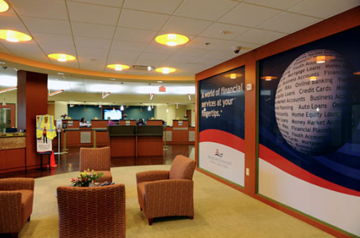
Interior of Arlington Community FCU.
And all of that, said Rosales, sounded great, until…
“As with all coming of age stories, all growing up stories, you eventually hit those awkward teenage years,” said Rosales during NAFCU’s annual meeting here during a session in which three CEOs shared their turnaround stories.
Making matters worse: the teenage years arrived at the same time the recession was hitting.
“It was not good, and made for some difficult years,” said Rosales, who was not with the credit union at the time. “In 2010, I had lunch with the former CEO, who laid it out for us. The credit union had negative earnings for three years straight. It had lost a lot of money in real estate and consumer lending. Its net worth, which had been 11.5%, had declined to 7.01%.”
Moreover, the credit union had just built a new building that encountered a number of issues and left ACFCU a 12% fixed-asset ratio. In response, the CU implemented salary and benefits freezes for four years for senior management. And how “old and saggy and hanging on the hinges” was its technology? Rosales said it took 40 minutes to get an instant issue debit card in branch.
'Something Running Through The Veins'
“Our service was terrible. As employees were leaving, we could not afford to replace them and we did not have a training department. And then the CEO said, ‘Would you like to join our team?’ I met with the executives and I chose to work there because there is something that is running through the veins of that credit union that is important, and that is this belief that it had a value proposition for the community.”
Rosales was hired as COO and with other members of senior management soon embarked on three areas of focus:
1. It adjusted lending practices and began taking more risk in the community. “We actually went deeper into the credit scores and started doing some risk-based lending,” she said.
2. It improved member service by identifying with and supporting its community.
3. It worked to maximize earnings.
“We already had a great VP of lending and a great CFO, but the best thing we did was bring in a VP of People and Culture. That was essential to our success and culture,” said Rosales.
A 'Hiccup'
Amidst that new beginning there was a “hiccup,” said Rosales.
“NCUA came in and got to work, and they left us with a DOR with 25 to 30 items on it, along with an LUA,” said Rosales. “We refused to accept the LUA. We did not want that public cloud hanging over our heads. We pushed back, and NCUA did rescind the LUA.”
A big change for the credit union, said Rosales, was in how it approached lending. It moved to put the emphasis on the ability to repay, rather than the credit score.
“We got everybody to understand our lending success was going to come from relationships,” she said. “We had to understand intent and ability and that meant we had to listen and evaluate, mine for clues and apply those clues to reality.”
With its lending, Arlington Community FCU:
- Expanded scope and included subprime credit scores
- Lowered sub-prime rates. “It sounds counterintuitive to go from the 17% range to the 13% range,” said Rosales. “Yes, it cut into income, but that delta is what got members into cars.”
- Created special products, including a Credit Builder Loan and a Payday Alternative Loan, and it went deeper on C&D tier, especially PFI.
- Retrained the lending team and NCUA to understand its lending model.
- It created a kinder and gentler collections team. “We knew they would have to choose who to pay, and we told them you should choose to pay us and we will be there for you,” said Rosales.
'Department of Efficiency and Innovation'
In terms of member service, Rosales said Arlington Community has implemented at “Remarkable Service Program,” has invested and “fully lived” in its communities, has reshaped its community branding strategy, and has been actively targeting Millennials.
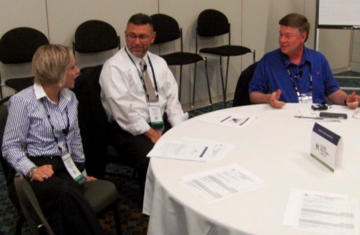
At NAFCU, from left, Karen Rosales, Scott Duszynski and Dan McGowan.
It has also created a Department of Efficiency and Innovation.
“This is really important to our organization. It’s hard for us to keep pace with the big players,” said Rosales. The initiative has forced employees to pause and talk innovation, according to Rosales, and that means no excuses. “I don’t want to hear that we’re small. Every month introduce some innovation to our members.”
Rosales said Arlington Community has outgrown those “awkward” teenage years. Today it has $250 million in assets, and 84% of its members have loans with it. It has seen double-digit loan growth for the past four years, its membership growth is double its peers, and its checking account penetration is 60%. Net worth has grown to 9.5%.
“We do have a heavy expense model in lending, but it’s purposeful,” said Rosales. “We could cut expenses tomorrow if we wanted to, but that would not be serving our community.”
Recently, Arlington Community FCU was voted by readers of a local publication as the “Best Community Banks.” The five honorable mentions? All local banks.