

SAN DIEGO–Four credit unions of various asset sizes shared how they have built successful indirect lending operations, in addition to the advice and lessons learned they have picked up along the way.
The four credit unions—all very successful indirect lenders, including the largest indirect lender in the country, shared insights into their programs during the CU Direct DRIVE 16 Conference here. The four panelist and their credit unions:
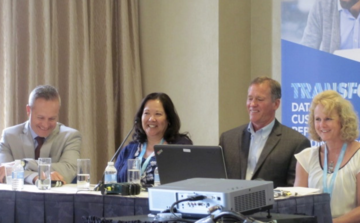
From left, Michael Kramer, Laura Agustin, Mark Wild, Julie Kinney
- Julie Kinney, indirect senior lending manager, Summit Credit Union
- Mark Wild, vice president of Colorado lending for San Antonio-based Security Service Federal Credit Union
- Laura Agustin, consumer lending manager, Alliance Credit Union
- Michael Kramer, director of indirect lending/underwriting at TTCU The Credit Union, Tulsa, Okla.
Here’s a look at what each had to say:
Julie Kinney, Summit Credit Union
Like each of the indirect lending execs, Kinney stressed the importance of building relationships with auto lending beginning from the initial meeting, and then on an ongoing basis moving forward. A credit union rep is joined by a rep from CU Direct on on-site visits to explain the program that is offered. That is followed up by an email that includes a link to a YouTube video in which the credit union explains its program. The credit union creates goals for dealers, including a competition.
“In 2014 we restructured our indirect lending department,” said Kinney. “With the restructuring dealer financing became our sole focus. We have built stronger relationships with dealers, and in 2015 made twice as many visits to dealers. Consistent decisioning is one of our niches; no matter which underwriter they get, they get the same decision. We have ongoing, clear communications, which makes problem-solving easier.”
Kinney said the credit union’s Sign & Drive program has also been appreciated, as it drives buyers to dealers. In addition, it has featured various dealers as part of its radio advertising.
Mark Wild, Security Service FCU
The $9.2-billion Security Service is the #1 U.S. lender in indirect lending volume, working with about 750 dealers in Texas, Utah and Colorado. In 2015 Security Service won a Diamond Award for Portfolio management from CU Direct. Wild said SSFCU breaks portfolio management into four categories loan origination, balance sheet management, servicing, and asset recovery.
Security Service did $3 billion in indirect lending volume during 2015, and will likely hit that number again in 2016.
“The mix of business in our portfolio is changing a bit. We’re doing more mortgage and consumer lending, and that is by design,” said Wild. “Sixty-five percent of our originations were indirect in 2015, and we plan to keep on originating the other loans.”
Wild said Security Service has seen record demand for all of its products beyond just auto loans. The CU moved to make all of its loan products more attractive, including credit cards, and Wild said that has driven the increased volumes.
“With managing balance sheet liquidity, we did $15 billion in loans over last three years. How does that fit into a $9-bilion organization? It doesn’t, we have participated out about $2.8 billion in participations, $2.2 billion to other credit unions,” said Wild.
Wild said Security Service has built a reputation for solid servicing, and that its goal is to treat the member the “way they expect to be treated.”
Finally, he said SSFCU has made strides in improving asset recovery as its improved its processes and added technology. “The unique thing we’ve done is our Champion Challengers,” he said. “You think you have a good collections company, but how do you know. We have beat our collections company (on recoveries) 13 months in a row, and we hired a third party to compete with both of us to see how we’re doing.”
Laurie Agustin, Alliance Credit Union
Agustin has overseen a 230% increase in the CU’s lending portfolio. Alliance operates in Northern California and North Carolina. In California it targets three counties and the top 20 dealers, with an average of $20 million funded per month. It also offers a first-time buyers program. In North Carolina, it operates in three counties and has partnered with the top 10 dealers, averaging $3 million funded monthly.
In 2014, the credit union did 1,831 loans for $49 million with average yield of 4.85%. In 2015, it did 1,750 loans for $45 million in loans, with an average yield of 5.16% due to its first-time auto buyer program. It did all of that with a staff of three.
Agustin said Alliance, like most CUs, makes regular onsite visits as part of its Dealer Business Development program, and it does place an emphasis on answering the phone when dealers call. She said Alliance, which uses CU Direct’s Smart Fund solution, has worked to be very consistent in its underwriting.
But it has also hit some speed bumps. For a period of time it fell behind in funding loans. Agustin said the CU hosted a dealer breakfast and was upfront about the issues it was facing. Having made improvements in its operation, Alliance announced at that breakfast that moving forward, “if we don’t do it in 48 hours, we’ll give you an additional $100. That has really helped, and they have helped, too, when things are incomplete in getting it completed.”
The much-discussed “Holy Grail” of indirect lending, the ability to turn members who join via an indirect loan into profitable, engaged members, is a focus at Alliance. Agustin said ACU calls each new is contacted within 48 hours, but not with a cross-sales effort.
“We thank them for their auto loans and answer any questions about their new loan,” said Agustin. “We set up auto payment or ACH, ask about their dealer experience, and then cross sell products. We launched that in December of 2015, and we have about a 20% penetration with cross-sales with this.”
The credit union has most recently introduced the ACU Complete Auto Network, an online offering where members can click on dealership details, gets insight and commitments from the dealership regarding excellence, and where dealers even make special deals available, such as on oil changes.
“Members have opportunity to take a survey and give feedback. Dealers like to hear the feedback,” said Agustin.
Michael Kramer, TTCU
In addition to its indirect auto loan program, TTCU also does RV lending, for which it has a portfolio of about $150 million in its overall loan portfolio of $750 million. It makes loans in Oklahoma, plus Kansas, Missouri, Arkansas, Iowa and Texas.
“We started our program in 2009, and over the last seven years the average ROA has been 1.3%,” said Kramer of the program that does about $23 million a month in indirect loans.
TTCU The Credit Union also has approximately 13 dealerships through which it sells its credit cards.
“On a daily basis, our underwriters call back on all tiers with credit scores of 650 or greater,” he said. “We use SmartFund with preferred dealer. We do have an indirect business development officer. Each of our underwriters is responsible for about 20 dealers of their own.”
He said the credit union also does lunches with dealership owners and finance directors.
Kramer said TTCU adds new dealers every month, but he also noted it cuts dealers every month, as well. “You have to make sure you are not doing business with those who don’t want to deal with you,” he said.
On a quarterly basis it hosts contests for dealers, and each year it conducts a popular golf tournament. Dealers are also given swag that includes pullover jackets and mouse pads with all of the CU contact numbers printed on them.
Kramer said TTCU has used an outside firm, Auto Cash, to oversee gas card giveaways with test drives on preapprovals.
Like any lender, TTCU has repo’s, and Kramer said it does repo sales at dealerships offering a 2.49% rate over 84 months. “That saves us from the auction and saves us about $3,000 a car.” He said it is able to sell about 40% of its repo’s through dealers, and 100% of repossessed RVs through those dealers.
A big issue not often discussed, said Kramer, is the importance of people.
“If your people are not happy, the dealers will not be happy,” said Kramer. “You have to take care of your underwriters and managers. Pay is good but leading by example every day is what a good team needs to grow. You have to let your people own projects and dealers.”
The Q&A
Here are some of the other points made by panelists during a Q&A after the presentations:
- “You have to get to know dealers as people in addition to just the business relationship. You can work through issues a lot better and coach a lot better.”
- “Keep your dealers in the loop. We were short-staffed for a long time. We didn’t hide anything and they followed up with us. We have even shared where the credit union is going, and our vision is part of their vision.”
- “You can’t give the dealer everything they want; it’s not a one-way street. You always have to have a game plan. Some relationships get better, some never do. I’ve had some dealers say, ‘Fraud is going to happen.’ That’s awesome. You have to be able to explain to that dealer what you’re doing. Just because another lender does something crazy doesn’t mean you get desperate.”
- “We run a golf tournament that people go ‘wow’ over. We spend a lot of money, prizes on every hole, just about everyone walks away with something. It’s for our higher-performing dealers—usually do it at the beginning of holidays. It can be expensive. A good golf tournament can run you $15,000 or more. What we do is we’re friends with our warranty reps and we’re friends with CU Direct, and we work that where we get donations for prize giveaways. We have dealerships sponsor holes with cars. So we get ten grand donated.”
- “Our budget is not as big. We do small dealer car sales on their lot and we have CU employees there. We don’t get a lot, but the dealers are so happy that we are promoting them.”
On the question of turning indirect members into full-fledged members:
- “You have to get everyone’s buy-in at the credit union, branch managers especially, that indirect matters and that you are on the same page and that this is where the bread and butter is. It took my credit union like four years to realize that. The leads matter and they have to be worked.”
- “We have onboarding through the whole credit union. With our first-time homebuyers, we do 100% phone interviews. So that group is excited. A lot don’t know what credit unions are. We are considering an offer to reduce the rate by 25 basis points if there are 12 months of payments on time.”
- “We are reaching out based on geographical locations. If the new member is within five miles of a branch, people in the branch call to give them that local welcome.”