

SEATTLE–Changes in the marketplace coupled with demographic and technology trends are combining to give a boost to credit unions when it comes to expanding their offerings in investment services, as well as the number of members using them.
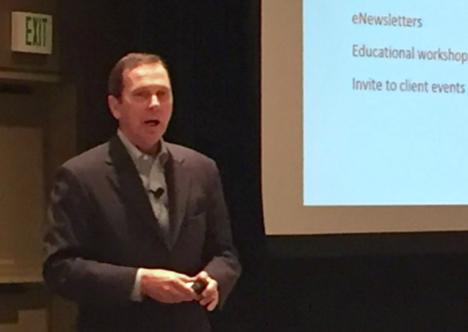
Gary Weave speaking to CUs.
How has investment services market changed over the years? According to Gary Weuve, vice president of CUNA Brokerages Services, Inc.’s Center for Advisor Excellence., it has evolved for the better, moving away from brokers to wealth managers who now can provide holistic solutions.
“I think this is going to evolve even further with the new Department of Labor fiduciary regulations requiring you to act in the best interest of your members,” said Weuve, adding a sentiment that’s seldom heard: “I think this is a really positive regulation.
Weuve told CUNA’s America’s Credit Union Conference he sees three opportunities in investment program offerings by credit unions, including:
Serving the Retirement Needs of Baby Boomers
“This is a market of 76 million members, and each day 10,000 turn 65 and that will continue for next 20 years,” Weuve said. “The market is moving from the accumulation stage to the distribution stage. The other thing going on is this transfer of wealth that is passing on to heirs. It is the biggest transfer of assets ever. The first wave of Baby Boomers is turning 70 and starting to spend down assets. At 70 and a half there are mandatory distributions; they have to start taking assets out.”
Weuve urged credit unions to have a program in which staff training has been emphasized.
“One thing I think really important in the training of the advisors is that they understand the credit union movement and the relationship you have with members,” he said. “It’s also important that senior management are all on the same page and know why you are offering investment services.”
Weuve recommended credit unions brand their programs with their own names so it’s clear to the members who is offering the investment services.
When it comes to getting the word out, Weuve called for getting beyond just marketing campaigns and also offering education-based workshops, Retirement Readiness Boot Camps, education on Social Security and Medicare; education on building sustainable income in retirement, and education on health care in retirement.
He also urged CUs to do staff referral training.
“At every interaction with an advisor, they should be making the member aware they are available to offer second opinions to friends and family,” said Weuve.
Legacy Planning
With so much of the population aging and preparing to retire, Weuve recommended establishing financial planning processes, including creating plans for sustainable retirement income and discussing the purposes of living wills and powers of attorney, as well as partnering with a health insurance representative.
He said marketing should be specifically focused on what he called “Red Zone” retirees, those age 55 to 75.
“Communicate your difference. What makes you different than the Wells Fargo person across the street? What is your value proposition? I think one of the huge ones is that the advisor sits in a credit union and no one is going to treat them better.”
Attract Millennial Clients. No, Seriously
Weuve said that attracting Millennials to investment services is something he seldom sees, for the obvious reason: “They don’t have an money.”
But Millennials are often the children and grandchildren of people who do have assets, and they need to prepare for inheritances, he said.
“Today, your advisor is managing the assets the member has invested with your program,” he said. “The advisor can be proactive in helping the Millennial children who will receive these assets.”
Weuve acknowledged wealth transfer and discussing money-related matters inside a family can be a sensitive issue, and several members of the audience said the issue made them uncomfortable, as well.
But there are reasons to start conversations with everyone in the family, Weuve said. He noted that in many long marriages, when the husband dies 65% of the time assets switch to another advisor. Why? Because the couple’s advisor had always spoken to the husband, and the widow moves the funds, often to a female investment advisor.
Strategies Shared
How can a credit union/investment advisor build relationships with entire family? Weuve offered these strategies:
- Family meeting. “These are often great to do during the holidays when families are together, or do anytime using Skype and FaceTime. Use it to communicate values, financial desires, and health care directives. These are not easy conversations, and will be uncomfortable for your advisors through the first two or three.”
- Ask Resistant Clients, “Will the transition of the family wealth have a positive impact on the lives of your children and grandchildren. And that last one is important.”
- I suggest adding a Millennial advisor be partnered with the Baby Boomer advisor and have the Millennial talk to their peers. “Put them with someone who talks the same language.”
When using social media Weuve said credit unions/advisors must talk the language of Millennials, make communications personal, and measure engagement. In addition, he said credit unions would be smart to create an advisory board with Gen Y and Millennial members. All information shared should be limited to digestible bits, he said, and meetings should run longer than 30 minutes.