

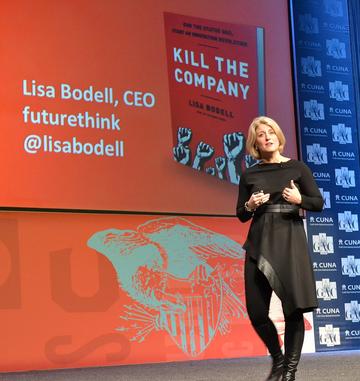
Lisa Bodell
WASHINGTON—Credit unions would benefit from adding a “chief simplification officer” to eliminate unnecessary complexity growing within organizations and getting in the way of doing business, says one change expert and author.
Lisa Bodell, speaking at CUNA’s GAC, added that credit unions being less complex than cumbersome big banks have the better opportunity to change and meet consumers’ evolving financial needs.
“Be inspired to change. Change is a choice,” Bodell said. “You have so much of an advantage over the large banks. You can start with killing stupid rules and processes. Make simplification happen.”
Bodell asserted that as businesses grow they get caught up in complexity.
“In speaking with audiences across the globe, I have asked this simple question,” said Bodell. “I asked, ‘What do you spend most of your work day doing?’ What is interesting is not the uniqueness of the answers but the absolute conformity of the answers—no matter the country, company or culture they said meetings and e-mails. That sound familiar?”
That’s too bad, said Bodell, noting that most people get up in the morning with the desire to do very meaningful work, not wade through meetings and e-mails.
“Who wakes up and says, ‘I have so many meetings and e-mails to get through today—fantastic.’ Sometimes these things become so much of what you do you become complacent and don’t do anything else.”
Bodell said that kind of mentality does not allow companies to adapt and evolve. She cited several examples of the kinds of change that lies ahead in the global marketplace, including a prototype BMW that improves the health of the driver.
“In a pilot with the University of Southern California, a prototype BMW Mini is equipped with 300 sensors. It’s the next wave of cars,” said Bodell. “We spend a lot of time in our cars. When you sit down in this Mini the first thing it does is tell you how much weight you lost or gained since the last time you drove it. It’s a terrible car, ladies. Do not get this car!”
The steering wheel also has heart rate sensors, and the ventilation system checks the outside air pollution levels and can suggest routes that offer cleaner air.
“The point is,” said Bodell, “the future is not about who you are today but who you are becoming. What will your business be dong in the next 10 years that it is not do today?”
Again citing the issues that keep companies from answering that question, Bodell said a common mistake is placing process over culture and doing over thinking. “Thinking has become a daring act within many companies,” she said. “Your brain goes on as soon as you get up and goes off as soon as you step into the office.”