

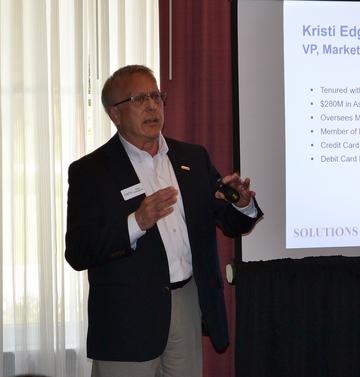
Dean Knudtson
ORLANDO—Fees is not a four-letter word, according to one analyst, who says that’s just a fact credit unions are going to need to come to grips with as debit interchange—a big piece of CU non-interest income—is going away.
“If you are not seeing 15% of your card revenue from fees, there is opportunity,” said Dean Knudtson, senior portfolio consultant at CSCU.
Knudtson assessed the fees CUs are charging and those many are not.
“Annual fees and enrollment fees, why don’t you charge them,” asked Knudtson during CSCU’s Solutions 2016 annual conference here. “I ask that question of credit unions all the time. But I also suggest that you can charge those fees and waive them based on members’ relationships—for example if their annual card spend tops $10,000.”
Big Miss
Knudtson said he is aware most credit unions do not charge application fees. And one of the biggest “misses” are late fees. Knudtson explained that the issue is not that credit unions don’t charge late fees, but they waive them too often and wait too long to assess them.
“Late fees are a biggie, really. They are your greatest source of revenue,” said Knudtson. “When are you assessing late fees, at the point the member is late? If you wait much past the day they are late you are encouraging members to be late with their payments. If they are one day late, charge them on that day.”
Balance transfer fees, however, are something to which Knudtson is opposed.
“I hate them,” he said. “We are encouraging members to bring over balances to us, so why are we charging them?”
Knudtson also emphasized that over-limit fees are not illegal post CARD Act, as some people believe.
Other fees Knudtson advised considering:
- Foreign transaction
- Cash advance
- NSF fees
Knudtson advised that fee structures should also incent desired behavior with low or no fees for the behaviors the CU wants and penalize with higher fees for negative behavior.
“I am not telling you to charge each of these fees I have discussed, but I am saying there are opportunities,” Knudtson said. “We can still remain true to our mission of helping people even if we charge fees. There is room to charge more fees and our fees are lower than banks’.”
And the main reason credit unions should be considering greater fee income is to offset the revenue they will lose as debit interchange shrinks dramatically thanks to the Durbin rules and also EMV.
The Durbin Bite
Knudtson cited the Durbin Amendment allowing a merchant to choose the least expensive rail, PIN-less debit, and now moves by some major retailers—like Kroger and Walmart—to accept only chip and PIN, not chip and signature.
“The moral of the story is that debit interchange as we have known it is changing dramatically,” said Knudtson, noting that in addition to adding fee revenue to offset the decline CUs must also shift debit cardholders to credit.
“Migrate debit to credit. Incent with rewards,” said Knudtson. “You should also consider business credit cards as they receive higher interchange and their average spend is higher. You get just 50 to 100 business cards and they more than pay for themselves.”