

NEW YORK–The Great Attrition has become the Great Renegotiation, and one management firm has some recommendations for how credit unions can compete for workers, including identifying numerous critical “personas.”
“Competition for talent remains fierce. For certain categories of workers, the barriers to switching employers have dropped dramatically…The voluntary quit rate is 25% higher than prepandemic levels,” noted McKinsey & Co. “At the current and projected pace of hiring, quitting, and job creation, openings likely won’t return to normal levels for some time.”

McKinsey said what it is seeing is a fundamental mismatch between companies’ demand for talent and the number of workers willing to supply it.
“Employers continue to rely on traditional levers to attract and retain people, including compensation, titles, and advancement opportunities,” the management consulting company said. “Those factors are important, particularly for a large reservoir of workers we call ‘traditionalists.’ However, the COVID-19 pandemic has led more and more people to reevaluate what they want from a job—and from life—which is creating a large pool of active and potential workers who are shunning the traditionalist path.”
According to McKinsey, as a result of all that there is now a “structural gap” in the labor supply because there simply aren’t enough traditional employees to fill all the openings.
“Even when employers successfully woo these workers from rivals, they are just reshuffling talent and contributing to wage escalation while failing to solve the underlying structural imbalance,” the analysis said.
How to Win Back Workers
To close the gap, employers should try to win back nontraditional workers. But how?
McKinsey said its research identified distinct pools of workers with varied workplace priorities.
“Their differences show that employers have to take a multifaceted approach to attract and retain talent.
To better understand who might fill all the open jobs, we examined economic and labor statistics; conducted a large global survey to learn more about what is driving people to stay, leave, or return; and applied advanced analytics to define specific segments of the workforce, both active and latent,” McKinsey stated.
The company explained its analysis of workers in six countries focused on which job attributes are motivating them, both positively and negatively, with survey participants in various phases of job churn asked why they left or would consider leaving and what would make them want to stay or come back.
‘More Than the Usual’
“It turns out that many workers want more than the usual compensation and job advancement carrots,” McKinisey reported. “To get at these priorities, we sorted respondents into smaller groups who shared the same set of primary needs that they want an employer to meet. Then we looked at whether these workers also shared demographic similarities. These groups of like-minded respondents became our “personas”—distinct pools of workers that employers can target in their search for talent. While most of these groups valued workplace flexibility highly, they differed in how they rated mental-health support, meaningful work, and career advancement.”
According to McKinsey, those differences show that no single solution is going to attract enough people to fill all the job openings and retain a productive workforce. Instead, employers can take a multipronged approach to reach different talent pools.
“This doesn’t mean that organizations have to change their mission, values, or purpose,” McKinsey stated. “Rather, they can showcase different facets of their employee value proposition to a broader number of workers and get more creative in their offers to current and potential employees.”
The Personas
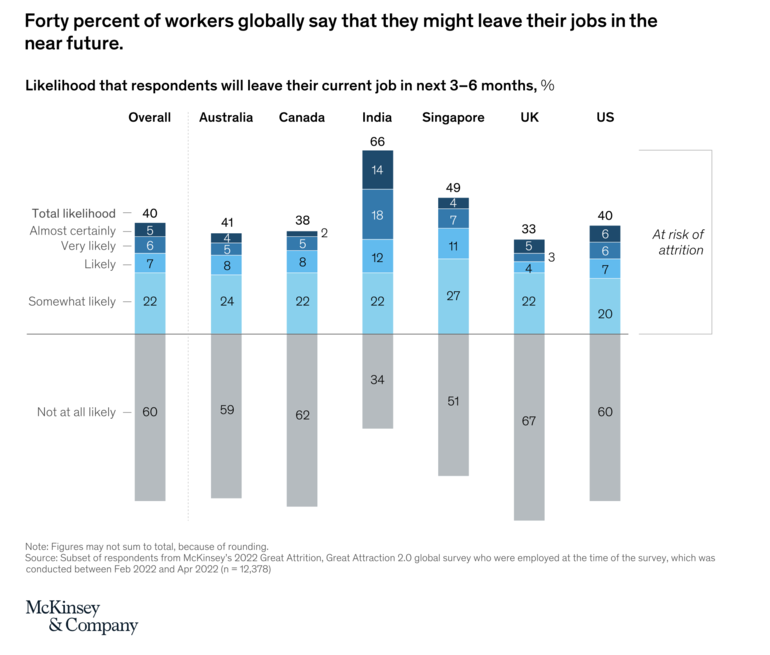
McKinsey said there are several crucial employee personas that companies must understand to solve the attrition and attraction problem for the longer term, noting that 40% of workers continue to indicate they plan to leave their job.
The Traditionalists
“The star of the classic labor pool won’t be enough to fill all the jobs,” McKinsey said. “Traditionalists are career-oriented people who care about work–life balance but are willing to make trade-offs for the sake of their jobs. They are motivated to work full-time for large companies in return for a competitive compensation package and perks, a good job title, status at the company, and career advancement…They have been more risk averse, more likely to stick with their current employer, and less likely to quit without another job lined up. If they did leave their jobs, most have likely returned, wooed by a traditional value proposition such as higher pay.
Companies like traditionalists because these career-minded folks are easier to find through common recruitment strategies. Unfortunately, they don’t exist in high enough numbers.”
The Do-It-Yourselfers
“This persona, comprising the largest share of respondents, values workplace flexibility, meaningful work, and compensation as the top motivators for potentially returning to the traditional workforce. They tend to be 25 to 45 years old and run the gamut from self-employed to full-time employed in nontraditional roles to gig and part-time workers,” McKinsey said. “This group wants flexibility above all else. During the pandemic, workload-related stress, toxic managers, a desire for autonomy, and a feeling of not being appreciated led many people to look for something different.
“Attracting this cohort may be difficult, because organizations must show that what they offer is better than what these workers have created for themselves. Companies can provide the freedom that these workers crave and a sense of purpose, as well as a compensation package beyond what they have on their own,” the company continued. “To attract this group, companies can offer them freedom and a sense of purpose.”
The Caregivers & Others
“More than two years after the start of the pandemic, this persona needs little introduction. Members of this group are motivated by compensation but have another constellation of priorities for returning to their jobs: workplace flexibility, support for employee health and well-being, and career development,” McKinsey explained. “These are people who have decided to sit it out at home, with some actively looking for work and others who are passive job seekers hoping to find an opportunity that would justify reentering the paid labor force.
“The predominant age group is between 18 and 44, with more women than men, many who are parents or other caregivers. For many in this cohort, workplaces that are inflexible and that don’t provide a pathway to advancement aren’t worth the sacrifice of going back to work while continuing their caregiving duties. People in this profile are ready to lend their time and talents to companies that are willing to work with their schedules. The Relaxers
“In contrast to the previous personas, the people in this cohort are a mix of retirees, those not looking for work, and those who might return to traditional work under the right circumstances,” McKinsey said. “We call this latter group the ‘Gronks, referring to the American football player Rob Gronkowski, who retired but returned at the urging of his former teammate Tom Brady and the promise of not only pay but also a flexible contract with a great team.
“Like many who retired early during the pandemic, Gronks have completed their traditional careers and might not need more money to live comfortably. So they will want more than the traditional value proposition to be enticed back into the workforce—including the promise of meaningful work,” McKinsey continued. “Organizations have not pursued these seasoned workers as hard as they might. But it’s not too late: companies should consider reaching out to see if they can find the right balance to win people back.
Dynamics at Play
“There are interesting dynamics at play here. After a surge in retirement during the early months of the pandemic, the rate of retired workers returning to the job market has slowly been increasing. Some have been enticed by higher wages or an improved pandemic outlook, while others have felt the effects of inflation and a need to return to work as their nest egg dwindles faster than anticipated. But with estimates of just one in five of these ‘pandemic retired’ looking to return to the workforce, there are plenty more out there for companies to attract.”