

AURORA, Colo.–Just how quickly the market for electric vehicles (EVs) and EV financing has grown was apparent during a meeting of auto lenders here.
A session that examined trends in purchases, financing, delinquencies and more drew a full house during Origence’s Lending Tech Live meeting.
Melinda Zabritski of Experian Automotive led the session and noted that with Europe mandating manufacturers go all electric by 2035, and with the United States not that far behind, credit unions have little choice but to respond to the rapidly changing market, as the transition is going to have implications on leasing, direct and indirect loans, how vehicles are purchased and more.
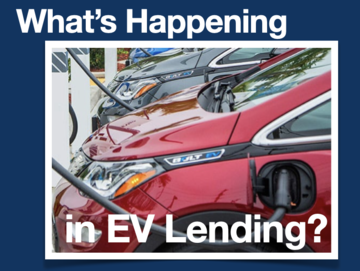
Zabritski focused her presentation around three primary points related to EVs:
- How and what consumers are purchasing
- Financing trends in the EV space
- EVs and loan performance
Growth in a ‘Handful of Years’
According to Zabritski, approximately 240,000 EVs were purchased at the retail level during 2021 out of an overall market of 13 million vehicles. Hybrids were responsible for another 432,000 sales.
It has taken just a “handful of years” for EVs to grow to 5% of the new vehicle financing market, with hybrids representing another 6.5%. The majority of EVs purchased are SUVs.
“We are going to see it continue to increase,” she predicted.
Not surprisingly, more than 40% of the EVs purchased were bought in California, followed by Texas (7%), Florida (7.5%) and Illinois (2.7%).
The number one selling EV in the U.S.? It will come as little surprise it’s the Tesla Model Y (35% of the market).. In fact, Tesla represents about 67% of the entire EV space in the country, although that is down from several years ago as Ford (6%) and others enter the market. The Tesla Model Y is about 35% of all vehicles sold.
“There is starting to be a lot more choice,” said Zabritski. “Used (financing) is also starting to grow as we are also seeing more choice.”
The Overall Market
Overall, approximately 60,000 EVs were financed during 2021, and 42,000 year to date in 2022, nearly all of which were Tesla Model 3’s, according to the Experian data.
And who is doing the financing of EVs? While credit unions have surged in marketshare in overall vehicle financing, banks dominate the new EV financing space.
Credit unions that are among the leaders in the EV lending space include Digital FCU, Navy FCU, PenFed , Logix, and SchoolsFirst, according to Experian
Wells Fargo is the number-one bank making EV loans. Credit unions cumulatively represent a l little over 20% of loans on EVs. Carvana, meanwhile, is the number-three lender for EVs.
“We are definitely seeing credit unions doing a lot more on used EVs,” Zabritski said.
Leasing of EVs, meanwhile, has taken a harder hit than rest of the market and is now about 14.5%, down from nearly 50% in 2017, according to Zabritski.
The Financing
Overall, approximately 60% of all used EV sales involve financing.
Not surprisingly, given the costs of EVs, the category attracts prime borrowers, Zabritski told th meeting, meaning borrowers have a “lot of choice” and the financing decision often becomes a “rate and term” game.
The Experian data show the average EV loan is for $44,099, with one in five loans for between $54,000 and $63,999. Approximately 4% of loans are for more than $94,000, while nearly 60% of used EVs are financed fir between $40,000 and $73,999.
“Almost 80% are model year 2018 and newer,” Zabritski said. “One thing to evaluate is how old will you go. Be prepared for the higher loan amounts on the used side.”
In addition, Zabritski said the market is beginning to see loan-to-value ratios increase on new EVs.
“Used values are on the rise, while the LTV has dropped YoY. Just like we see in the non-EV space, those used LTVs are coming down and are now at 92%,” Zabritski said. “It was around six months ago before I ever saw a used LTV lower than new. It’s absolutely crazy these days with the used EVs.”
Payments
According to Zabritski, EV payments tend to be higher than loans on other fuel types. The average used lease is around $900 a month. “Quite honestly, it’s cheaper to buy new and lease new. But this has to do with increased demand,” Zabritski said.
The average monthly loan payment on a new EV is $837, while on a used EV it’s $725,
“Until this year we had been seeing payments trending down as more options entered the market,” Zabritski said. “But the exact opposite is happening in the used space. This isn’t going to go away in a couple of years. By the time new (vehicles) level out it will still take four to five years for the used to catch up.”
The Nissan Leaf remains the most affordable in terms of payment, Zabritski said, only half-joking “you can almost get it for free,” with a payment around $293 a month.
Terms
The Experian data show the average term for a loan on a new EV is 67.5 months, while used is 70.3.
“Overall, consumers are kind of shifting to the longer terms,” Zabritski said. “Credit unions tend to have some of the longer terms, but that’s not completely true in the EV space. Banks are averaging the longest new EV terms , while credit unions have longer used terms.”
Zabritski said rates on loans for new EVs have been trending down and that 65%-70% of new EVs that are financed have rates under 3%.
“I have talked to some folks where the rates are the same for EVs and non-EVs,” she said.
Loan Performance
Both new and used EVs have the best performance (on loans from 2017 forward), according to Zabritski. The 90+ days delinquency rate on new EVs is just 0.19%, compared to a rate on gas powered vehicles of 2.13%.
On loans for used EVs, the delinquency rate is also low at .84%, according to the Experian data. Zabritski urged credit unions to review their portfolio’s performance according to fuel type. Loans on Fiats (1.61%), BMWs (1.4%) and Nissans (1.03%) have the highest default rate among loans for EVs. The highest delinquency rates are on loans with 75-month terms.