

LAS VEGAS–To get your organization to where it needs to be in 2020 is going to require a “stretch,” for both the organization and the individuals involved, one researcher told credit unions.
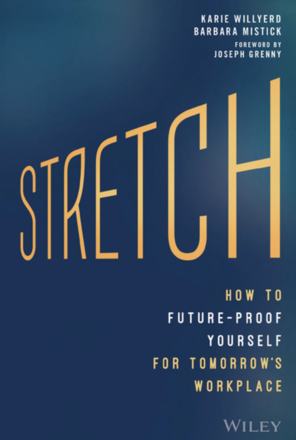
Dr. Barbara Mistick, co-author with Karie Willyerd of “Stretch: How to Future Proof Yourself for Tomorrow’s Workplace,” told the CUNA HR and Organizational Development Council annual meeting here, that her research—which includes a 27-country survey of more than 5,400 people, half of whom were executives–has uncovered “five stretch practices” that will enhance both workplaces and individual careers as the future of work and employment continues to change in radical ways.
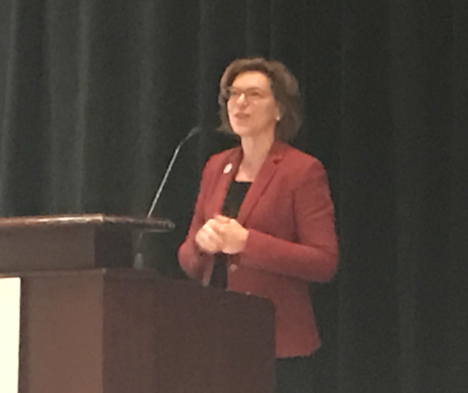
Dr. Barbara Mistick at CUNA HR OD Council meeting.
Mistick, who is also president of Wilson College in Chambersburg, Penn., said that in broad terms what these changes mean for organizations are:
- Global competition
- Increasing complexity and the need to simplify
- Reduced life span of companies unable to shift
- Outsourcing, offshoring, with repatriation of automated work.
- Rapid technology adaptation
- Increased use of a flexible workforce.
What does it mean for individuals and organizations? According to Mistick, “at some level, all of us are going to have to become technologies.”
In addition, it will mean:
- Global talent competition
- Virtual work teams
- From 11 jobs in a lifetime to hundreds
- Everyone must become a marketer of themselves
- Everyone is an entrepreneur
- An increasing divided between the skilled and not skilled
- Reliance upon your virtual guild to stay current
- Living longer and working longer
Mistick said the world is evolving from accessing information to curating information, a vital role for HR specialists as they put resources in front of employees.
What Concerns You Most?
In the survey that was the basis for the book, the authors asked, “What concerns you most about the future?” The responses:
- Wage stagnation (27%)
- Economic uncertainty (19%)
- Not enough opportunities for advancement (35%)
- Position changing or becoming obsolete (40%)
- Inadequate staffing levels (31%)
People are nervous about robots, said Mistick, and worry about how soon they will be replaced. But she believes robots will increasingly take over routine work and allow people to spend time on other jobs. Still, Mistick said robots are going to be felt in medical diagnosis, companionship, legal research, financial advice, call centers and driverless cars.
Mistick pointed to Gallup research that indicated just 30% of today’s workforce is actively engaged in their jobs. Approximately 50% are neither engaged or disengaged. “What that tells you is we are really counting on that 30% to keep our organizations alive.”
Mistick identified three of what she called “Stretch Imperatives.” They are:
It’s All on You
“Most of the training and development we do today is around compliance,” said Mistick. “So where do you find the time to train and develop. What we have found is it’s really on each individual to grasp that you’ve got to it yourself.
Options
“You need to be able to change a little bit at a time.”
You Have Dreams
“We have this sense of where we want to go, and we can’t lose sight of that as we get into the workforce.”
To prepare for the workplace of the future, Mistick recommended these five “Stretch Practices:”
Learn on the Fly
This is about maximizing your opportunities to learn outside a formal classroom environment; being a better informal learner.
“Learning is often about practicing. How do we find time to learn on the fly? One of the things that really struck us, if there is one great lesson I could leave you with, it is that mindsets really make a difference.” Mistick said those with fixed mindsets that “I just can’t do this for one way or another” are often unadaptable. It’s the others who are adaptable who are much better engaged at work, she said.
So, what can an organization do to create a workplace 2020?
According to Mistick, organizations should define expected capabilities (solid conversations with managers are critical); curate learning options (workers often feel overwhelmed by all the options, and employers should ask what a person wants to learn and then populate a smaller list of choices).
Be Open
Recognizing opportunities and seeking new options in your daily work. She quoted Chris James, whom she encountered in her research, who said, “We are all learning a living.” For managers, it means developing the people one works with rather than viewing the job from one’s own perspective. What can organizations do? Mistick recommended measuring whether managers are giving feedback (people, especially Millennials, want feedback all the time, not just in annual review); and providing training on how an organization operates (transparency, including bad news).
Build Diverse Networks
The idea is that optimizing your network to find opportunities to stay up to date. And that means interacting with networks with which a person has both strong and weak ties. Often, those with strong ties want to protect a person, and discourage them from taking risks. For that reason, the weak ties network can be more beneficial and likely to encourage a person to “stretch.” What can organizations do? Mistick urged sponsoring mentoring and affinity programs, as it makes clear a manager cares; and provide online tools for social collaboration as a means of connecting people together.
Be Greedy About Experiences
This is about being purposeful about assignments and experiences to broaden options for tomorrow.
Why is it OK to be greedy about experiences? “What we discovered is you really need to be aggressive about opportunities for yourself,” said Mistick. “We saw that people who had more experiences were happier with their jobs at the end of the day.”
She said one of the best ways to get experiences is to make sure you are working for a good boss, according to Mistick. But what makes for a good boss? Career-maker bosses come in many styles, said Mistick, but organizations must find ways to reward career-makers by rewarding those kinds of skills. This can mean mid-life internships, for instance, said Mistick.
Bounce Forward
This is about recognizing setbacks and failures from learning experiences; getting motivation to move forward.
“There are going to be setbacks over time,” noted Mistick. “We all have setbacks. We have these great dreams, but life happens. That’s the reason we call this ‘bouncing forward.’ This is about what did I learn in that experience, and how can I use that in how I change.”
The three attributes of bouncing forward, said Mistick, are grit, resilience, and motivation (having a forward focus).